

corresponding isoquinolones 7, in which the phenyl group is attached to the carbon
adjacent to a nitrogen atom. The regioselectivity increased with increasing size of
the alkyl group.
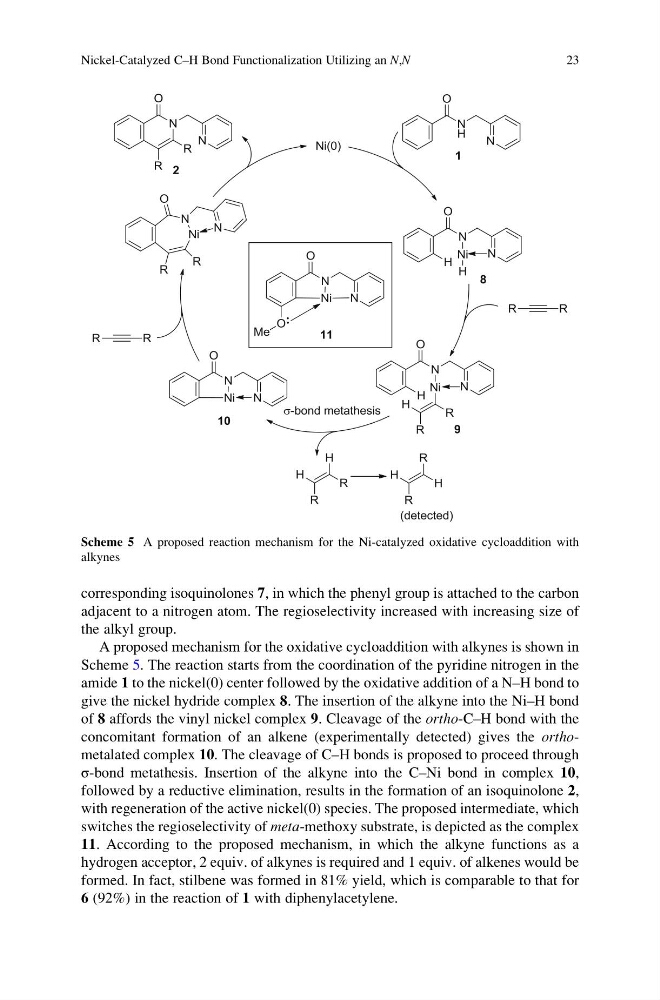
A proposed mechanism for the oxidative cycloaddition with alkynes is shown in
Scheme 5. The reaction starts from the coordination of the pyridine nitrogen in the
amide 1 to the nickel(0) center followed by the oxidative addition of a N–H bond to
give the nickel hydride complex 8. The insertion of the alkyne into the Ni–H bond
of 8 affords the vinyl nickel complex 9. Cleavage of the ortho-C–H bond with the
concomitant formation of an alkene (experimentally detected) gives the orthometalated complex 10. The cleavage of C–H bonds is proposed to proceed through
σ-bond metathesis. Insertion of the alkyne into the C–Ni bond in complex 10,
followed by a reductive elimination, results in the formation of an isoquinolone 2,
with regeneration of the active nickel(0) species. The proposed intermediate, which
switches the regioselectivity of meta-methoxy substrate, is depicted as the complex
11. According to the proposed mechanism, in which the alkyne functions as a
hydrogen acceptor, 2 equiv. of alkynes is required and 1 equiv. of alkenes would be
formed. In fact, stilbene was formed in 81% yield, which is comparable to that for
6 (92%) in the reaction of 1 with diphenylacetylene.
Scheme 5 A proposed reaction mechanism for the Ni-catalyzed oxidative cycloaddition with
alkynes
Nickel-Catalyzed C–H Bond Functionalization Utilizing an N,N
23
adjacent to a nitrogen atom. The regioselectivity increased with increasing size of
the alkyl group.
A proposed mechanism for the oxidative cycloaddition with alkynes is shown in
Scheme 5. The reaction starts from the coordination of the pyridine nitrogen in the
amide 1 to the nickel(0) center followed by the oxidative addition of a N–H bond to
give the nickel hydride complex 8. The insertion of the alkyne into the Ni–H bond
of 8 affords the vinyl nickel complex 9. Cleavage of the ortho-C–H bond with the
concomitant formation of an alkene (experimentally detected) gives the orthometalated complex 10. The cleavage of C–H bonds is proposed to proceed through
σ-bond metathesis. Insertion of the alkyne into the C–Ni bond in complex 10,
followed by a reductive elimination, results in the formation of an isoquinolone 2,
with regeneration of the active nickel(0) species. The proposed intermediate, which
switches the regioselectivity of meta-methoxy substrate, is depicted as the complex
11. According to the proposed mechanism, in which the alkyne functions as a
hydrogen acceptor, 2 equiv. of alkynes is required and 1 equiv. of alkenes would be
formed. In fact, stilbene was formed in 81% yield, which is comparable to that for
6 (92%) in the reaction of 1 with diphenylacetylene.
Scheme 5 A proposed reaction mechanism for the Ni-catalyzed oxidative cycloaddition with
alkynes
Nickel-Catalyzed C–H Bond Functionalization Utilizing an N,N
23