

using Rh(III) as the catalyst [23, 24]. However, the reaction does not require the
addition of a metal oxidant or an intramolecular sacrificed oxidizing substituent in
the substrate, in contrast to the Rh(III) system. Instead, an alkyne functioned as the
hydrogen acceptor. Later, Pd(II) [25] and Ru(II) were also found to catalyze
oxidative cycloaddition of aromatic amides to internal alkynes leading to
isoquinolones [26] (for the Ru(II)-catalyzed isoquinolone synthesis utilizing an
8-aminoquinoline directing group, see [27]). However, the use of an inexpensive
and abundant metal, such as Ni as the catalyst, is significant. A key to the success of
this reaction was the utilization of a 2-pyridinylmethylamine moiety as the directing
group. Among the directing groups examined, a 2-pyridinylmethylamine was found
to be a superior directing group.
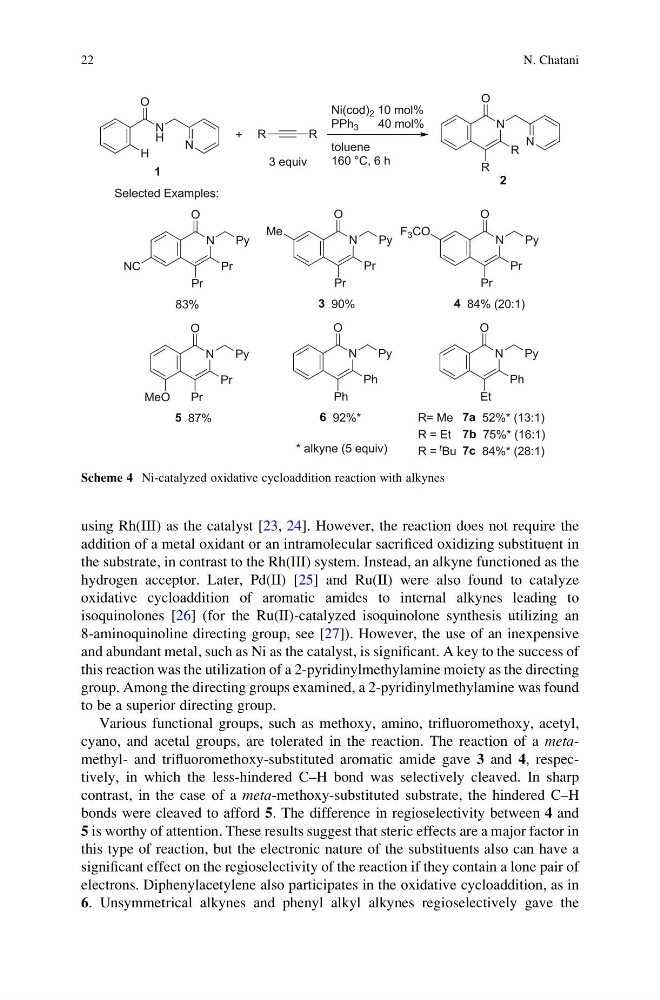
Various functional groups, such as methoxy, amino, trifluoromethoxy, acetyl,
cyano, and acetal groups, are tolerated in the reaction. The reaction of a metamethyl- and trifluoromethoxy-substituted aromatic amide gave 3 and 4, respectively, in which the less-hindered C–H bond was selectively cleaved. In sharp
contrast, in the case of a meta-methoxy-substituted substrate, the hindered C–H
bonds were cleaved to afford 5. The difference in regioselectivity between 4 and
5 is worthy of attention. These results suggest that steric effects are a major factor in
this type of reaction, but the electronic nature of the substituents also can have a
significant effect on the regioselectivity of the reaction if they contain a lone pair of
electrons. Diphenylacetylene also participates in the oxidative cycloaddition, as in
6. Unsymmetrical alkynes and phenyl alkyl alkynes regioselectively gave the
Scheme 4 Ni-catalyzed oxidative cycloaddition reaction with alkynes
22
N. Chatani
addition of a metal oxidant or an intramolecular sacrificed oxidizing substituent in
the substrate, in contrast to the Rh(III) system. Instead, an alkyne functioned as the
hydrogen acceptor. Later, Pd(II) [25] and Ru(II) were also found to catalyze
oxidative cycloaddition of aromatic amides to internal alkynes leading to
isoquinolones [26] (for the Ru(II)-catalyzed isoquinolone synthesis utilizing an
8-aminoquinoline directing group, see [27]). However, the use of an inexpensive
and abundant metal, such as Ni as the catalyst, is significant. A key to the success of
this reaction was the utilization of a 2-pyridinylmethylamine moiety as the directing
group. Among the directing groups examined, a 2-pyridinylmethylamine was found
to be a superior directing group.
Various functional groups, such as methoxy, amino, trifluoromethoxy, acetyl,
cyano, and acetal groups, are tolerated in the reaction. The reaction of a metamethyl- and trifluoromethoxy-substituted aromatic amide gave 3 and 4, respectively, in which the less-hindered C–H bond was selectively cleaved. In sharp
contrast, in the case of a meta-methoxy-substituted substrate, the hindered C–H
bonds were cleaved to afford 5. The difference in regioselectivity between 4 and
5 is worthy of attention. These results suggest that steric effects are a major factor in
this type of reaction, but the electronic nature of the substituents also can have a
significant effect on the regioselectivity of the reaction if they contain a lone pair of
electrons. Diphenylacetylene also participates in the oxidative cycloaddition, as in
6. Unsymmetrical alkynes and phenyl alkyl alkynes regioselectively gave the
Scheme 4 Ni-catalyzed oxidative cycloaddition reaction with alkynes
22
N. Chatani