

Following this pioneering report, a number of the Ni-catalyzed functionalization
of C–H bonds have been reported. However, the functionalization of C–H bonds
catalyzed by Ni complexes is limited to C–H bonds in specific aromatic systems,
such as pyridine or activated pyridine derivatives and highly perfluorinated benzene
and azole derivatives, in which an acidic C–H bond is present (Fig. 1) [18]. On the
other hand, examples of the nickel-catalyzed activation of non-acidic C–H bonds in
benzene rings are rare. Recently, Chatani reported on the use of a powerful
combination of a Ni catalyst and an N,N
0 -bidentate directing group in the
chelation-assisted functionalization of C–H bonds, which is a promising chelation
system for developing new types of Ni-catalyzed functionalization of C–H bonds.
Since then, various transformations of C–H bonds catalyzed by Ni complexes have
been reported [19, 20]. This review focuses on the Ni-catalyzed functionalization of
C–H bonds by taking advantage of N,N
0 -bidentate directing groups. A pioneering
example of an N,N
0 -bidentate directing group was reported by Daugulis [21].
2 C(sp
2
)-H Activation
2.1 Oxidative Cycloaddition of C(sp
2
)–H Bonds with Alkynes
In 2011, Chatani and coworkers reported on the Ni(0)-catalyzed oxidative cycloaddition of aromatic amides 1 to internal alkynes for the synthesis of isoquinolone
derivatives 2 (Scheme 4) [22]. A similar transformation was previously reported
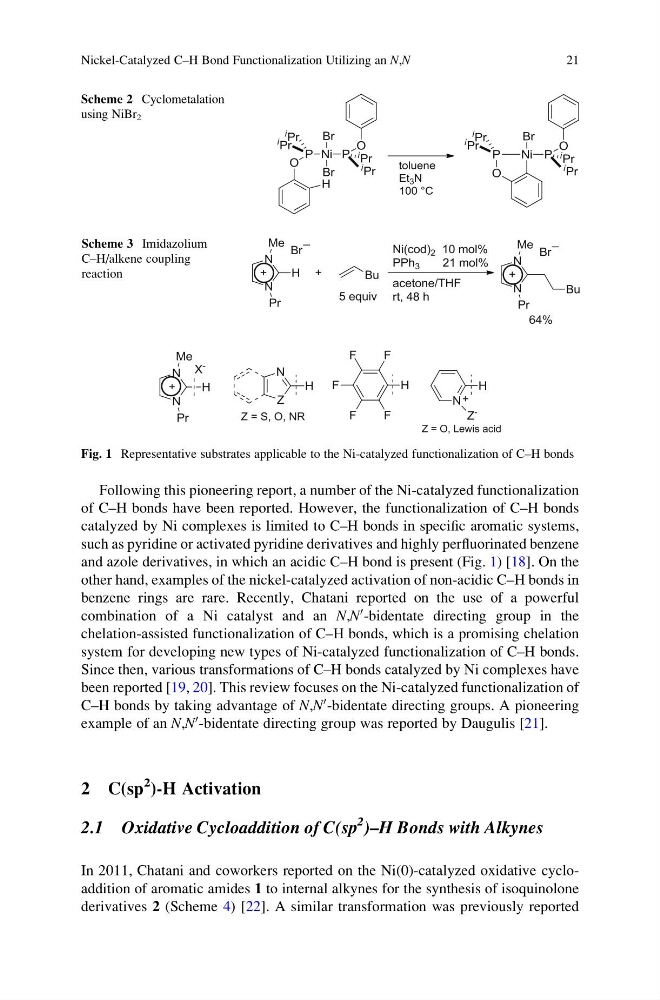
Scheme 2 Cyclometalation
using NiBr 2
Scheme 3 Imidazolium
C–H/alkene coupling
reaction
Fig. 1 Representative substrates applicable to the Ni-catalyzed functionalization of C–H bonds
Nickel-Catalyzed C–H Bond Functionalization Utilizing an N,N
21
of C–H bonds have been reported. However, the functionalization of C–H bonds
catalyzed by Ni complexes is limited to C–H bonds in specific aromatic systems,
such as pyridine or activated pyridine derivatives and highly perfluorinated benzene
and azole derivatives, in which an acidic C–H bond is present (Fig. 1) [18]. On the
other hand, examples of the nickel-catalyzed activation of non-acidic C–H bonds in
benzene rings are rare. Recently, Chatani reported on the use of a powerful
combination of a Ni catalyst and an N,N
0 -bidentate directing group in the
chelation-assisted functionalization of C–H bonds, which is a promising chelation
system for developing new types of Ni-catalyzed functionalization of C–H bonds.
Since then, various transformations of C–H bonds catalyzed by Ni complexes have
been reported [19, 20]. This review focuses on the Ni-catalyzed functionalization of
C–H bonds by taking advantage of N,N
0 -bidentate directing groups. A pioneering
example of an N,N
0 -bidentate directing group was reported by Daugulis [21].
2 C(sp
2
)-H Activation
2.1 Oxidative Cycloaddition of C(sp
2
)–H Bonds with Alkynes
In 2011, Chatani and coworkers reported on the Ni(0)-catalyzed oxidative cycloaddition of aromatic amides 1 to internal alkynes for the synthesis of isoquinolone
derivatives 2 (Scheme 4) [22]. A similar transformation was previously reported
Scheme 2 Cyclometalation
using NiBr 2
Scheme 3 Imidazolium
C–H/alkene coupling
reaction
Fig. 1 Representative substrates applicable to the Ni-catalyzed functionalization of C–H bonds
Nickel-Catalyzed C–H Bond Functionalization Utilizing an N,N
21