

1 Introduction
A wide variety of transition metal complexes, such as Pd, Ru, Rh, and Ir, have been
used as catalysts in a variety of catalytic functionalizations of C–H bonds, such as
arylation, alkenylation, alkylation, carbonylation, dehydrogenation, amination, oxidation, silylation, and borylation [1–9]. Among the transition metal complexes used
thus far in the functionalization of C–H bonds, the most powerful and extensively
studied involve Pd complexes. Pd complexes are known to show a high catalytic
activity in a wide variety of functionalization reactions of C–H bonds. Because of
this, many groups are now using Pd catalysts in the development of such functionalization reactions. Mechanistic studies of the Pd-catalyzed functionalization of C–H
bonds, including stoichiometric reactions, have also been conducted. However, the
recent focus on developing synthetic methodology for various functionalization
reactions using less costly and more abundant first row metals, such as Fe, Co, Ni,
and Cu, is a challenging task. Ni catalysts are of particular interest in this area
[10, 11].
In 1963, an early example of the stoichiometric cyclometalation of C–H bonds
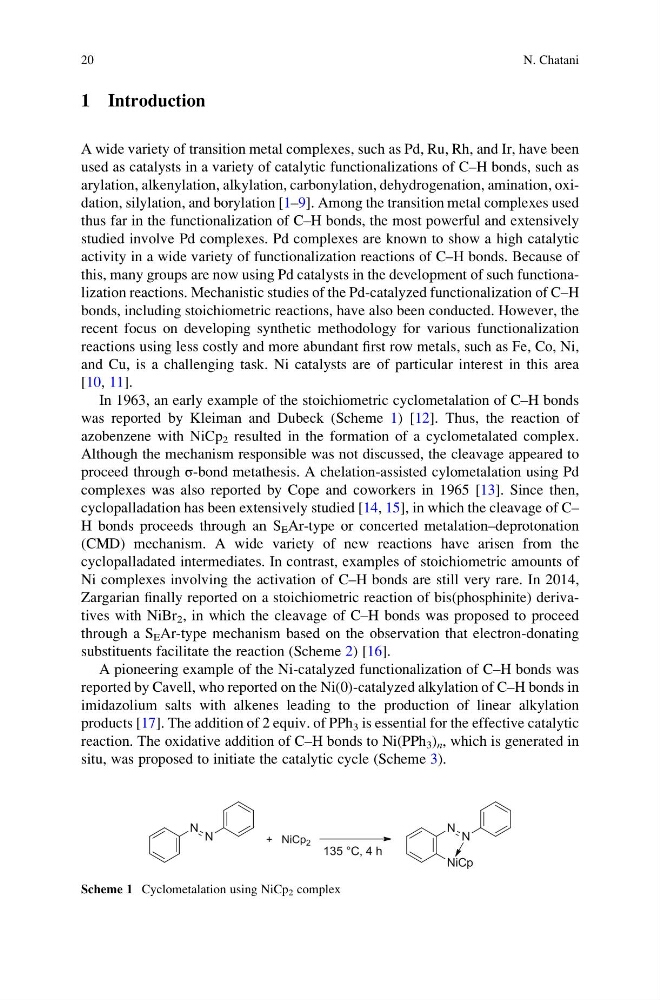
was reported by Kleiman and Dubeck (Scheme 1) [12]. Thus, the reaction of
azobenzene with NiCp 2 resulted in the formation of a cyclometalated complex.
Although the mechanism responsible was not discussed, the cleavage appeared to
proceed through σ-bond metathesis. A chelation-assisted cylometalation using Pd
complexes was also reported by Cope and coworkers in 1965 [13]. Since then,
cyclopalladation has been extensively studied [14, 15], in which the cleavage of C–
H bonds proceeds through an S E Ar-type or concerted metalation–deprotonation
(CMD) mechanism. A wide variety of new reactions have arisen from the
cyclopalladated intermediates. In contrast, examples of stoichiometric amounts of
Ni complexes involving the activation of C–H bonds are still very rare. In 2014,
Zargarian finally reported on a stoichiometric reaction of bis(phosphinite) derivatives with NiBr 2 , in which the cleavage of C–H bonds was proposed to proceed
through a S E Ar-type mechanism based on the observation that electron-donating
substituents facilitate the reaction (Scheme 2) [16].
A pioneering example of the Ni-catalyzed functionalization of C–H bonds was
reported by Cavell, who reported on the Ni(0)-catalyzed alkylation of C–H bonds in
imidazolium salts with alkenes leading to the production of linear alkylation
products [17]. The addition of 2 equiv. of PPh 3 is essential for the effective catalytic
reaction. The oxidative addition of C–H bonds to Ni(PPh 3 ) n , which is generated in
situ, was proposed to initiate the catalytic cycle (Scheme 3).
Scheme 1 Cyclometalation using NiCp 2 complex
20
N. Chatani
A wide variety of transition metal complexes, such as Pd, Ru, Rh, and Ir, have been
used as catalysts in a variety of catalytic functionalizations of C–H bonds, such as
arylation, alkenylation, alkylation, carbonylation, dehydrogenation, amination, oxidation, silylation, and borylation [1–9]. Among the transition metal complexes used
thus far in the functionalization of C–H bonds, the most powerful and extensively
studied involve Pd complexes. Pd complexes are known to show a high catalytic
activity in a wide variety of functionalization reactions of C–H bonds. Because of
this, many groups are now using Pd catalysts in the development of such functionalization reactions. Mechanistic studies of the Pd-catalyzed functionalization of C–H
bonds, including stoichiometric reactions, have also been conducted. However, the
recent focus on developing synthetic methodology for various functionalization
reactions using less costly and more abundant first row metals, such as Fe, Co, Ni,
and Cu, is a challenging task. Ni catalysts are of particular interest in this area
[10, 11].
In 1963, an early example of the stoichiometric cyclometalation of C–H bonds
was reported by Kleiman and Dubeck (Scheme 1) [12]. Thus, the reaction of
azobenzene with NiCp 2 resulted in the formation of a cyclometalated complex.
Although the mechanism responsible was not discussed, the cleavage appeared to
proceed through σ-bond metathesis. A chelation-assisted cylometalation using Pd
complexes was also reported by Cope and coworkers in 1965 [13]. Since then,
cyclopalladation has been extensively studied [14, 15], in which the cleavage of C–
H bonds proceeds through an S E Ar-type or concerted metalation–deprotonation
(CMD) mechanism. A wide variety of new reactions have arisen from the
cyclopalladated intermediates. In contrast, examples of stoichiometric amounts of
Ni complexes involving the activation of C–H bonds are still very rare. In 2014,
Zargarian finally reported on a stoichiometric reaction of bis(phosphinite) derivatives with NiBr 2 , in which the cleavage of C–H bonds was proposed to proceed
through a S E Ar-type mechanism based on the observation that electron-donating
substituents facilitate the reaction (Scheme 2) [16].
A pioneering example of the Ni-catalyzed functionalization of C–H bonds was
reported by Cavell, who reported on the Ni(0)-catalyzed alkylation of C–H bonds in
imidazolium salts with alkenes leading to the production of linear alkylation
products [17]. The addition of 2 equiv. of PPh 3 is essential for the effective catalytic
reaction. The oxidative addition of C–H bonds to Ni(PPh 3 ) n , which is generated in
situ, was proposed to initiate the catalytic cycle (Scheme 3).
Scheme 1 Cyclometalation using NiCp 2 complex
20
N. Chatani