

3 Functionalization of C(sp
3
)–H Bonds
3.1 Substrates Possessing a Directing Group
Directed activation of a C(sp
3 )–H bond by an iron complex was much less investigated than the reaction of C(sp
2 )–H bonds. Li reported the phosphine-directed C
(sp
3 )–H to form an iron pincer complex (e.g., [80]). Ohki and Tatsumi reported that
Cp*Fe complexes bearing imidazolium salts undergo cyclometalation through C–H
activation or can cleave the C–H bond of a heteroarene [81].
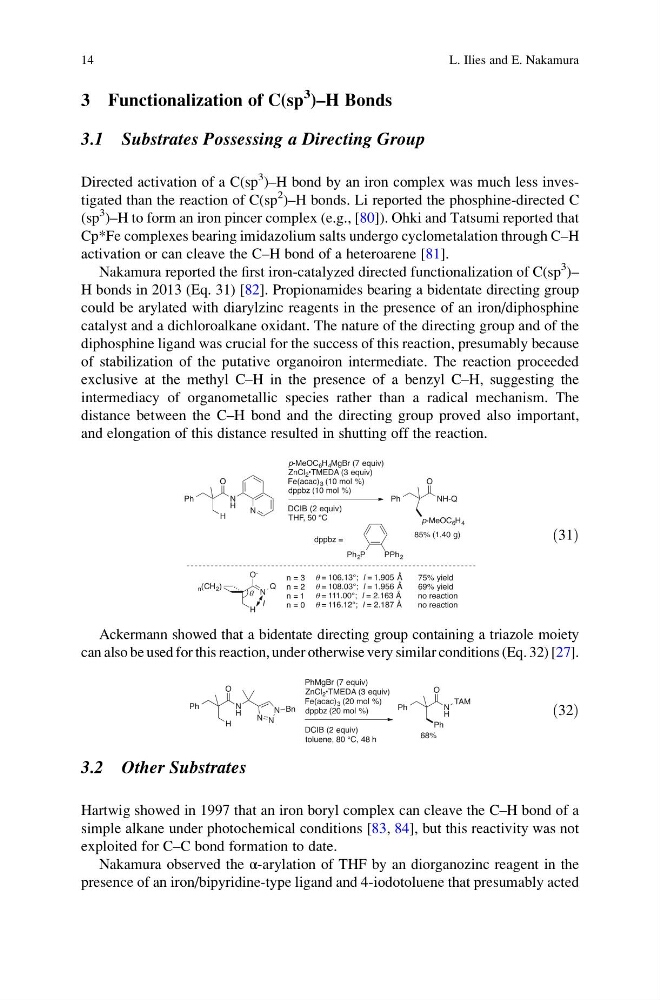
Nakamura reported the first iron-catalyzed directed functionalization of C(sp
3 )–
H bonds in 2013 (Eq. 31) [82]. Propionamides bearing a bidentate directing group
could be arylated with diarylzinc reagents in the presence of an iron/diphosphine
catalyst and a dichloroalkane oxidant. The nature of the directing group and of the
diphosphine ligand was crucial for the success of this reaction, presumably because
of stabilization of the putative organoiron intermediate. The reaction proceeded
exclusive at the methyl C–H in the presence of a benzyl C–H, suggesting the
intermediacy of organometallic species rather than a radical mechanism. The
distance between the C–H bond and the directing group proved also important,
and elongation of this distance resulted in shutting off the reaction.
ð31Þ
Ackermann showed that a bidentate directing group containing a triazole moiety
can also be used for this reaction, under otherwise very similar conditions (Eq. 32) [27].
ð32Þ
3.2 Other Substrates
Hartwig showed in 1997 that an iron boryl complex can cleave the C–H bond of a
simple alkane under photochemical conditions [83, 84], but this reactivity was not
exploited for C–C bond formation to date.
Nakamura observed the α-arylation of THF by an diorganozinc reagent in the
presence of an iron/bipyridine-type ligand and 4-iodotoluene that presumably acted
14
L. Ilies and E. Nakamura
3
)–H Bonds
3.1 Substrates Possessing a Directing Group
Directed activation of a C(sp
3 )–H bond by an iron complex was much less investigated than the reaction of C(sp
2 )–H bonds. Li reported the phosphine-directed C
(sp
3 )–H to form an iron pincer complex (e.g., [80]). Ohki and Tatsumi reported that
Cp*Fe complexes bearing imidazolium salts undergo cyclometalation through C–H
activation or can cleave the C–H bond of a heteroarene [81].
Nakamura reported the first iron-catalyzed directed functionalization of C(sp
3 )–
H bonds in 2013 (Eq. 31) [82]. Propionamides bearing a bidentate directing group
could be arylated with diarylzinc reagents in the presence of an iron/diphosphine
catalyst and a dichloroalkane oxidant. The nature of the directing group and of the
diphosphine ligand was crucial for the success of this reaction, presumably because
of stabilization of the putative organoiron intermediate. The reaction proceeded
exclusive at the methyl C–H in the presence of a benzyl C–H, suggesting the
intermediacy of organometallic species rather than a radical mechanism. The
distance between the C–H bond and the directing group proved also important,
and elongation of this distance resulted in shutting off the reaction.
ð31Þ
Ackermann showed that a bidentate directing group containing a triazole moiety
can also be used for this reaction, under otherwise very similar conditions (Eq. 32) [27].
ð32Þ
3.2 Other Substrates
Hartwig showed in 1997 that an iron boryl complex can cleave the C–H bond of a
simple alkane under photochemical conditions [83, 84], but this reactivity was not
exploited for C–C bond formation to date.
Nakamura observed the α-arylation of THF by an diorganozinc reagent in the
presence of an iron/bipyridine-type ligand and 4-iodotoluene that presumably acted
14
L. Ilies and E. Nakamura