

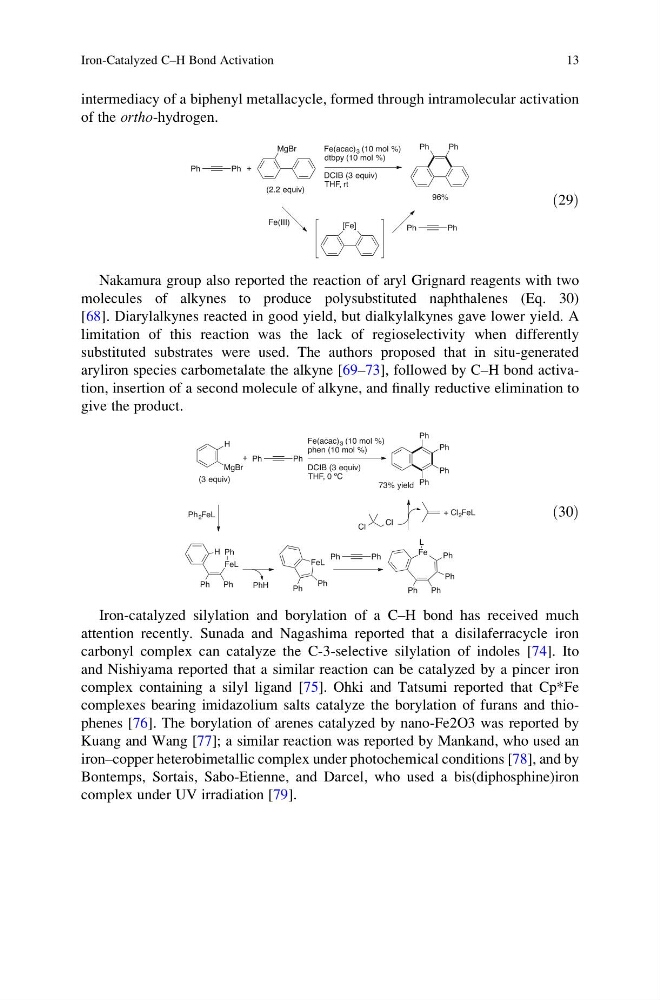
intermediacy of a biphenyl metallacycle, formed through intramolecular activation
of the ortho-hydrogen.
ð29Þ
Nakamura group also reported the reaction of aryl Grignard reagents with two
molecules of alkynes to produce polysubstituted naphthalenes (Eq. 30)
[68]. Diarylalkynes reacted in good yield, but dialkylalkynes gave lower yield. A
limitation of this reaction was the lack of regioselectivity when differently
substituted substrates were used. The authors proposed that in situ-generated
aryliron species carbometalate the alkyne [69–73], followed by C–H bond activation, insertion of a second molecule of alkyne, and finally reductive elimination to
give the product.
ð30Þ
Iron-catalyzed silylation and borylation of a C–H bond has received much
attention recently. Sunada and Nagashima reported that a disilaferracycle iron
carbonyl complex can catalyze the C-3-selective silylation of indoles [74]. Ito
and Nishiyama reported that a similar reaction can be catalyzed by a pincer iron
complex containing a silyl ligand [75]. Ohki and Tatsumi reported that Cp*Fe
complexes bearing imidazolium salts catalyze the borylation of furans and thiophenes [76]. The borylation of arenes catalyzed by nano-Fe2O3 was reported by
Kuang and Wang [77]; a similar reaction was reported by Mankand, who used an
iron–copper heterobimetallic complex under photochemical conditions [78], and by
Bontemps, Sortais, Sabo-Etienne, and Darcel, who used a bis(diphosphine)iron
complex under UV irradiation [79].
Iron-Catalyzed C–H Bond Activation
13
of the ortho-hydrogen.
ð29Þ
Nakamura group also reported the reaction of aryl Grignard reagents with two
molecules of alkynes to produce polysubstituted naphthalenes (Eq. 30)
[68]. Diarylalkynes reacted in good yield, but dialkylalkynes gave lower yield. A
limitation of this reaction was the lack of regioselectivity when differently
substituted substrates were used. The authors proposed that in situ-generated
aryliron species carbometalate the alkyne [69–73], followed by C–H bond activation, insertion of a second molecule of alkyne, and finally reductive elimination to
give the product.
ð30Þ
Iron-catalyzed silylation and borylation of a C–H bond has received much
attention recently. Sunada and Nagashima reported that a disilaferracycle iron
carbonyl complex can catalyze the C-3-selective silylation of indoles [74]. Ito
and Nishiyama reported that a similar reaction can be catalyzed by a pincer iron
complex containing a silyl ligand [75]. Ohki and Tatsumi reported that Cp*Fe
complexes bearing imidazolium salts catalyze the borylation of furans and thiophenes [76]. The borylation of arenes catalyzed by nano-Fe2O3 was reported by
Kuang and Wang [77]; a similar reaction was reported by Mankand, who used an
iron–copper heterobimetallic complex under photochemical conditions [78], and by
Bontemps, Sortais, Sabo-Etienne, and Darcel, who used a bis(diphosphine)iron
complex under UV irradiation [79].
Iron-Catalyzed C–H Bond Activation
13