

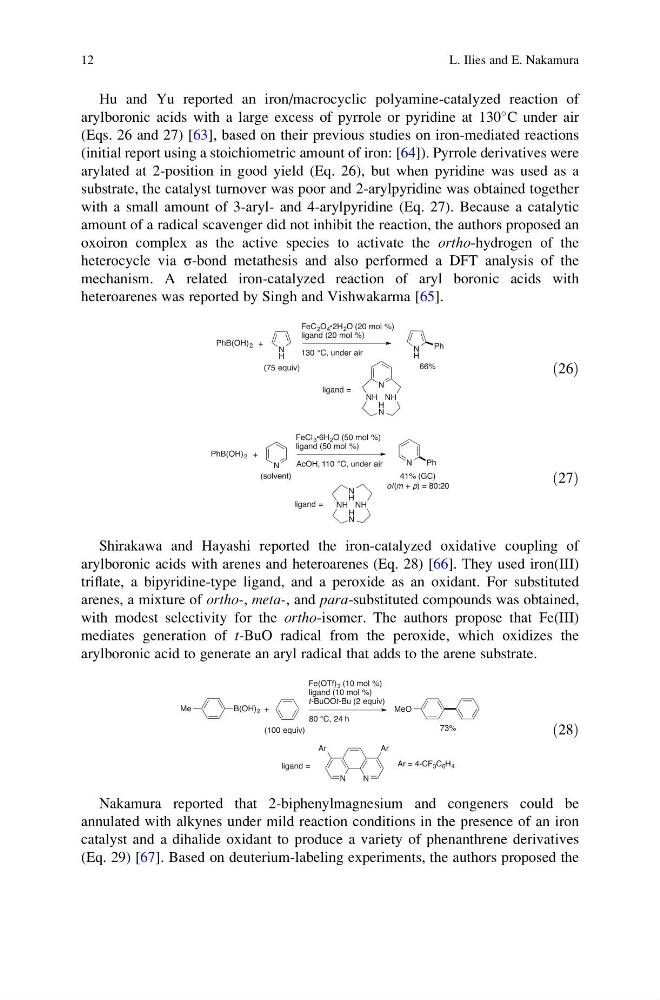
Hu and Yu reported an iron/macrocyclic polyamine-catalyzed reaction of
arylboronic acids with a large excess of pyrrole or pyridine at 130
C under air
(Eqs. 26 and 27) [63], based on their previous studies on iron-mediated reactions
(initial report using a stoichiometric amount of iron: [64]). Pyrrole derivatives were
arylated at 2-position in good yield (Eq. 26), but when pyridine was used as a
substrate, the catalyst turnover was poor and 2-arylpyridine was obtained together
with a small amount of 3-aryl- and 4-arylpyridine (Eq. 27). Because a catalytic
amount of a radical scavenger did not inhibit the reaction, the authors proposed an
oxoiron complex as the active species to activate the ortho-hydrogen of the
heterocycle via σ-bond metathesis and also performed a DFT analysis of the
mechanism. A related iron-catalyzed reaction of aryl boronic acids with
heteroarenes was reported by Singh and Vishwakarma [65].
ð26Þ
ð27Þ
Shirakawa and Hayashi reported the iron-catalyzed oxidative coupling of
arylboronic acids with arenes and heteroarenes (Eq. 28) [66]. They used iron(III)
triflate, a bipyridine-type ligand, and a peroxide as an oxidant. For substituted
arenes, a mixture of ortho-, meta-, and para-substituted compounds was obtained,
with modest selectivity for the ortho-isomer. The authors propose that Fe(III)
mediates generation of t-BuO radical from the peroxide, which oxidizes the
arylboronic acid to generate an aryl radical that adds to the arene substrate.
ð28Þ
Nakamura reported that 2-biphenylmagnesium and congeners could be
annulated with alkynes under mild reaction conditions in the presence of an iron
catalyst and a dihalide oxidant to produce a variety of phenanthrene derivatives
(Eq. 29) [67]. Based on deuterium-labeling experiments, the authors proposed the
12
L. Ilies and E. Nakamura
arylboronic acids with a large excess of pyrrole or pyridine at 130
C under air
(Eqs. 26 and 27) [63], based on their previous studies on iron-mediated reactions
(initial report using a stoichiometric amount of iron: [64]). Pyrrole derivatives were
arylated at 2-position in good yield (Eq. 26), but when pyridine was used as a
substrate, the catalyst turnover was poor and 2-arylpyridine was obtained together
with a small amount of 3-aryl- and 4-arylpyridine (Eq. 27). Because a catalytic
amount of a radical scavenger did not inhibit the reaction, the authors proposed an
oxoiron complex as the active species to activate the ortho-hydrogen of the
heterocycle via σ-bond metathesis and also performed a DFT analysis of the
mechanism. A related iron-catalyzed reaction of aryl boronic acids with
heteroarenes was reported by Singh and Vishwakarma [65].
ð26Þ
ð27Þ
Shirakawa and Hayashi reported the iron-catalyzed oxidative coupling of
arylboronic acids with arenes and heteroarenes (Eq. 28) [66]. They used iron(III)
triflate, a bipyridine-type ligand, and a peroxide as an oxidant. For substituted
arenes, a mixture of ortho-, meta-, and para-substituted compounds was obtained,
with modest selectivity for the ortho-isomer. The authors propose that Fe(III)
mediates generation of t-BuO radical from the peroxide, which oxidizes the
arylboronic acid to generate an aryl radical that adds to the arene substrate.
ð28Þ
Nakamura reported that 2-biphenylmagnesium and congeners could be
annulated with alkynes under mild reaction conditions in the presence of an iron
catalyst and a dihalide oxidant to produce a variety of phenanthrene derivatives
(Eq. 29) [67]. Based on deuterium-labeling experiments, the authors proposed the
12
L. Ilies and E. Nakamura