

ð22Þ
2.2 Other Substrates
It has been known from the 1970s that an iron complex can cleave the C–H bond of
an arene [57, 58]. However, the exploitation of this reactivity for the development
of a catalytic reaction has been largely neglected to date. An early attempt was
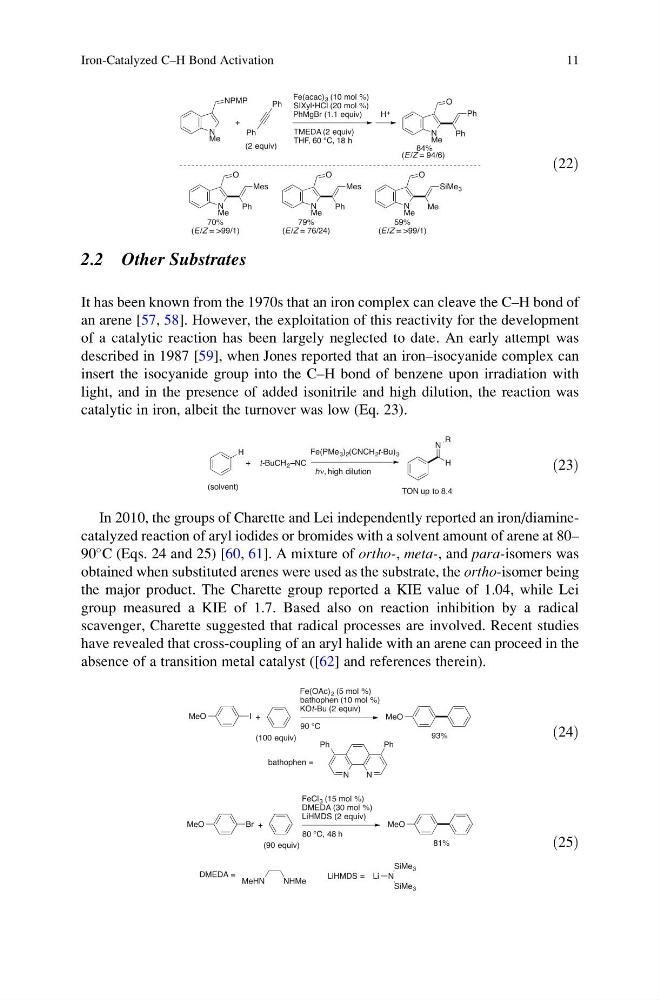
described in 1987 [59], when Jones reported that an iron–isocyanide complex can
insert the isocyanide group into the C–H bond of benzene upon irradiation with
light, and in the presence of added isonitrile and high dilution, the reaction was
catalytic in iron, albeit the turnover was low (Eq. 23).
ð23Þ
In 2010, the groups of Charette and Lei independently reported an iron/diaminecatalyzed reaction of aryl iodides or bromides with a solvent amount of arene at 80–
90
C (Eqs. 24 and 25) [60, 61]. A mixture of ortho-, meta-, and para-isomers was
obtained when substituted arenes were used as the substrate, the ortho-isomer being
the major product. The Charette group reported a KIE value of 1.04, while Lei
group measured a KIE of 1.7. Based also on reaction inhibition by a radical
scavenger, Charette suggested that radical processes are involved. Recent studies
have revealed that cross-coupling of an aryl halide with an arene can proceed in the
absence of a transition metal catalyst ([62] and references therein).
ð24Þ
ð25Þ
Iron-Catalyzed C–H Bond Activation
11
2.2 Other Substrates
It has been known from the 1970s that an iron complex can cleave the C–H bond of
an arene [57, 58]. However, the exploitation of this reactivity for the development
of a catalytic reaction has been largely neglected to date. An early attempt was
described in 1987 [59], when Jones reported that an iron–isocyanide complex can
insert the isocyanide group into the C–H bond of benzene upon irradiation with
light, and in the presence of added isonitrile and high dilution, the reaction was
catalytic in iron, albeit the turnover was low (Eq. 23).
ð23Þ
In 2010, the groups of Charette and Lei independently reported an iron/diaminecatalyzed reaction of aryl iodides or bromides with a solvent amount of arene at 80–
90
C (Eqs. 24 and 25) [60, 61]. A mixture of ortho-, meta-, and para-isomers was
obtained when substituted arenes were used as the substrate, the ortho-isomer being
the major product. The Charette group reported a KIE value of 1.04, while Lei
group measured a KIE of 1.7. Based also on reaction inhibition by a radical
scavenger, Charette suggested that radical processes are involved. Recent studies
have revealed that cross-coupling of an aryl halide with an arene can proceed in the
absence of a transition metal catalyst ([62] and references therein).
ð24Þ
ð25Þ
Iron-Catalyzed C–H Bond Activation
11