

ð20Þ
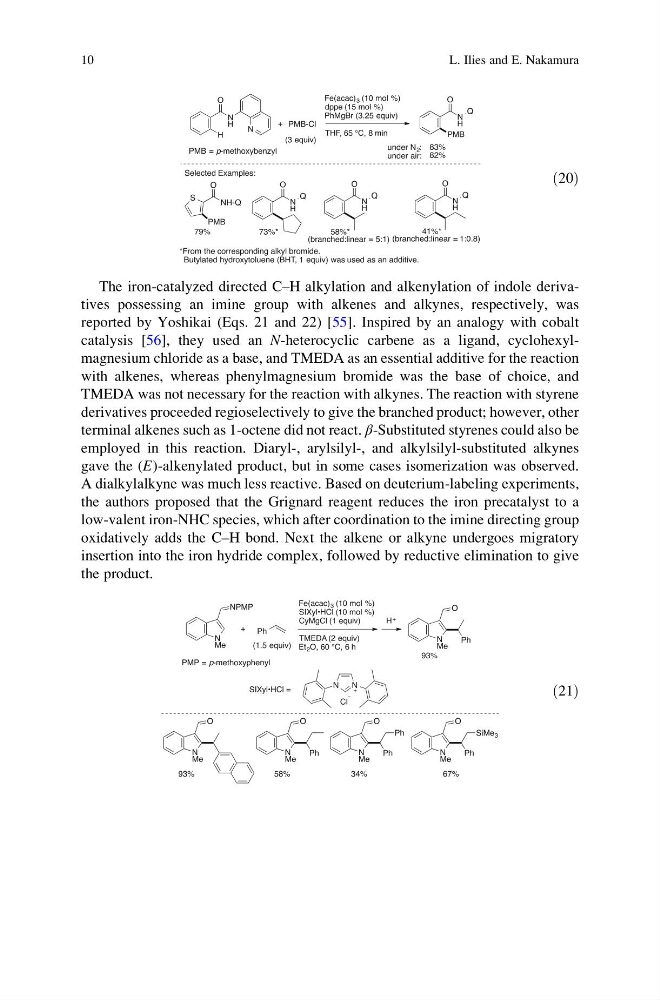
The iron-catalyzed directed C–H alkylation and alkenylation of indole derivatives possessing an imine group with alkenes and alkynes, respectively, was
reported by Yoshikai (Eqs. 21 and 22) [55]. Inspired by an analogy with cobalt
catalysis [56], they used an N-heterocyclic carbene as a ligand, cyclohexylmagnesium chloride as a base, and TMEDA as an essential additive for the reaction
with alkenes, whereas phenylmagnesium bromide was the base of choice, and
TMEDA was not necessary for the reaction with alkynes. The reaction with styrene
derivatives proceeded regioselectively to give the branched product; however, other
terminal alkenes such as 1-octene did not react. β-Substituted styrenes could also be
employed in this reaction. Diaryl-, arylsilyl-, and alkylsilyl-substituted alkynes
gave the (E)-alkenylated product, but in some cases isomerization was observed.
A dialkylalkyne was much less reactive. Based on deuterium-labeling experiments,
the authors proposed that the Grignard reagent reduces the iron precatalyst to a
low-valent iron-NHC species, which after coordination to the imine directing group
oxidatively adds the C–H bond. Next the alkene or alkyne undergoes migratory
insertion into the iron hydride complex, followed by reductive elimination to give
the product.
ð21Þ
10
L. Ilies and E. Nakamura
The iron-catalyzed directed C–H alkylation and alkenylation of indole derivatives possessing an imine group with alkenes and alkynes, respectively, was
reported by Yoshikai (Eqs. 21 and 22) [55]. Inspired by an analogy with cobalt
catalysis [56], they used an N-heterocyclic carbene as a ligand, cyclohexylmagnesium chloride as a base, and TMEDA as an essential additive for the reaction
with alkenes, whereas phenylmagnesium bromide was the base of choice, and
TMEDA was not necessary for the reaction with alkynes. The reaction with styrene
derivatives proceeded regioselectively to give the branched product; however, other
terminal alkenes such as 1-octene did not react. β-Substituted styrenes could also be
employed in this reaction. Diaryl-, arylsilyl-, and alkylsilyl-substituted alkynes
gave the (E)-alkenylated product, but in some cases isomerization was observed.
A dialkylalkyne was much less reactive. Based on deuterium-labeling experiments,
the authors proposed that the Grignard reagent reduces the iron precatalyst to a
low-valent iron-NHC species, which after coordination to the imine directing group
oxidatively adds the C–H bond. Next the alkene or alkyne undergoes migratory
insertion into the iron hydride complex, followed by reductive elimination to give
the product.
ð21Þ
10
L. Ilies and E. Nakamura