

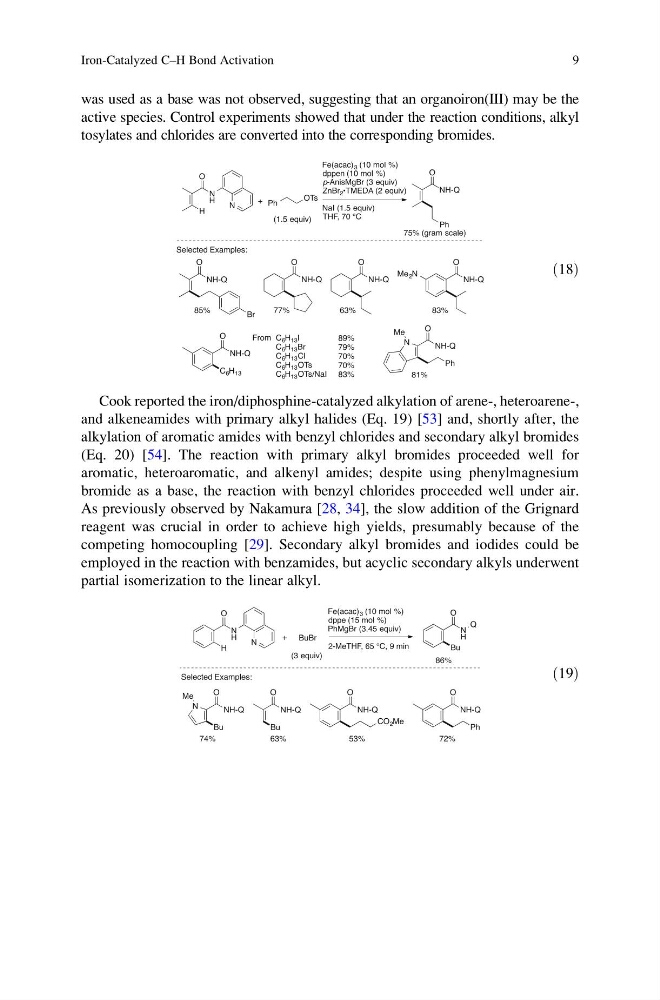
was used as a base was not observed, suggesting that an organoiron(III) may be the
active species. Control experiments showed that under the reaction conditions, alkyl
tosylates and chlorides are converted into the corresponding bromides.
ð18Þ
Cook reported the iron/diphosphine-catalyzed alkylation of arene-, heteroarene-,
and alkeneamides with primary alkyl halides (Eq. 19) [53] and, shortly after, the
alkylation of aromatic amides with benzyl chlorides and secondary alkyl bromides
(Eq. 20) [54]. The reaction with primary alkyl bromides proceeded well for
aromatic, heteroaromatic, and alkenyl amides; despite using phenylmagnesium
bromide as a base, the reaction with benzyl chlorides proceeded well under air.
As previously observed by Nakamura [28, 34], the slow addition of the Grignard
reagent was crucial in order to achieve high yields, presumably because of the
competing homocoupling [29]. Secondary alkyl bromides and iodides could be
employed in the reaction with benzamides, but acyclic secondary alkyls underwent
partial isomerization to the linear alkyl.
ð19Þ
Iron-Catalyzed C–H Bond Activation
9
active species. Control experiments showed that under the reaction conditions, alkyl
tosylates and chlorides are converted into the corresponding bromides.
ð18Þ
Cook reported the iron/diphosphine-catalyzed alkylation of arene-, heteroarene-,
and alkeneamides with primary alkyl halides (Eq. 19) [53] and, shortly after, the
alkylation of aromatic amides with benzyl chlorides and secondary alkyl bromides
(Eq. 20) [54]. The reaction with primary alkyl bromides proceeded well for
aromatic, heteroaromatic, and alkenyl amides; despite using phenylmagnesium
bromide as a base, the reaction with benzyl chlorides proceeded well under air.
As previously observed by Nakamura [28, 34], the slow addition of the Grignard
reagent was crucial in order to achieve high yields, presumably because of the
competing homocoupling [29]. Secondary alkyl bromides and iodides could be
employed in the reaction with benzamides, but acyclic secondary alkyls underwent
partial isomerization to the linear alkyl.
ð19Þ
Iron-Catalyzed C–H Bond Activation
9