

organometallic reagent and the reaction between the organometallic reagent and the
electrophile compete with the desired reaction of the C–H substrate with the
electrophile.
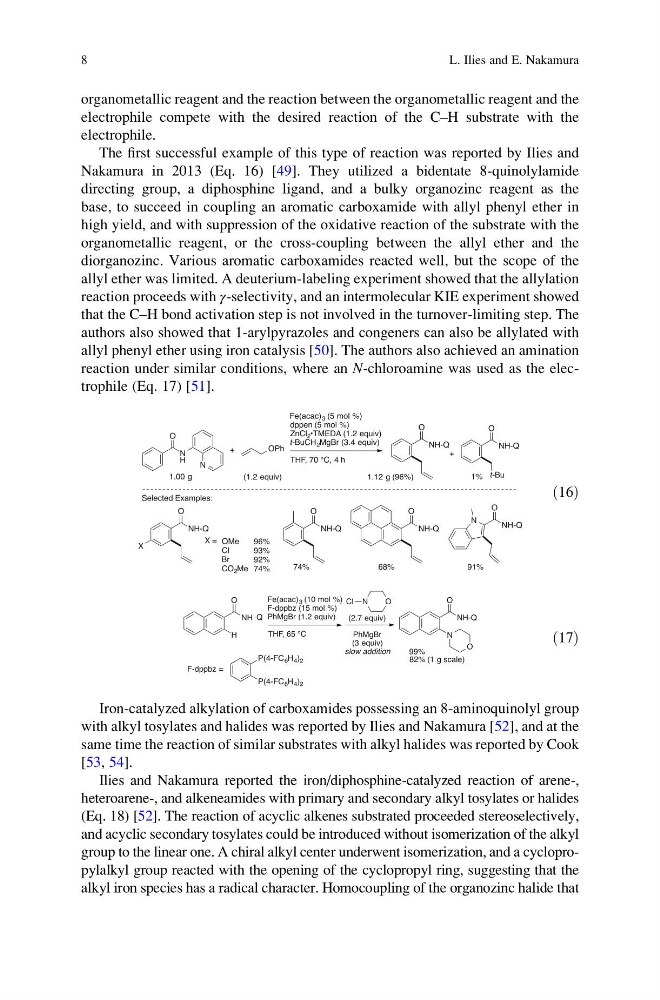
The first successful example of this type of reaction was reported by Ilies and
Nakamura in 2013 (Eq. 16) [49]. They utilized a bidentate 8-quinolylamide
directing group, a diphosphine ligand, and a bulky organozinc reagent as the
base, to succeed in coupling an aromatic carboxamide with allyl phenyl ether in
high yield, and with suppression of the oxidative reaction of the substrate with the
organometallic reagent, or the cross-coupling between the allyl ether and the
diorganozinc. Various aromatic carboxamides reacted well, but the scope of the
allyl ether was limited. A deuterium-labeling experiment showed that the allylation
reaction proceeds with γ-selectivity, and an intermolecular KIE experiment showed
that the C–H bond activation step is not involved in the turnover-limiting step. The
authors also showed that 1-arylpyrazoles and congeners can also be allylated with
allyl phenyl ether using iron catalysis [50]. The authors also achieved an amination
reaction under similar conditions, where an N-chloroamine was used as the electrophile (Eq. 17) [51].
ð16Þ
ð17Þ
Iron-catalyzed alkylation of carboxamides possessing an 8-aminoquinolyl group
with alkyl tosylates and halides was reported by Ilies and Nakamura [52], and at the
same time the reaction of similar substrates with alkyl halides was reported by Cook
[53, 54].
Ilies and Nakamura reported the iron/diphosphine-catalyzed reaction of arene-,
heteroarene-, and alkeneamides with primary and secondary alkyl tosylates or halides
(Eq. 18) [52]. The reaction of acyclic alkenes substrated proceeded stereoselectively,
and acyclic secondary tosylates could be introduced without isomerization of the alkyl
group to the linear one. A chiral alkyl center underwent isomerization, and a cyclopropylalkyl group reacted with the opening of the cyclopropyl ring, suggesting that the
alkyl iron species has a radical character. Homocoupling of the organozinc halide that
8
L. Ilies and E. Nakamura
electrophile compete with the desired reaction of the C–H substrate with the
electrophile.
The first successful example of this type of reaction was reported by Ilies and
Nakamura in 2013 (Eq. 16) [49]. They utilized a bidentate 8-quinolylamide
directing group, a diphosphine ligand, and a bulky organozinc reagent as the
base, to succeed in coupling an aromatic carboxamide with allyl phenyl ether in
high yield, and with suppression of the oxidative reaction of the substrate with the
organometallic reagent, or the cross-coupling between the allyl ether and the
diorganozinc. Various aromatic carboxamides reacted well, but the scope of the
allyl ether was limited. A deuterium-labeling experiment showed that the allylation
reaction proceeds with γ-selectivity, and an intermolecular KIE experiment showed
that the C–H bond activation step is not involved in the turnover-limiting step. The
authors also showed that 1-arylpyrazoles and congeners can also be allylated with
allyl phenyl ether using iron catalysis [50]. The authors also achieved an amination
reaction under similar conditions, where an N-chloroamine was used as the electrophile (Eq. 17) [51].
ð16Þ
ð17Þ
Iron-catalyzed alkylation of carboxamides possessing an 8-aminoquinolyl group
with alkyl tosylates and halides was reported by Ilies and Nakamura [52], and at the
same time the reaction of similar substrates with alkyl halides was reported by Cook
[53, 54].
Ilies and Nakamura reported the iron/diphosphine-catalyzed reaction of arene-,
heteroarene-, and alkeneamides with primary and secondary alkyl tosylates or halides
(Eq. 18) [52]. The reaction of acyclic alkenes substrated proceeded stereoselectively,
and acyclic secondary tosylates could be introduced without isomerization of the alkyl
group to the linear one. A chiral alkyl center underwent isomerization, and a cyclopropylalkyl group reacted with the opening of the cyclopropyl ring, suggesting that the
alkyl iron species has a radical character. Homocoupling of the organozinc halide that
8
L. Ilies and E. Nakamura