

ð14Þ
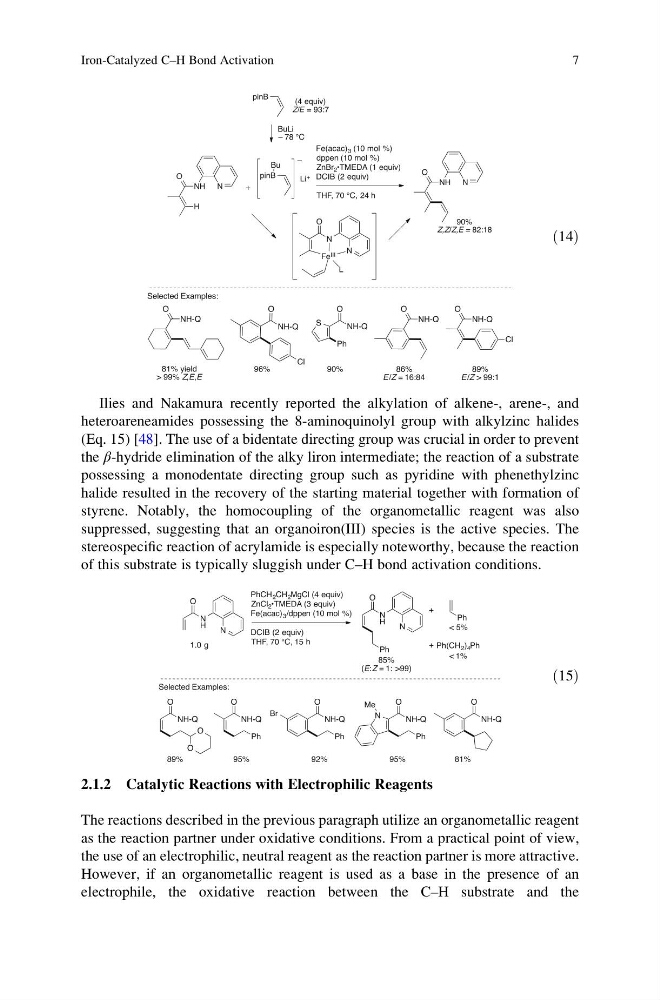
Ilies and Nakamura recently reported the alkylation of alkene-, arene-, and
heteroareneamides possessing the 8-aminoquinolyl group with alkylzinc halides
(Eq. 15) [48]. The use of a bidentate directing group was crucial in order to prevent
the β-hydride elimination of the alky liron intermediate; the reaction of a substrate
possessing a monodentate directing group such as pyridine with phenethylzinc
halide resulted in the recovery of the starting material together with formation of
styrene. Notably, the homocoupling of the organometallic reagent was also
suppressed, suggesting that an organoiron(III) species is the active species. The
stereospecific reaction of acrylamide is especially noteworthy, because the reaction
of this substrate is typically sluggish under C–H bond activation conditions.
ð15Þ
2.1.2 Catalytic Reactions with Electrophilic Reagents
The reactions described in the previous paragraph utilize an organometallic reagent
as the reaction partner under oxidative conditions. From a practical point of view,
the use of an electrophilic, neutral reagent as the reaction partner is more attractive.
However, if an organometallic reagent is used as a base in the presence of an
electrophile, the oxidative reaction between the C–H substrate and the
Iron-Catalyzed C–H Bond Activation
7
Ilies and Nakamura recently reported the alkylation of alkene-, arene-, and
heteroareneamides possessing the 8-aminoquinolyl group with alkylzinc halides
(Eq. 15) [48]. The use of a bidentate directing group was crucial in order to prevent
the β-hydride elimination of the alky liron intermediate; the reaction of a substrate
possessing a monodentate directing group such as pyridine with phenethylzinc
halide resulted in the recovery of the starting material together with formation of
styrene. Notably, the homocoupling of the organometallic reagent was also
suppressed, suggesting that an organoiron(III) species is the active species. The
stereospecific reaction of acrylamide is especially noteworthy, because the reaction
of this substrate is typically sluggish under C–H bond activation conditions.
ð15Þ
2.1.2 Catalytic Reactions with Electrophilic Reagents
The reactions described in the previous paragraph utilize an organometallic reagent
as the reaction partner under oxidative conditions. From a practical point of view,
the use of an electrophilic, neutral reagent as the reaction partner is more attractive.
However, if an organometallic reagent is used as a base in the presence of an
electrophile, the oxidative reaction between the C–H substrate and the
Iron-Catalyzed C–H Bond Activation
7