

ð12Þ
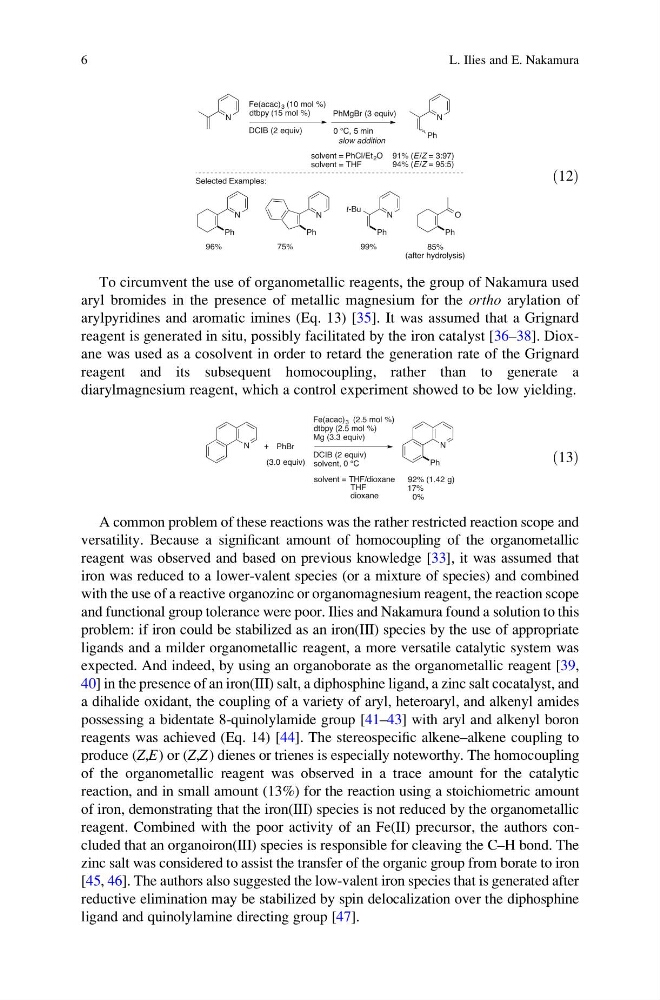
To circumvent the use of organometallic reagents, the group of Nakamura used
aryl bromides in the presence of metallic magnesium for the ortho arylation of
arylpyridines and aromatic imines (Eq. 13) [35]. It was assumed that a Grignard
reagent is generated in situ, possibly facilitated by the iron catalyst [36–38]. Dioxane was used as a cosolvent in order to retard the generation rate of the Grignard
reagent and its subsequent homocoupling, rather than to generate a
diarylmagnesium reagent, which a control experiment showed to be low yielding.
ð13Þ
A common problem of these reactions was the rather restricted reaction scope and
versatility. Because a significant amount of homocoupling of the organometallic
reagent was observed and based on previous knowledge [33], it was assumed that
iron was reduced to a lower-valent species (or a mixture of species) and combined
with the use of a reactive organozinc or organomagnesium reagent, the reaction scope
and functional group tolerance were poor. Ilies and Nakamura found a solution to this
problem: if iron could be stabilized as an iron(III) species by the use of appropriate
ligands and a milder organometallic reagent, a more versatile catalytic system was
expected. And indeed, by using an organoborate as the organometallic reagent [39,
40] in the presence of an iron(III) salt, a diphosphine ligand, a zinc salt cocatalyst, and
a dihalide oxidant, the coupling of a variety of aryl, heteroaryl, and alkenyl amides
possessing a bidentate 8-quinolylamide group [41–43] with aryl and alkenyl boron
reagents was achieved (Eq. 14) [44]. The stereospecific alkene–alkene coupling to
produce (Z,E) or (Z,Z) dienes or trienes is especially noteworthy. The homocoupling
of the organometallic reagent was observed in a trace amount for the catalytic
reaction, and in small amount (13%) for the reaction using a stoichiometric amount
of iron, demonstrating that the iron(III) species is not reduced by the organometallic
reagent. Combined with the poor activity of an Fe(II) precursor, the authors concluded that an organoiron(III) species is responsible for cleaving the C–H bond. The
zinc salt was considered to assist the transfer of the organic group from borate to iron
[45, 46]. The authors also suggested the low-valent iron species that is generated after
reductive elimination may be stabilized by spin delocalization over the diphosphine
ligand and quinolylamine directing group [47].
6
L. Ilies and E. Nakamura
To circumvent the use of organometallic reagents, the group of Nakamura used
aryl bromides in the presence of metallic magnesium for the ortho arylation of
arylpyridines and aromatic imines (Eq. 13) [35]. It was assumed that a Grignard
reagent is generated in situ, possibly facilitated by the iron catalyst [36–38]. Dioxane was used as a cosolvent in order to retard the generation rate of the Grignard
reagent and its subsequent homocoupling, rather than to generate a
diarylmagnesium reagent, which a control experiment showed to be low yielding.
ð13Þ
A common problem of these reactions was the rather restricted reaction scope and
versatility. Because a significant amount of homocoupling of the organometallic
reagent was observed and based on previous knowledge [33], it was assumed that
iron was reduced to a lower-valent species (or a mixture of species) and combined
with the use of a reactive organozinc or organomagnesium reagent, the reaction scope
and functional group tolerance were poor. Ilies and Nakamura found a solution to this
problem: if iron could be stabilized as an iron(III) species by the use of appropriate
ligands and a milder organometallic reagent, a more versatile catalytic system was
expected. And indeed, by using an organoborate as the organometallic reagent [39,
40] in the presence of an iron(III) salt, a diphosphine ligand, a zinc salt cocatalyst, and
a dihalide oxidant, the coupling of a variety of aryl, heteroaryl, and alkenyl amides
possessing a bidentate 8-quinolylamide group [41–43] with aryl and alkenyl boron
reagents was achieved (Eq. 14) [44]. The stereospecific alkene–alkene coupling to
produce (Z,E) or (Z,Z) dienes or trienes is especially noteworthy. The homocoupling
of the organometallic reagent was observed in a trace amount for the catalytic
reaction, and in small amount (13%) for the reaction using a stoichiometric amount
of iron, demonstrating that the iron(III) species is not reduced by the organometallic
reagent. Combined with the poor activity of an Fe(II) precursor, the authors concluded that an organoiron(III) species is responsible for cleaving the C–H bond. The
zinc salt was considered to assist the transfer of the organic group from borate to iron
[45, 46]. The authors also suggested the low-valent iron species that is generated after
reductive elimination may be stabilized by spin delocalization over the diphosphine
ligand and quinolylamine directing group [47].
6
L. Ilies and E. Nakamura