

deuterium oxide (Eq. 11), suggested the intermediacy of a ferracycle. Kinetic
isotope effect experiments showed a large value for the intermolecular (3.4) and
intramolecular (3.1) competition, indicating that coordination of the pyridyl group
to the iron catalyst takes place in a reversible manner and that the following C–H
bond-cleavage step is the first irreversible step of the catalytic cycle [32]. Taking
also into account the cyclometalation reaction with diorganoiron complexes
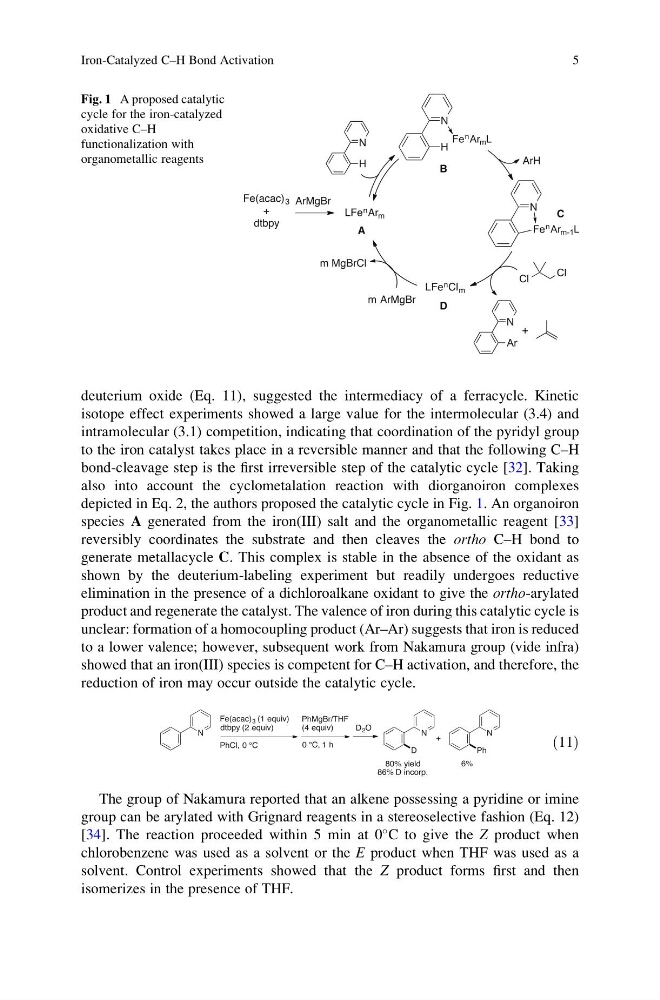
depicted in Eq. 2, the authors proposed the catalytic cycle in Fig. 1. An organoiron
species A generated from the iron(III) salt and the organometallic reagent [33]
reversibly coordinates the substrate and then cleaves the ortho C–H bond to
generate metallacycle C. This complex is stable in the absence of the oxidant as
shown by the deuterium-labeling experiment but readily undergoes reductive
elimination in the presence of a dichloroalkane oxidant to give the ortho-arylated
product and regenerate the catalyst. The valence of iron during this catalytic cycle is
unclear: formation of a homocoupling product (Ar–Ar) suggests that iron is reduced
to a lower valence; however, subsequent work from Nakamura group (vide infra)
showed that an iron(III) species is competent for C–H activation, and therefore, the
reduction of iron may occur outside the catalytic cycle.
ð11Þ
The group of Nakamura reported that an alkene possessing a pyridine or imine
group can be arylated with Grignard reagents in a stereoselective fashion (Eq. 12)
[34]. The reaction proceeded within 5 min at 0
C to give the Z product when
chlorobenzene was used as a solvent or the E product when THF was used as a
solvent. Control experiments showed that the Z product forms first and then
isomerizes in the presence of THF.
Fig. 1 A proposed catalytic
cycle for the iron-catalyzed
oxidative C–H
functionalization with
organometallic reagents
Iron-Catalyzed C–H Bond Activation
5
isotope effect experiments showed a large value for the intermolecular (3.4) and
intramolecular (3.1) competition, indicating that coordination of the pyridyl group
to the iron catalyst takes place in a reversible manner and that the following C–H
bond-cleavage step is the first irreversible step of the catalytic cycle [32]. Taking
also into account the cyclometalation reaction with diorganoiron complexes
depicted in Eq. 2, the authors proposed the catalytic cycle in Fig. 1. An organoiron
species A generated from the iron(III) salt and the organometallic reagent [33]
reversibly coordinates the substrate and then cleaves the ortho C–H bond to
generate metallacycle C. This complex is stable in the absence of the oxidant as
shown by the deuterium-labeling experiment but readily undergoes reductive
elimination in the presence of a dichloroalkane oxidant to give the ortho-arylated
product and regenerate the catalyst. The valence of iron during this catalytic cycle is
unclear: formation of a homocoupling product (Ar–Ar) suggests that iron is reduced
to a lower valence; however, subsequent work from Nakamura group (vide infra)
showed that an iron(III) species is competent for C–H activation, and therefore, the
reduction of iron may occur outside the catalytic cycle.
ð11Þ
The group of Nakamura reported that an alkene possessing a pyridine or imine
group can be arylated with Grignard reagents in a stereoselective fashion (Eq. 12)
[34]. The reaction proceeded within 5 min at 0
C to give the Z product when
chlorobenzene was used as a solvent or the E product when THF was used as a
solvent. Control experiments showed that the Z product forms first and then
isomerizes in the presence of THF.
Fig. 1 A proposed catalytic
cycle for the iron-catalyzed
oxidative C–H
functionalization with
organometallic reagents
Iron-Catalyzed C–H Bond Activation
5