

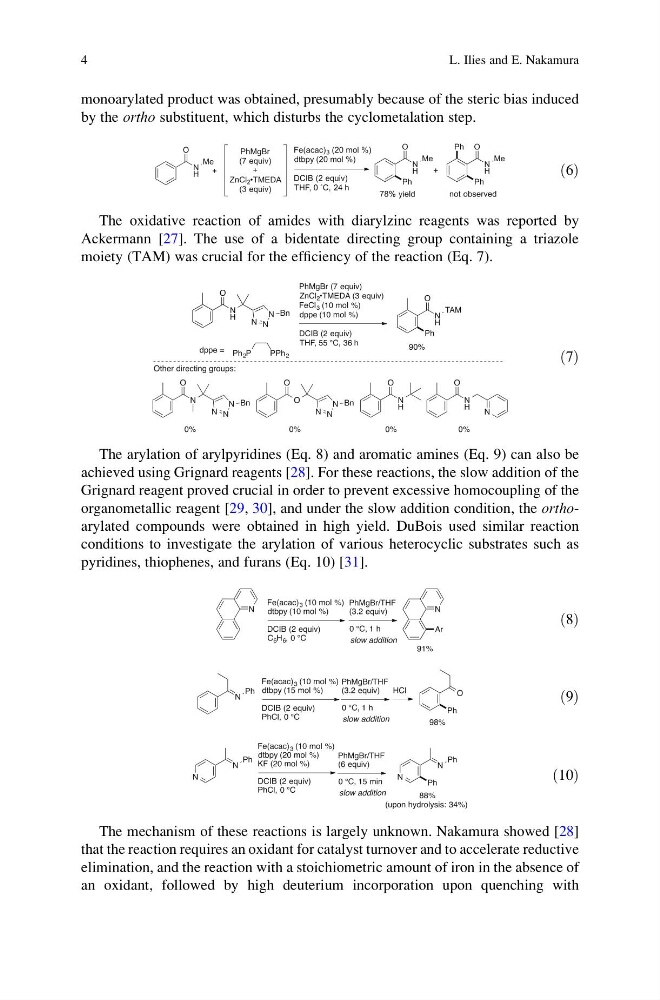
monoarylated product was obtained, presumably because of the steric bias induced
by the ortho substituent, which disturbs the cyclometalation step.
ð6Þ
The oxidative reaction of amides with diarylzinc reagents was reported by
Ackermann [27]. The use of a bidentate directing group containing a triazole
moiety (TAM) was crucial for the efficiency of the reaction (Eq. 7).
ð7Þ
The arylation of arylpyridines (Eq. 8) and aromatic amines (Eq. 9) can also be
achieved using Grignard reagents [28]. For these reactions, the slow addition of the
Grignard reagent proved crucial in order to prevent excessive homocoupling of the
organometallic reagent [29, 30], and under the slow addition condition, the orthoarylated compounds were obtained in high yield. DuBois used similar reaction
conditions to investigate the arylation of various heterocyclic substrates such as
pyridines, thiophenes, and furans (Eq. 10) [31].
ð8Þ
ð9Þ
ð10Þ
The mechanism of these reactions is largely unknown. Nakamura showed [28]
that the reaction requires an oxidant for catalyst turnover and to accelerate reductive
elimination, and the reaction with a stoichiometric amount of iron in the absence of
an oxidant, followed by high deuterium incorporation upon quenching with
4
L. Ilies and E. Nakamura
by the ortho substituent, which disturbs the cyclometalation step.
ð6Þ
The oxidative reaction of amides with diarylzinc reagents was reported by
Ackermann [27]. The use of a bidentate directing group containing a triazole
moiety (TAM) was crucial for the efficiency of the reaction (Eq. 7).
ð7Þ
The arylation of arylpyridines (Eq. 8) and aromatic amines (Eq. 9) can also be
achieved using Grignard reagents [28]. For these reactions, the slow addition of the
Grignard reagent proved crucial in order to prevent excessive homocoupling of the
organometallic reagent [29, 30], and under the slow addition condition, the orthoarylated compounds were obtained in high yield. DuBois used similar reaction
conditions to investigate the arylation of various heterocyclic substrates such as
pyridines, thiophenes, and furans (Eq. 10) [31].
ð8Þ
ð9Þ
ð10Þ
The mechanism of these reactions is largely unknown. Nakamura showed [28]
that the reaction requires an oxidant for catalyst turnover and to accelerate reductive
elimination, and the reaction with a stoichiometric amount of iron in the absence of
an oxidant, followed by high deuterium incorporation upon quenching with
4
L. Ilies and E. Nakamura