

ð2Þ
2.1.1 Catalytic Reactions with Nucleophilic Reagents
After the relatively numerous reports on cyclometalation reactions using iron
complexes, the first example of a catalytic reaction was reported in 2008, when
Nakamura and collaborators reported that arylpyridines and congeners can be
arylated with diarylzinc generated in situ from a Grignard reagent and
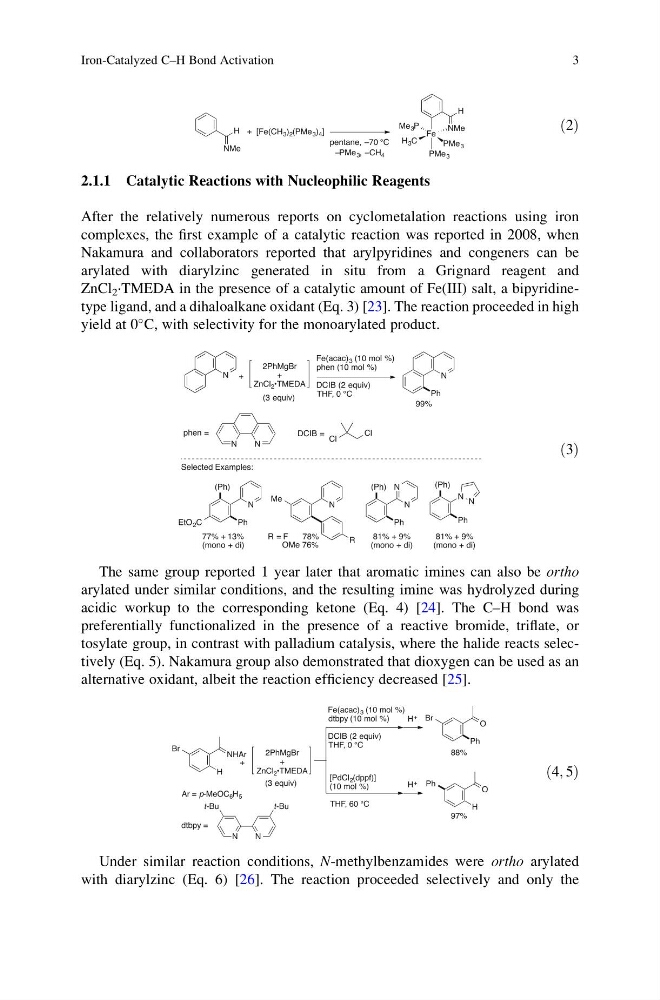
ZnCl 2 ·TMEDA in the presence of a catalytic amount of Fe(III) salt, a bipyridinetype ligand, and a dihaloalkane oxidant (Eq. 3) [23]. The reaction proceeded in high
yield at 0
C, with selectivity for the monoarylated product.
ð3Þ
The same group reported 1 year later that aromatic imines can also be ortho
arylated under similar conditions, and the resulting imine was hydrolyzed during
acidic workup to the corresponding ketone (Eq. 4) [24]. The C–H bond was
preferentially functionalized in the presence of a reactive bromide, triflate, or
tosylate group, in contrast with palladium catalysis, where the halide reacts selectively (Eq. 5). Nakamura group also demonstrated that dioxygen can be used as an
alternative oxidant, albeit the reaction efficiency decreased [25].
ð4; 5Þ
Under similar reaction conditions, N-methylbenzamides were ortho arylated
with diarylzinc (Eq. 6) [26]. The reaction proceeded selectively and only the
Iron-Catalyzed C–H Bond Activation
3
2.1.1 Catalytic Reactions with Nucleophilic Reagents
After the relatively numerous reports on cyclometalation reactions using iron
complexes, the first example of a catalytic reaction was reported in 2008, when
Nakamura and collaborators reported that arylpyridines and congeners can be
arylated with diarylzinc generated in situ from a Grignard reagent and
ZnCl 2 ·TMEDA in the presence of a catalytic amount of Fe(III) salt, a bipyridinetype ligand, and a dihaloalkane oxidant (Eq. 3) [23]. The reaction proceeded in high
yield at 0
C, with selectivity for the monoarylated product.
ð3Þ
The same group reported 1 year later that aromatic imines can also be ortho
arylated under similar conditions, and the resulting imine was hydrolyzed during
acidic workup to the corresponding ketone (Eq. 4) [24]. The C–H bond was
preferentially functionalized in the presence of a reactive bromide, triflate, or
tosylate group, in contrast with palladium catalysis, where the halide reacts selectively (Eq. 5). Nakamura group also demonstrated that dioxygen can be used as an
alternative oxidant, albeit the reaction efficiency decreased [25].
ð4; 5Þ
Under similar reaction conditions, N-methylbenzamides were ortho arylated
with diarylzinc (Eq. 6) [26]. The reaction proceeded selectively and only the
Iron-Catalyzed C–H Bond Activation
3