

1 Introduction
Transition-metal-catalyzed carbon–hydrogen (C–H) activation followed by carbon–
carbon (C–C) bond formation has become one of the most active research topics in
recent synthetic chemistry, because it could enable the straightforward, step-efficient
construction of the framework of target molecules [1–5]. However, there are serious
challenges to overcome for the development of these reactions: the C–H bond is
thermodynamically stable and difficult to cleave, especially in the presence of other
functional groups, typically more labile; also, to differentiate between the many C–H
bonds in an organic molecule is a formidable task. Utilization of a directing group,
which coordinates the metal catalyst and cleaves the proximity C–H bond selectively
in an intramolecular-like fashion, has been a popular strategy to overcome these
problems. Late-transition metals such as Pd, Ru, Rh, Ir, etc. have been extensively
investigated for this purpose, and versatile and efficient catalytic systems based on
these metals have been achieved. However, economic and environmental incentives
shifted the interest to first-row transition metals (base metals) for C–H bond activation
[6]. Among these, iron is the most abundant transition metal, inexpensive, and
nontoxic, and therefore, it has attracted special attention for catalysis [7, 8].
This review describes the utilization of iron as a catalyst for directed C–H bond
activation, followed by C–C bond formation. Nondirected reactions, many of which
proceed through radical pathways, are briefly discussed. Carbon–heteroatom bond
formation is briefly discussed, and reactions where iron acts as a Lewis acid or
simply as a radical initiator are outside the scope of this review. Several reviews or
minireviews discussing iron-catalyzed C–H bond activation have been published
recently [9–16].
2 Functionalization of C(sp
2
)–H Bonds
2.1 Substrates Possessing a Directing Group
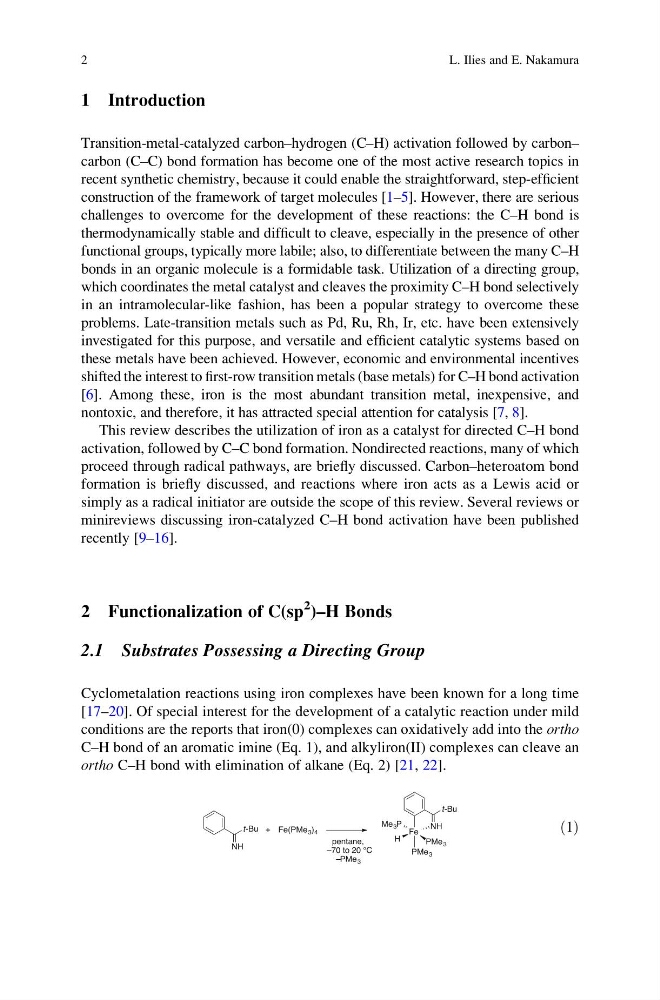
Cyclometalation reactions using iron complexes have been known for a long time
[17–20]. Of special interest for the development of a catalytic reaction under mild
conditions are the reports that iron(0) complexes can oxidatively add into the ortho
C–H bond of an aromatic imine (Eq. 1), and alkyliron(II) complexes can cleave an
ortho C–H bond with elimination of alkane (Eq. 2) [21, 22].
ð1Þ
2
L. Ilies and E. Nakamura
Transition-metal-catalyzed carbon–hydrogen (C–H) activation followed by carbon–
carbon (C–C) bond formation has become one of the most active research topics in
recent synthetic chemistry, because it could enable the straightforward, step-efficient
construction of the framework of target molecules [1–5]. However, there are serious
challenges to overcome for the development of these reactions: the C–H bond is
thermodynamically stable and difficult to cleave, especially in the presence of other
functional groups, typically more labile; also, to differentiate between the many C–H
bonds in an organic molecule is a formidable task. Utilization of a directing group,
which coordinates the metal catalyst and cleaves the proximity C–H bond selectively
in an intramolecular-like fashion, has been a popular strategy to overcome these
problems. Late-transition metals such as Pd, Ru, Rh, Ir, etc. have been extensively
investigated for this purpose, and versatile and efficient catalytic systems based on
these metals have been achieved. However, economic and environmental incentives
shifted the interest to first-row transition metals (base metals) for C–H bond activation
[6]. Among these, iron is the most abundant transition metal, inexpensive, and
nontoxic, and therefore, it has attracted special attention for catalysis [7, 8].
This review describes the utilization of iron as a catalyst for directed C–H bond
activation, followed by C–C bond formation. Nondirected reactions, many of which
proceed through radical pathways, are briefly discussed. Carbon–heteroatom bond
formation is briefly discussed, and reactions where iron acts as a Lewis acid or
simply as a radical initiator are outside the scope of this review. Several reviews or
minireviews discussing iron-catalyzed C–H bond activation have been published
recently [9–16].
2 Functionalization of C(sp
2
)–H Bonds
2.1 Substrates Possessing a Directing Group
Cyclometalation reactions using iron complexes have been known for a long time
[17–20]. Of special interest for the development of a catalytic reaction under mild
conditions are the reports that iron(0) complexes can oxidatively add into the ortho
C–H bond of an aromatic imine (Eq. 1), and alkyliron(II) complexes can cleave an
ortho C–H bond with elimination of alkane (Eq. 2) [21, 22].
ð1Þ
2
L. Ilies and E. Nakamura