

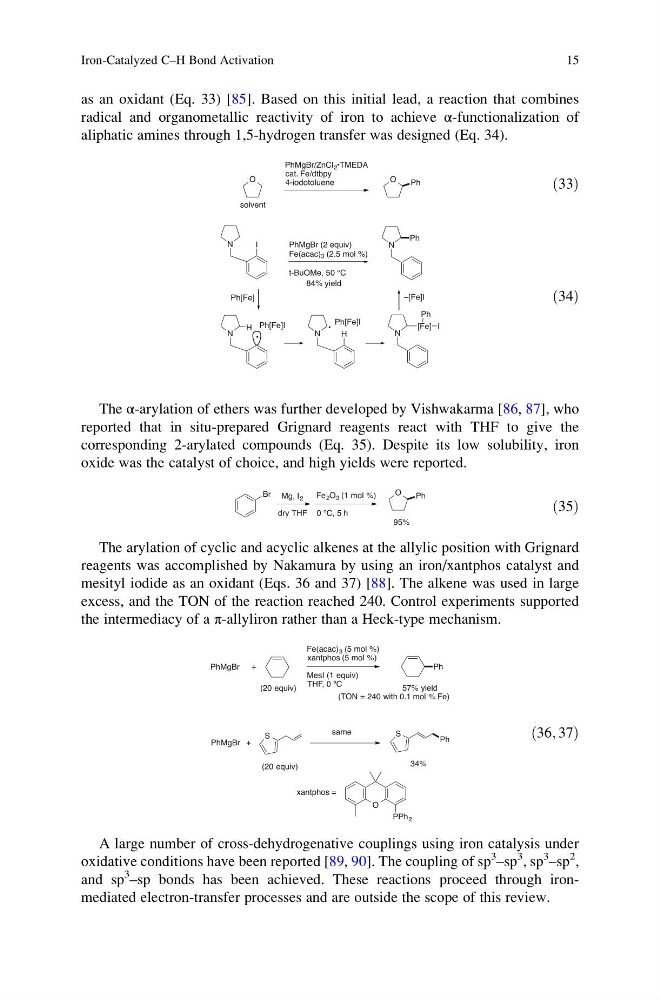
as an oxidant (Eq. 33) [85]. Based on this initial lead, a reaction that combines
radical and organometallic reactivity of iron to achieve α-functionalization of
aliphatic amines through 1,5-hydrogen transfer was designed (Eq. 34).
ð33Þ
I
N
PhMgBr (2 equiv)
Fe(acac) 3 (2.5 mol %)
t-BuOMe, 50 °C
N
Ph
N
N
[Fe]
Ph[Fe]
Ph[Fe]I
N
Ph[Fe]I
H
Ph
I
–[Fe]I
84% yield
H
ð34Þ
The α-arylation of ethers was further developed by Vishwakarma [86, 87], who
reported that in situ-prepared Grignard reagents react with THF to give the
corresponding 2-arylated compounds (Eq. 35). Despite its low solubility, iron
oxide was the catalyst of choice, and high yields were reported.
ð35Þ
The arylation of cyclic and acyclic alkenes at the allylic position with Grignard
reagents was accomplished by Nakamura by using an iron/xantphos catalyst and
mesityl iodide as an oxidant (Eqs. 36 and 37) [88]. The alkene was used in large
excess, and the TON of the reaction reached 240. Control experiments supported
the intermediacy of a π-allyliron rather than a Heck-type mechanism.
ð36; 37Þ
A large number of cross-dehydrogenative couplings using iron catalysis under
oxidative conditions have been reported [89, 90]. The coupling of sp
3 –sp
3 , sp
3 –sp
2 ,
and sp
3 –sp bonds has been achieved. These reactions proceed through ironmediated electron-transfer processes and are outside the scope of this review.
Iron-Catalyzed C–H Bond Activation
15
radical and organometallic reactivity of iron to achieve α-functionalization of
aliphatic amines through 1,5-hydrogen transfer was designed (Eq. 34).
ð33Þ
I
N
PhMgBr (2 equiv)
Fe(acac) 3 (2.5 mol %)
t-BuOMe, 50 °C
N
Ph
N
N
[Fe]
Ph[Fe]
Ph[Fe]I
N
Ph[Fe]I
H
Ph
I
–[Fe]I
84% yield
H
ð34Þ
The α-arylation of ethers was further developed by Vishwakarma [86, 87], who
reported that in situ-prepared Grignard reagents react with THF to give the
corresponding 2-arylated compounds (Eq. 35). Despite its low solubility, iron
oxide was the catalyst of choice, and high yields were reported.
ð35Þ
The arylation of cyclic and acyclic alkenes at the allylic position with Grignard
reagents was accomplished by Nakamura by using an iron/xantphos catalyst and
mesityl iodide as an oxidant (Eqs. 36 and 37) [88]. The alkene was used in large
excess, and the TON of the reaction reached 240. Control experiments supported
the intermediacy of a π-allyliron rather than a Heck-type mechanism.
ð36; 37Þ
A large number of cross-dehydrogenative couplings using iron catalysis under
oxidative conditions have been reported [89, 90]. The coupling of sp
3 –sp
3 , sp
3 –sp
2 ,
and sp
3 –sp bonds has been achieved. These reactions proceed through ironmediated electron-transfer processes and are outside the scope of this review.
Iron-Catalyzed C–H Bond Activation
15