

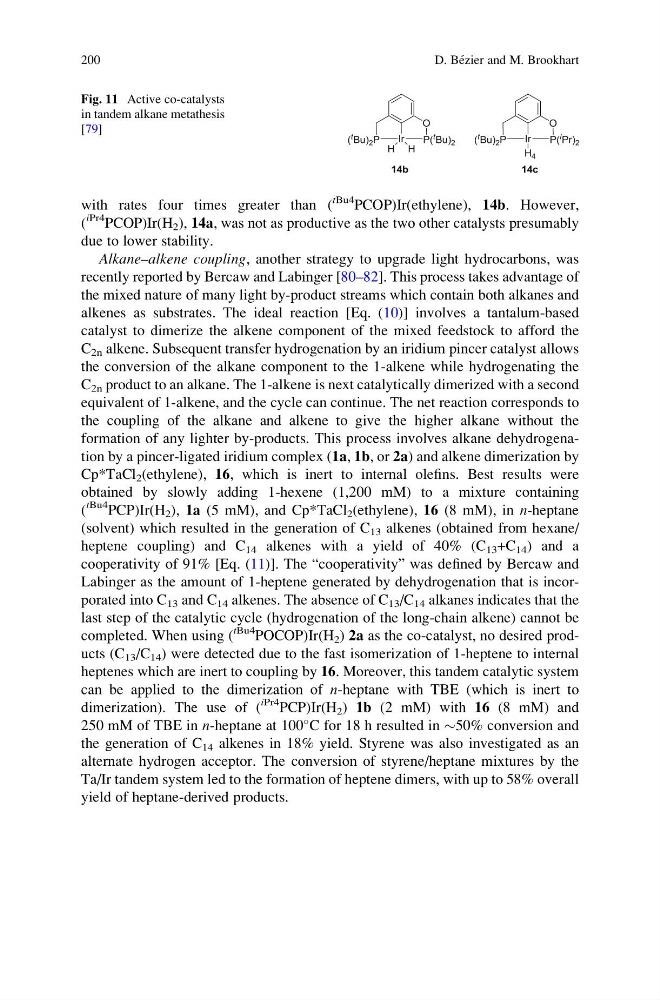
with rates four times greater than (
tBu4
PCOP)Ir(ethylene), 14b. However,
(
iPr4 PCOP)Ir(H 2 ), 14a, was not as productive as the two other catalysts presumably
due to lower stability.
Alkane–alkene coupling, another strategy to upgrade light hydrocarbons, was
recently reported by Bercaw and Labinger [80–82]. This process takes advantage of
the mixed nature of many light by-product streams which contain both alkanes and
alkenes as substrates. The ideal reaction [Eq. (10)] involves a tantalum-based
catalyst to dimerize the alkene component of the mixed feedstock to afford the
C 2n alkene. Subsequent transfer hydrogenation by an iridium pincer catalyst allows
the conversion of the alkane component to the 1-alkene while hydrogenating the
C 2n product to an alkane. The 1-alkene is next catalytically dimerized with a second
equivalent of 1-alkene, and the cycle can continue. The net reaction corresponds to
the coupling of the alkane and alkene to give the higher alkane without the
formation of any lighter by-products. This process involves alkane dehydrogenation by a pincer-ligated iridium complex (1a, 1b, or 2a) and alkene dimerization by
Cp*TaCl 2 (ethylene), 16, which is inert to internal olefins. Best results were
obtained by slowly adding 1-hexene (1,200 mM) to a mixture containing
(
tBu4 PCP)Ir(H 2 ), 1a (5 mM), and Cp*TaCl 2 (ethylene), 16 (8 mM), in n-heptane
(solvent) which resulted in the generation of C 13 alkenes (obtained from hexane/
heptene coupling) and C 14 alkenes with a yield of 40% (C 13 +C 14 ) and a
cooperativity of 91% [Eq. (11)]. The “cooperativity” was defined by Bercaw and
Labinger as the amount of 1-heptene generated by dehydrogenation that is incorporated into C 13 and C 14 alkenes. The absence of C 13 /C 14 alkanes indicates that the
last step of the catalytic cycle (hydrogenation of the long-chain alkene) cannot be
completed. When using (
tBu4 POCOP)Ir(H 2 ) 2a as the co-catalyst, no desired products (C 13 /C 14 ) were detected due to the fast isomerization of 1-heptene to internal
heptenes which are inert to coupling by 16. Moreover, this tandem catalytic system
can be applied to the dimerization of n-heptane with TBE (which is inert to
dimerization). The use of (
iPr4 PCP)Ir(H 2 ) 1b (2 mM) with 16 (8 mM) and
250 mM of TBE in n-heptane at 100
C for 18 h resulted in $50% conversion and
the generation of C 14 alkenes in 18% yield. Styrene was also investigated as an
alternate hydrogen acceptor. The conversion of styrene/heptane mixtures by the
Ta/Ir tandem system led to the formation of heptene dimers, with up to 58% overall
yield of heptane-derived products.
Fig. 11 Active co-catalysts
in tandem alkane metathesis
[79]
200
D. Be ´zier and M. Brookhart
tBu4
PCOP)Ir(ethylene), 14b. However,
(
iPr4 PCOP)Ir(H 2 ), 14a, was not as productive as the two other catalysts presumably
due to lower stability.
Alkane–alkene coupling, another strategy to upgrade light hydrocarbons, was
recently reported by Bercaw and Labinger [80–82]. This process takes advantage of
the mixed nature of many light by-product streams which contain both alkanes and
alkenes as substrates. The ideal reaction [Eq. (10)] involves a tantalum-based
catalyst to dimerize the alkene component of the mixed feedstock to afford the
C 2n alkene. Subsequent transfer hydrogenation by an iridium pincer catalyst allows
the conversion of the alkane component to the 1-alkene while hydrogenating the
C 2n product to an alkane. The 1-alkene is next catalytically dimerized with a second
equivalent of 1-alkene, and the cycle can continue. The net reaction corresponds to
the coupling of the alkane and alkene to give the higher alkane without the
formation of any lighter by-products. This process involves alkane dehydrogenation by a pincer-ligated iridium complex (1a, 1b, or 2a) and alkene dimerization by
Cp*TaCl 2 (ethylene), 16, which is inert to internal olefins. Best results were
obtained by slowly adding 1-hexene (1,200 mM) to a mixture containing
(
tBu4 PCP)Ir(H 2 ), 1a (5 mM), and Cp*TaCl 2 (ethylene), 16 (8 mM), in n-heptane
(solvent) which resulted in the generation of C 13 alkenes (obtained from hexane/
heptene coupling) and C 14 alkenes with a yield of 40% (C 13 +C 14 ) and a
cooperativity of 91% [Eq. (11)]. The “cooperativity” was defined by Bercaw and
Labinger as the amount of 1-heptene generated by dehydrogenation that is incorporated into C 13 and C 14 alkenes. The absence of C 13 /C 14 alkanes indicates that the
last step of the catalytic cycle (hydrogenation of the long-chain alkene) cannot be
completed. When using (
tBu4 POCOP)Ir(H 2 ) 2a as the co-catalyst, no desired products (C 13 /C 14 ) were detected due to the fast isomerization of 1-heptene to internal
heptenes which are inert to coupling by 16. Moreover, this tandem catalytic system
can be applied to the dimerization of n-heptane with TBE (which is inert to
dimerization). The use of (
iPr4 PCP)Ir(H 2 ) 1b (2 mM) with 16 (8 mM) and
250 mM of TBE in n-heptane at 100
C for 18 h resulted in $50% conversion and
the generation of C 14 alkenes in 18% yield. Styrene was also investigated as an
alternate hydrogen acceptor. The conversion of styrene/heptane mixtures by the
Ta/Ir tandem system led to the formation of heptene dimers, with up to 58% overall
yield of heptane-derived products.
Fig. 11 Active co-catalysts
in tandem alkane metathesis
[79]
200
D. Be ´zier and M. Brookhart