

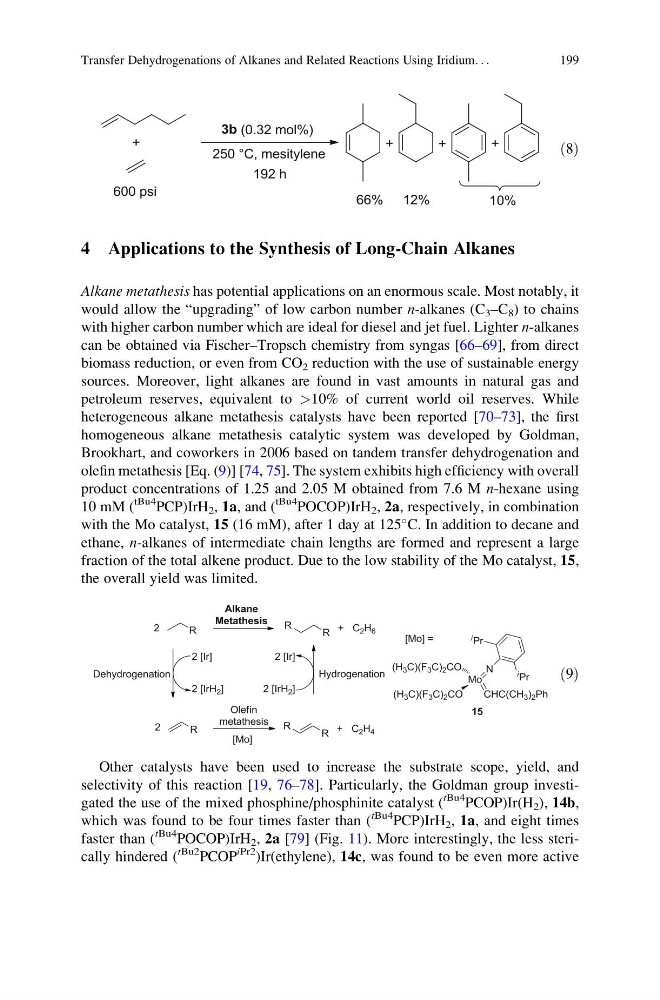
ð8Þ
4 Applications to the Synthesis of Long-Chain Alkanes
Alkane metathesis has potential applications on an enormous scale. Most notably, it
would allow the “upgrading” of low carbon number n-alkanes (C 3 –C 8 ) to chains
with higher carbon number which are ideal for diesel and jet fuel. Lighter n-alkanes
can be obtained via Fischer–Tropsch chemistry from syngas [66–69], from direct
biomass reduction, or even from CO 2 reduction with the use of sustainable energy
sources. Moreover, light alkanes are found in vast amounts in natural gas and
petroleum reserves, equivalent to >10% of current world oil reserves. While
heterogeneous alkane metathesis catalysts have been reported [70–73], the first
homogeneous alkane metathesis catalytic system was developed by Goldman,
Brookhart, and coworkers in 2006 based on tandem transfer dehydrogenation and
olefin metathesis [Eq. (9)] [74, 75]. The system exhibits high efficiency with overall
product concentrations of 1.25 and 2.05 M obtained from 7.6 M n-hexane using
10 mM (
tBu4 PCP)IrH 2 , 1a, and (
tBu4 POCOP)IrH 2 , 2a, respectively, in combination
with the Mo catalyst, 15 (16 mM), after 1 day at 125
C. In addition to decane and
ethane, n-alkanes of intermediate chain lengths are formed and represent a large
fraction of the total alkene product. Due to the low stability of the Mo catalyst, 15,
the overall yield was limited.
ð9Þ
Other catalysts have been used to increase the substrate scope, yield, and
selectivity of this reaction [19, 76–78]. Particularly, the Goldman group investigated the use of the mixed phosphine/phosphinite catalyst (
tBu4 PCOP)Ir(H 2 ), 14b,
which was found to be four times faster than (
tBu4 PCP)IrH 2 , 1a, and eight times
faster than (
tBu4 POCOP)IrH 2 , 2a [79] (Fig. 11). More interestingly, the less sterically hindered (
tBu2 PCOP
iPr2
)Ir(ethylene), 14c, was found to be even more active
Transfer Dehydrogenations of Alkanes and Related Reactions Using Iridium. . .
199
4 Applications to the Synthesis of Long-Chain Alkanes
Alkane metathesis has potential applications on an enormous scale. Most notably, it
would allow the “upgrading” of low carbon number n-alkanes (C 3 –C 8 ) to chains
with higher carbon number which are ideal for diesel and jet fuel. Lighter n-alkanes
can be obtained via Fischer–Tropsch chemistry from syngas [66–69], from direct
biomass reduction, or even from CO 2 reduction with the use of sustainable energy
sources. Moreover, light alkanes are found in vast amounts in natural gas and
petroleum reserves, equivalent to >10% of current world oil reserves. While
heterogeneous alkane metathesis catalysts have been reported [70–73], the first
homogeneous alkane metathesis catalytic system was developed by Goldman,
Brookhart, and coworkers in 2006 based on tandem transfer dehydrogenation and
olefin metathesis [Eq. (9)] [74, 75]. The system exhibits high efficiency with overall
product concentrations of 1.25 and 2.05 M obtained from 7.6 M n-hexane using
10 mM (
tBu4 PCP)IrH 2 , 1a, and (
tBu4 POCOP)IrH 2 , 2a, respectively, in combination
with the Mo catalyst, 15 (16 mM), after 1 day at 125
C. In addition to decane and
ethane, n-alkanes of intermediate chain lengths are formed and represent a large
fraction of the total alkene product. Due to the low stability of the Mo catalyst, 15,
the overall yield was limited.
ð9Þ
Other catalysts have been used to increase the substrate scope, yield, and
selectivity of this reaction [19, 76–78]. Particularly, the Goldman group investigated the use of the mixed phosphine/phosphinite catalyst (
tBu4 PCOP)Ir(H 2 ), 14b,
which was found to be four times faster than (
tBu4 PCP)IrH 2 , 1a, and eight times
faster than (
tBu4 POCOP)IrH 2 , 2a [79] (Fig. 11). More interestingly, the less sterically hindered (
tBu2 PCOP
iPr2
)Ir(ethylene), 14c, was found to be even more active
Transfer Dehydrogenations of Alkanes and Related Reactions Using Iridium. . .
199