

[63]. p-Xylene is one of the highest volume chemical intermediates derived from
petroleum. Its primary use is for the production of the dimethyl ester of terephthalic
acid, which is copolymerized with ethylene glycol to produce polyethylene terephthalate (PET). Traditionally, p-xylene is produced by catalytic reforming of
various crude oil streams, followed by a difficult separation of the mixture
containing benzene, toluene, o-xylene, m-xylene, and p-xylene. Taking advantage
of the abundance of ethane in the USA via the recent shale gas boom, the use of
ethylene (obtained from cracking of ethane) [64] has drawn growing interest as a
feedstock. By using ethylene as the sole feedstock, the Brookhart group developed
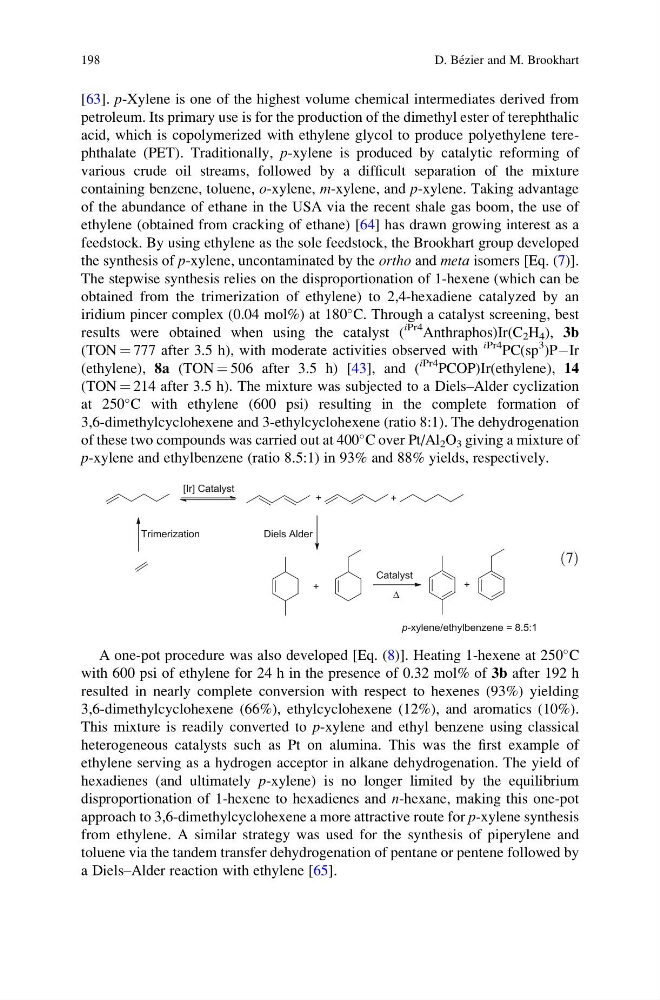
the synthesis of p-xylene, uncontaminated by the ortho and meta isomers [Eq. (7)].
The stepwise synthesis relies on the disproportionation of 1-hexene (which can be
obtained from the trimerization of ethylene) to 2,4-hexadiene catalyzed by an
iridium pincer complex (0.04 mol%) at 180
C. Through a catalyst screening, best
results were obtained when using the catalyst (
iPr4 Anthraphos)Ir(C 2 H 4 ), 3b
(TON ¼ 777 after 3.5 h), with moderate activities observed with
iPr4 PC(sp
3 )PÀIr
(ethylene), 8a (TON ¼ 506 after 3.5 h) [43], and (
iPr4 PCOP)Ir(ethylene), 14
(TON ¼ 214 after 3.5 h). The mixture was subjected to a Diels–Alder cyclization
at 250
C with ethylene (600 psi) resulting in the complete formation of
3,6-dimethylcyclohexene and 3-ethylcyclohexene (ratio 8:1). The dehydrogenation
of these two compounds was carried out at 400
C over Pt/Al 2 O 3 giving a mixture of
p-xylene and ethylbenzene (ratio 8.5:1) in 93% and 88% yields, respectively.
ð7Þ
A one-pot procedure was also developed [Eq. (8)]. Heating 1-hexene at 250
C
with 600 psi of ethylene for 24 h in the presence of 0.32 mol% of 3b after 192 h
resulted in nearly complete conversion with respect to hexenes (93%) yielding
3,6-dimethylcyclohexene (66%), ethylcyclohexene (12%), and aromatics (10%).
This mixture is readily converted to p-xylene and ethyl benzene using classical
heterogeneous catalysts such as Pt on alumina. This was the first example of
ethylene serving as a hydrogen acceptor in alkane dehydrogenation. The yield of
hexadienes (and ultimately p-xylene) is no longer limited by the equilibrium
disproportionation of 1-hexene to hexadienes and n-hexane, making this one-pot
approach to 3,6-dimethylcyclohexene a more attractive route for p-xylene synthesis
from ethylene. A similar strategy was used for the synthesis of piperylene and
toluene via the tandem transfer dehydrogenation of pentane or pentene followed by
a Diels–Alder reaction with ethylene [65].
198
D. Be ´zier and M. Brookhart
petroleum. Its primary use is for the production of the dimethyl ester of terephthalic
acid, which is copolymerized with ethylene glycol to produce polyethylene terephthalate (PET). Traditionally, p-xylene is produced by catalytic reforming of
various crude oil streams, followed by a difficult separation of the mixture
containing benzene, toluene, o-xylene, m-xylene, and p-xylene. Taking advantage
of the abundance of ethane in the USA via the recent shale gas boom, the use of
ethylene (obtained from cracking of ethane) [64] has drawn growing interest as a
feedstock. By using ethylene as the sole feedstock, the Brookhart group developed
the synthesis of p-xylene, uncontaminated by the ortho and meta isomers [Eq. (7)].
The stepwise synthesis relies on the disproportionation of 1-hexene (which can be
obtained from the trimerization of ethylene) to 2,4-hexadiene catalyzed by an
iridium pincer complex (0.04 mol%) at 180
C. Through a catalyst screening, best
results were obtained when using the catalyst (
iPr4 Anthraphos)Ir(C 2 H 4 ), 3b
(TON ¼ 777 after 3.5 h), with moderate activities observed with
iPr4 PC(sp
3 )PÀIr
(ethylene), 8a (TON ¼ 506 after 3.5 h) [43], and (
iPr4 PCOP)Ir(ethylene), 14
(TON ¼ 214 after 3.5 h). The mixture was subjected to a Diels–Alder cyclization
at 250
C with ethylene (600 psi) resulting in the complete formation of
3,6-dimethylcyclohexene and 3-ethylcyclohexene (ratio 8:1). The dehydrogenation
of these two compounds was carried out at 400
C over Pt/Al 2 O 3 giving a mixture of
p-xylene and ethylbenzene (ratio 8.5:1) in 93% and 88% yields, respectively.
ð7Þ
A one-pot procedure was also developed [Eq. (8)]. Heating 1-hexene at 250
C
with 600 psi of ethylene for 24 h in the presence of 0.32 mol% of 3b after 192 h
resulted in nearly complete conversion with respect to hexenes (93%) yielding
3,6-dimethylcyclohexene (66%), ethylcyclohexene (12%), and aromatics (10%).
This mixture is readily converted to p-xylene and ethyl benzene using classical
heterogeneous catalysts such as Pt on alumina. This was the first example of
ethylene serving as a hydrogen acceptor in alkane dehydrogenation. The yield of
hexadienes (and ultimately p-xylene) is no longer limited by the equilibrium
disproportionation of 1-hexene to hexadienes and n-hexane, making this one-pot
approach to 3,6-dimethylcyclohexene a more attractive route for p-xylene synthesis
from ethylene. A similar strategy was used for the synthesis of piperylene and
toluene via the tandem transfer dehydrogenation of pentane or pentene followed by
a Diels–Alder reaction with ethylene [65].
198
D. Be ´zier and M. Brookhart