

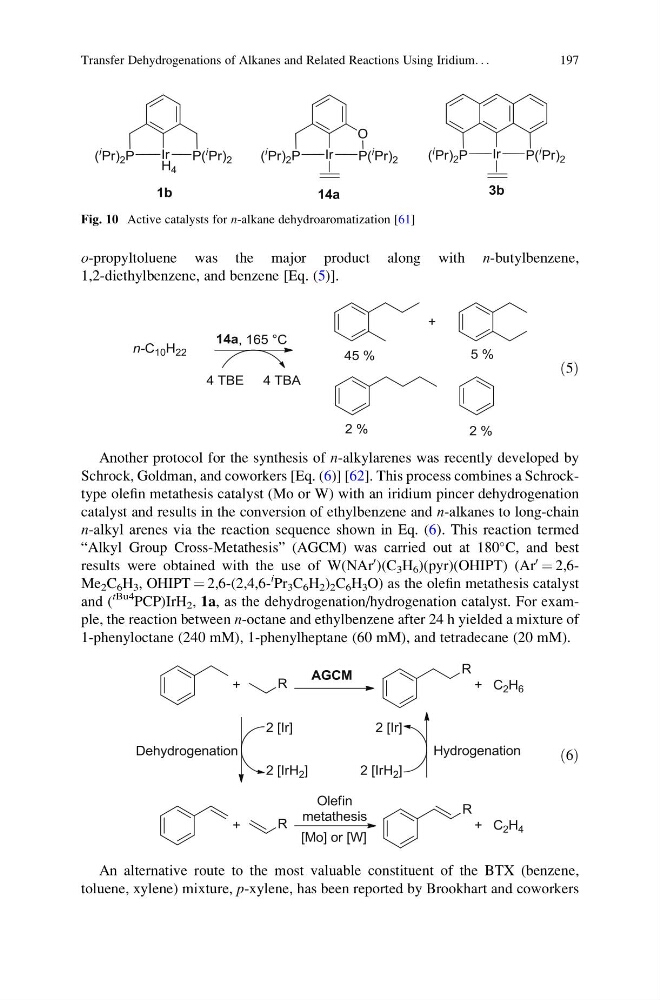
o-propyltoluene was the major product along with n-butylbenzene,
1,2-diethylbenzene, and benzene [Eq. (5)].
ð5Þ
Another protocol for the synthesis of n-alkylarenes was recently developed by
Schrock, Goldman, and coworkers [Eq. (6)] [62]. This process combines a Schrocktype olefin metathesis catalyst (Mo or W) with an iridium pincer dehydrogenation
catalyst and results in the conversion of ethylbenzene and n-alkanes to long-chain
n-alkyl arenes via the reaction sequence shown in Eq. (6). This reaction termed
“Alkyl Group Cross-Metathesis” (AGCM) was carried out at 180
C, and best
results were obtained with the use of W(NAr
0 )(C 3 H 6 )(pyr)(OHIPT) (Ar
0
¼ 2,6Me 2 C 6 H 3 , OHIPT ¼ 2,6-(2,4,6i
Pr 3 C 6 H 2 ) 2 C 6 H 3 O) as the olefin metathesis catalyst
and (
tBu4 PCP)IrH 2 , 1a, as the dehydrogenation/hydrogenation catalyst. For example, the reaction between n-octane and ethylbenzene after 24 h yielded a mixture of
1-phenyloctane (240 mM), 1-phenylheptane (60 mM), and tetradecane (20 mM).
ð6Þ
An alternative route to the most valuable constituent of the BTX (benzene,
toluene, xylene) mixture, p-xylene, has been reported by Brookhart and coworkers
Fig. 10 Active catalysts for n-alkane dehydroaromatization [61]
Transfer Dehydrogenations of Alkanes and Related Reactions Using Iridium. . .
197
1,2-diethylbenzene, and benzene [Eq. (5)].
ð5Þ
Another protocol for the synthesis of n-alkylarenes was recently developed by
Schrock, Goldman, and coworkers [Eq. (6)] [62]. This process combines a Schrocktype olefin metathesis catalyst (Mo or W) with an iridium pincer dehydrogenation
catalyst and results in the conversion of ethylbenzene and n-alkanes to long-chain
n-alkyl arenes via the reaction sequence shown in Eq. (6). This reaction termed
“Alkyl Group Cross-Metathesis” (AGCM) was carried out at 180
C, and best
results were obtained with the use of W(NAr
0 )(C 3 H 6 )(pyr)(OHIPT) (Ar
0
¼ 2,6Me 2 C 6 H 3 , OHIPT ¼ 2,6-(2,4,6i
Pr 3 C 6 H 2 ) 2 C 6 H 3 O) as the olefin metathesis catalyst
and (
tBu4 PCP)IrH 2 , 1a, as the dehydrogenation/hydrogenation catalyst. For example, the reaction between n-octane and ethylbenzene after 24 h yielded a mixture of
1-phenyloctane (240 mM), 1-phenylheptane (60 mM), and tetradecane (20 mM).
ð6Þ
An alternative route to the most valuable constituent of the BTX (benzene,
toluene, xylene) mixture, p-xylene, has been reported by Brookhart and coworkers
Fig. 10 Active catalysts for n-alkane dehydroaromatization [61]
Transfer Dehydrogenations of Alkanes and Related Reactions Using Iridium. . .
197