

synthesis of aromatics from alkanes becomes increasingly attractive. Heterogeneously catalyzed dehydroaromatization of n-alkanes is known to occur at very
high temperatures (>500
C) but with low yields and low selectivity [55–60].
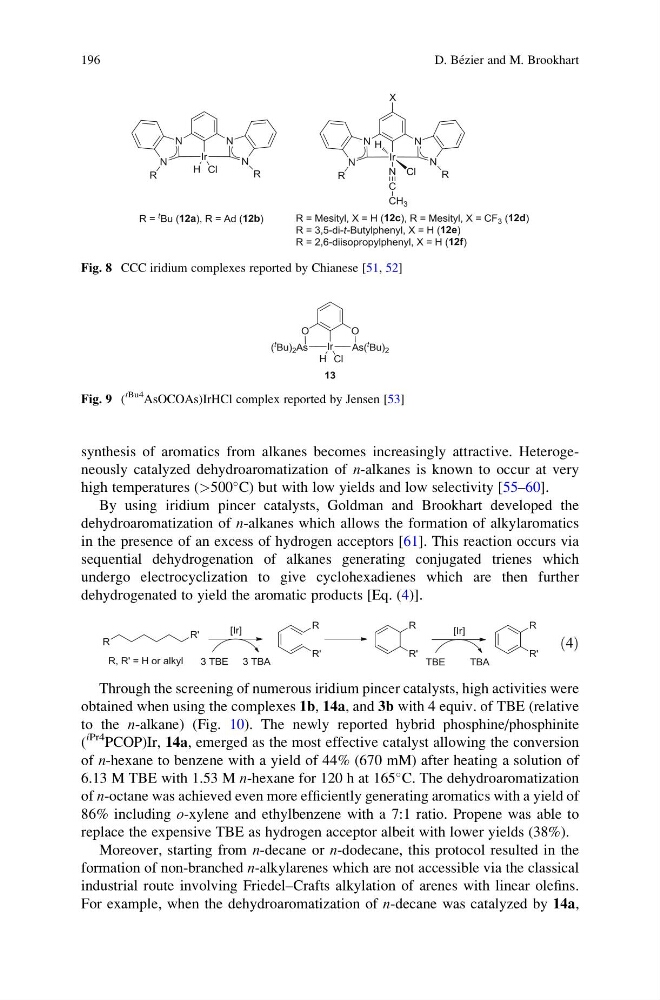
By using iridium pincer catalysts, Goldman and Brookhart developed the
dehydroaromatization of n-alkanes which allows the formation of alkylaromatics
in the presence of an excess of hydrogen acceptors [61]. This reaction occurs via
sequential dehydrogenation of alkanes generating conjugated trienes which
undergo electrocyclization to give cyclohexadienes which are then further
dehydrogenated to yield the aromatic products [Eq. (4)].
ð4Þ
Through the screening of numerous iridium pincer catalysts, high activities were
obtained when using the complexes 1b, 14a, and 3b with 4 equiv. of TBE (relative
to the n-alkane) (Fig. 10). The newly reported hybrid phosphine/phosphinite
(
iPr4 PCOP)Ir, 14a, emerged as the most effective catalyst allowing the conversion
of n-hexane to benzene with a yield of 44% (670 mM) after heating a solution of
6.13 M TBE with 1.53 M n-hexane for 120 h at 165
C. The dehydroaromatization
of n-octane was achieved even more efficiently generating aromatics with a yield of
86% including o-xylene and ethylbenzene with a 7:1 ratio. Propene was able to
replace the expensive TBE as hydrogen acceptor albeit with lower yields (38%).
Moreover, starting from n-decane or n-dodecane, this protocol resulted in the
formation of non-branched n-alkylarenes which are not accessible via the classical
industrial route involving Friedel–Crafts alkylation of arenes with linear olefins.
For example, when the dehydroaromatization of n-decane was catalyzed by 14a,
Fig. 9 (
tBu4 AsOCOAs)IrHCl complex reported by Jensen [53]
Fig. 8 CCC iridium complexes reported by Chianese [51, 52]
196
D. Be ´zier and M. Brookhart
high temperatures (>500
C) but with low yields and low selectivity [55–60].
By using iridium pincer catalysts, Goldman and Brookhart developed the
dehydroaromatization of n-alkanes which allows the formation of alkylaromatics
in the presence of an excess of hydrogen acceptors [61]. This reaction occurs via
sequential dehydrogenation of alkanes generating conjugated trienes which
undergo electrocyclization to give cyclohexadienes which are then further
dehydrogenated to yield the aromatic products [Eq. (4)].
ð4Þ
Through the screening of numerous iridium pincer catalysts, high activities were
obtained when using the complexes 1b, 14a, and 3b with 4 equiv. of TBE (relative
to the n-alkane) (Fig. 10). The newly reported hybrid phosphine/phosphinite
(
iPr4 PCOP)Ir, 14a, emerged as the most effective catalyst allowing the conversion
of n-hexane to benzene with a yield of 44% (670 mM) after heating a solution of
6.13 M TBE with 1.53 M n-hexane for 120 h at 165
C. The dehydroaromatization
of n-octane was achieved even more efficiently generating aromatics with a yield of
86% including o-xylene and ethylbenzene with a 7:1 ratio. Propene was able to
replace the expensive TBE as hydrogen acceptor albeit with lower yields (38%).
Moreover, starting from n-decane or n-dodecane, this protocol resulted in the
formation of non-branched n-alkylarenes which are not accessible via the classical
industrial route involving Friedel–Crafts alkylation of arenes with linear olefins.
For example, when the dehydroaromatization of n-decane was catalyzed by 14a,
Fig. 9 (
tBu4 AsOCOAs)IrHCl complex reported by Jensen [53]
Fig. 8 CCC iridium complexes reported by Chianese [51, 52]
196
D. Be ´zier and M. Brookhart