

ð10Þ
ð11Þ
5 Dehydrogenation of Functionalized Organic Molecules
Despite the large number of highly active catalysts for alkane dehydrogenation,
surprisingly little work has been extended to functionalized substrates. An early
report by Jensen and Kaska showed modest reactivity (~57 TONs) for the dehydrogenation of tetrahydrofuran with TBE by using (
tBu4 PCP)Ir(H 2 ), 1a, as the
catalyst at 150
C [83]. Using the same catalyst, the dehydrogenation of tertiary
amines to form enamines in the presence of TBE at 90
C was reported by Goldman,
again with modest TONs (%10) [84]. A similar reaction developed by the Wendt
group with (PCyP)Ir(H)(Cl), 9, as catalyst required higher temperatures (120
C) to
obtain comparable activity [48]. In the context of hydrogen storage, acceptorless
dehydrogenation of N-ethylperhydrocarbazole by (
tBu4 PCP)Ir(H 2 ), 1a, (
iPr4 PCP)Ir
(H 2 ), 1b, and (
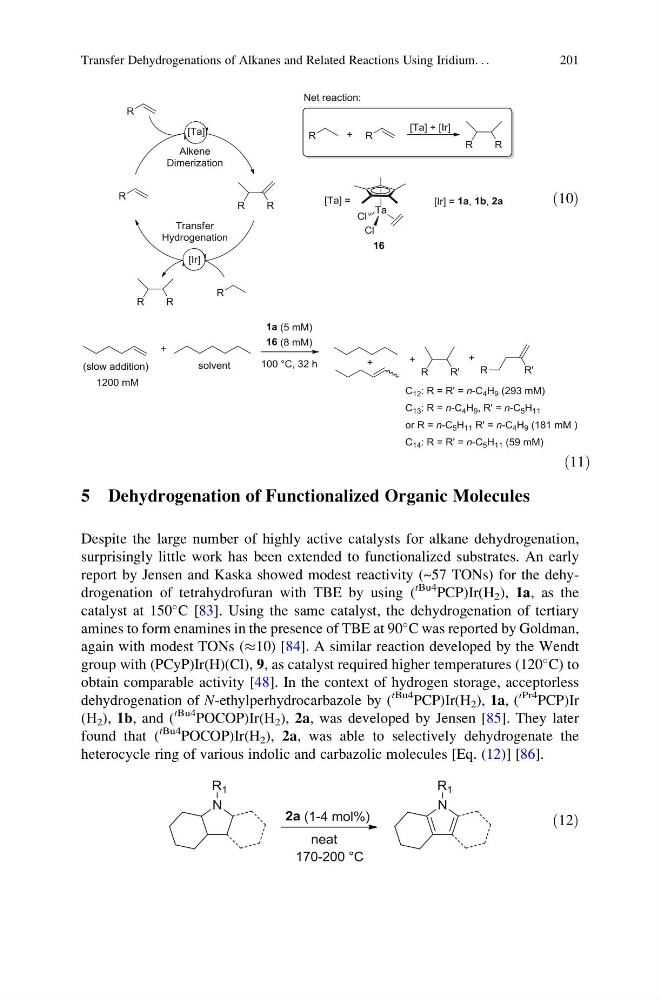
tBu4 POCOP)Ir(H 2 ), 2a, was developed by Jensen [85]. They later
found that (
tBu4 POCOP)Ir(H 2 ), 2a, was able to selectively dehydrogenate the
heterocycle ring of various indolic and carbazolic molecules [Eq. (12)] [86].
ð12Þ
Transfer Dehydrogenations of Alkanes and Related Reactions Using Iridium. . .
201
ð11Þ
5 Dehydrogenation of Functionalized Organic Molecules
Despite the large number of highly active catalysts for alkane dehydrogenation,
surprisingly little work has been extended to functionalized substrates. An early
report by Jensen and Kaska showed modest reactivity (~57 TONs) for the dehydrogenation of tetrahydrofuran with TBE by using (
tBu4 PCP)Ir(H 2 ), 1a, as the
catalyst at 150
C [83]. Using the same catalyst, the dehydrogenation of tertiary
amines to form enamines in the presence of TBE at 90
C was reported by Goldman,
again with modest TONs (%10) [84]. A similar reaction developed by the Wendt
group with (PCyP)Ir(H)(Cl), 9, as catalyst required higher temperatures (120
C) to
obtain comparable activity [48]. In the context of hydrogen storage, acceptorless
dehydrogenation of N-ethylperhydrocarbazole by (
tBu4 PCP)Ir(H 2 ), 1a, (
iPr4 PCP)Ir
(H 2 ), 1b, and (
tBu4 POCOP)Ir(H 2 ), 2a, was developed by Jensen [85]. They later
found that (
tBu4 POCOP)Ir(H 2 ), 2a, was able to selectively dehydrogenate the
heterocycle ring of various indolic and carbazolic molecules [Eq. (12)] [86].
ð12Þ
Transfer Dehydrogenations of Alkanes and Related Reactions Using Iridium. . .
201