

with TBE as the hydrogen acceptor. By using a COA/TBE ratio of 1:1, TONs up to
5,900 were achieved after 15 h at 200
C with an initial rate of 2,910 TO h
À1 . Due to
slight inhibition with TBE, this rate was increased to 5,600 TO h
À1 by using a
COA/TBE ratio of 4.8:1. This catalytic system also demonstrated high efficiency
for the transfer dehydrogenation of n-octane with TOF up to 1,400 h
À1 when the
reaction was carried out at 200
C with TBE (0.5 M). Under these conditions, a
selectivity of 33% for the formation of 1-octene was observed after 5 min due to fast
isomerization of the terminal olefin. The olefin isomerization mechanism by iridium pincer catalysts was shown by Goldman and Brookhart to proceed via a π-allyl
mechanism involving a η
3 -allyl iridium hydride intermediate [42]. At the same
temperature, by increasing the TBE concentration to 3 M, TONs up to 1,200 were
obtained.
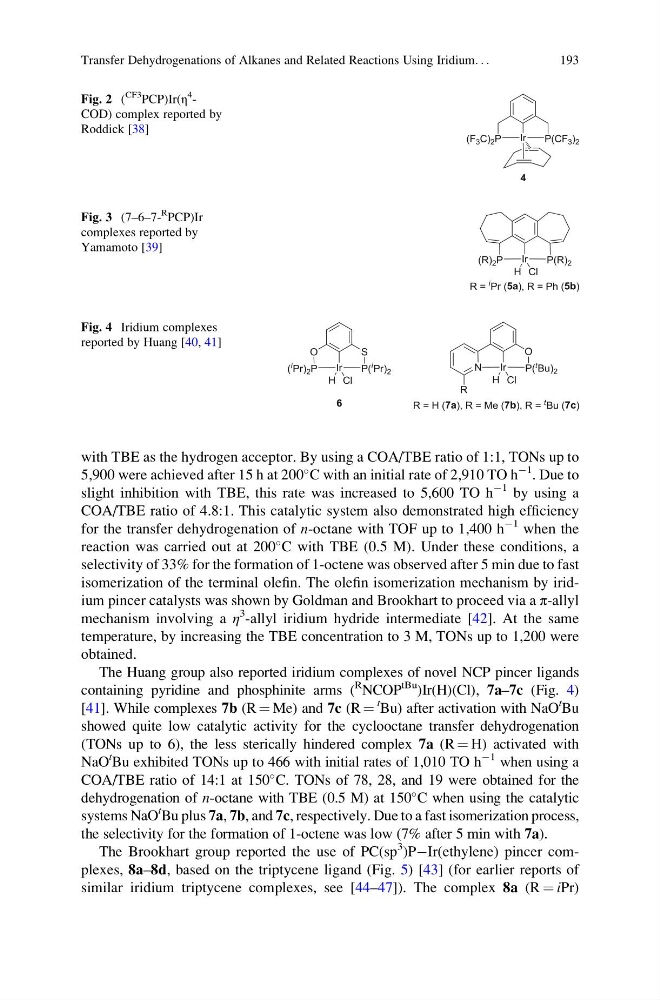
The Huang group also reported iridium complexes of novel NCP pincer ligands
containing pyridine and phosphinite arms (
R
NCOP
tBu
)Ir(H)(Cl), 7a–7c (Fig. 4)
[41]. While complexes 7b (R ¼ Me) and 7c (R ¼
t
Bu) after activation with NaO
t
Bu
showed quite low catalytic activity for the cyclooctane transfer dehydrogenation
(TONs up to 6), the less sterically hindered complex 7a (R ¼ H) activated with
NaO
t
Bu exhibited TONs up to 466 with initial rates of 1,010 TO h
À1 when using a
COA/TBE ratio of 14:1 at 150
C. TONs of 78, 28, and 19 were obtained for the
dehydrogenation of n-octane with TBE (0.5 M) at 150
C when using the catalytic
systems NaO
t
Bu plus 7a, 7b, and 7c, respectively. Due to a fast isomerization process,
the selectivity for the formation of 1-octene was low (7% after 5 min with 7a).
The Brookhart group reported the use of PC(sp
3 )PÀIr(ethylene) pincer complexes, 8a–8d, based on the triptycene ligand (Fig. 5) [43] (for earlier reports of
similar iridium triptycene complexes, see [44–47]). The complex 8a (R ¼ iPr)
Fig. 2 (
CF3
PCP)Ir(η
4
-
COD) complex reported by
Roddick [38]
Fig. 3 (7–6–7R PCP)Ir
complexes reported by
Yamamoto [39]
Fig. 4 Iridium complexes
reported by Huang [40, 41]
Transfer Dehydrogenations of Alkanes and Related Reactions Using Iridium. . .
193
5,900 were achieved after 15 h at 200
C with an initial rate of 2,910 TO h
À1 . Due to
slight inhibition with TBE, this rate was increased to 5,600 TO h
À1 by using a
COA/TBE ratio of 4.8:1. This catalytic system also demonstrated high efficiency
for the transfer dehydrogenation of n-octane with TOF up to 1,400 h
À1 when the
reaction was carried out at 200
C with TBE (0.5 M). Under these conditions, a
selectivity of 33% for the formation of 1-octene was observed after 5 min due to fast
isomerization of the terminal olefin. The olefin isomerization mechanism by iridium pincer catalysts was shown by Goldman and Brookhart to proceed via a π-allyl
mechanism involving a η
3 -allyl iridium hydride intermediate [42]. At the same
temperature, by increasing the TBE concentration to 3 M, TONs up to 1,200 were
obtained.
The Huang group also reported iridium complexes of novel NCP pincer ligands
containing pyridine and phosphinite arms (
R
NCOP
tBu
)Ir(H)(Cl), 7a–7c (Fig. 4)
[41]. While complexes 7b (R ¼ Me) and 7c (R ¼
t
Bu) after activation with NaO
t
Bu
showed quite low catalytic activity for the cyclooctane transfer dehydrogenation
(TONs up to 6), the less sterically hindered complex 7a (R ¼ H) activated with
NaO
t
Bu exhibited TONs up to 466 with initial rates of 1,010 TO h
À1 when using a
COA/TBE ratio of 14:1 at 150
C. TONs of 78, 28, and 19 were obtained for the
dehydrogenation of n-octane with TBE (0.5 M) at 150
C when using the catalytic
systems NaO
t
Bu plus 7a, 7b, and 7c, respectively. Due to a fast isomerization process,
the selectivity for the formation of 1-octene was low (7% after 5 min with 7a).
The Brookhart group reported the use of PC(sp
3 )PÀIr(ethylene) pincer complexes, 8a–8d, based on the triptycene ligand (Fig. 5) [43] (for earlier reports of
similar iridium triptycene complexes, see [44–47]). The complex 8a (R ¼ iPr)
Fig. 2 (
CF3
PCP)Ir(η
4
-
COD) complex reported by
Roddick [38]
Fig. 3 (7–6–7R PCP)Ir
complexes reported by
Yamamoto [39]
Fig. 4 Iridium complexes
reported by Huang [40, 41]
Transfer Dehydrogenations of Alkanes and Related Reactions Using Iridium. . .
193