

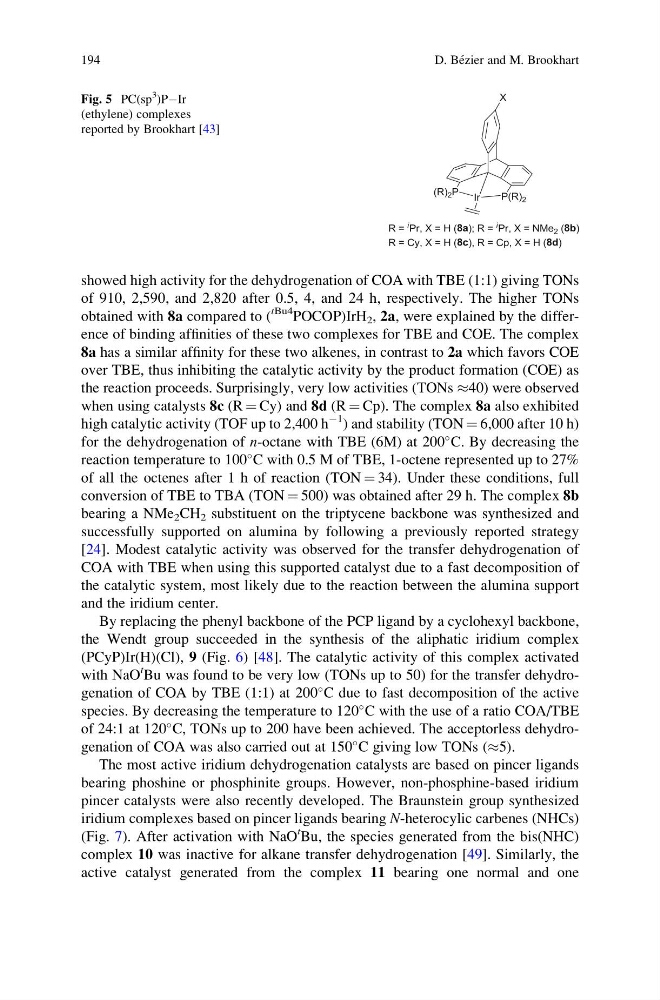
showed high activity for the dehydrogenation of COA with TBE (1:1) giving TONs
of 910, 2,590, and 2,820 after 0.5, 4, and 24 h, respectively. The higher TONs
obtained with 8a compared to (
tBu4 POCOP)IrH 2 , 2a, were explained by the difference of binding affinities of these two complexes for TBE and COE. The complex
8a has a similar affinity for these two alkenes, in contrast to 2a which favors COE
over TBE, thus inhibiting the catalytic activity by the product formation (COE) as
the reaction proceeds. Surprisingly, very low activities (TONs %40) were observed
when using catalysts 8c (R ¼ Cy) and 8d (R ¼ Cp). The complex 8a also exhibited
high catalytic activity (TOF up to 2,400 h
À1 ) and stability (TON ¼ 6,000 after 10 h)
for the dehydrogenation of n-octane with TBE (6M) at 200
C. By decreasing the
reaction temperature to 100
C with 0.5 M of TBE, 1-octene represented up to 27%
of all the octenes after 1 h of reaction (TON ¼ 34). Under these conditions, full
conversion of TBE to TBA (TON ¼ 500) was obtained after 29 h. The complex 8b
bearing a NMe 2 CH 2 substituent on the triptycene backbone was synthesized and
successfully supported on alumina by following a previously reported strategy
[24]. Modest catalytic activity was observed for the transfer dehydrogenation of
COA with TBE when using this supported catalyst due to a fast decomposition of
the catalytic system, most likely due to the reaction between the alumina support
and the iridium center.
By replacing the phenyl backbone of the PCP ligand by a cyclohexyl backbone,
the Wendt group succeeded in the synthesis of the aliphatic iridium complex
(PCyP)Ir(H)(Cl), 9 (Fig. 6) [48]. The catalytic activity of this complex activated
with NaO
t
Bu was found to be very low (TONs up to 50) for the transfer dehydrogenation of COA by TBE (1:1) at 200
C due to fast decomposition of the active
species. By decreasing the temperature to 120
C with the use of a ratio COA/TBE
of 24:1 at 120
C, TONs up to 200 have been achieved. The acceptorless dehydrogenation of COA was also carried out at 150
C giving low TONs (%5).
The most active iridium dehydrogenation catalysts are based on pincer ligands
bearing phoshine or phosphinite groups. However, non-phosphine-based iridium
pincer catalysts were also recently developed. The Braunstein group synthesized
iridium complexes based on pincer ligands bearing N-heterocylic carbenes (NHCs)
(Fig. 7). After activation with NaO
t
Bu, the species generated from the bis(NHC)
complex 10 was inactive for alkane transfer dehydrogenation [49]. Similarly, the
active catalyst generated from the complex 11 bearing one normal and one
Fig. 5 PC(sp
3
)PÀIr
(ethylene) complexes
reported by Brookhart [43]
194
D. Be ´zier and M. Brookhart
of 910, 2,590, and 2,820 after 0.5, 4, and 24 h, respectively. The higher TONs
obtained with 8a compared to (
tBu4 POCOP)IrH 2 , 2a, were explained by the difference of binding affinities of these two complexes for TBE and COE. The complex
8a has a similar affinity for these two alkenes, in contrast to 2a which favors COE
over TBE, thus inhibiting the catalytic activity by the product formation (COE) as
the reaction proceeds. Surprisingly, very low activities (TONs %40) were observed
when using catalysts 8c (R ¼ Cy) and 8d (R ¼ Cp). The complex 8a also exhibited
high catalytic activity (TOF up to 2,400 h
À1 ) and stability (TON ¼ 6,000 after 10 h)
for the dehydrogenation of n-octane with TBE (6M) at 200
C. By decreasing the
reaction temperature to 100
C with 0.5 M of TBE, 1-octene represented up to 27%
of all the octenes after 1 h of reaction (TON ¼ 34). Under these conditions, full
conversion of TBE to TBA (TON ¼ 500) was obtained after 29 h. The complex 8b
bearing a NMe 2 CH 2 substituent on the triptycene backbone was synthesized and
successfully supported on alumina by following a previously reported strategy
[24]. Modest catalytic activity was observed for the transfer dehydrogenation of
COA with TBE when using this supported catalyst due to a fast decomposition of
the catalytic system, most likely due to the reaction between the alumina support
and the iridium center.
By replacing the phenyl backbone of the PCP ligand by a cyclohexyl backbone,
the Wendt group succeeded in the synthesis of the aliphatic iridium complex
(PCyP)Ir(H)(Cl), 9 (Fig. 6) [48]. The catalytic activity of this complex activated
with NaO
t
Bu was found to be very low (TONs up to 50) for the transfer dehydrogenation of COA by TBE (1:1) at 200
C due to fast decomposition of the active
species. By decreasing the temperature to 120
C with the use of a ratio COA/TBE
of 24:1 at 120
C, TONs up to 200 have been achieved. The acceptorless dehydrogenation of COA was also carried out at 150
C giving low TONs (%5).
The most active iridium dehydrogenation catalysts are based on pincer ligands
bearing phoshine or phosphinite groups. However, non-phosphine-based iridium
pincer catalysts were also recently developed. The Braunstein group synthesized
iridium complexes based on pincer ligands bearing N-heterocylic carbenes (NHCs)
(Fig. 7). After activation with NaO
t
Bu, the species generated from the bis(NHC)
complex 10 was inactive for alkane transfer dehydrogenation [49]. Similarly, the
active catalyst generated from the complex 11 bearing one normal and one
Fig. 5 PC(sp
3
)PÀIr
(ethylene) complexes
reported by Brookhart [43]
194
D. Be ´zier and M. Brookhart