

ð2Þ
Crabtree started his investigations by using the cationic Ir(III) complex
IrH 2 (acetone) 2 (PPh 3 ) 2
+ followed by neutral Ir(III) carboxylates (PR 3 ) 2 IrH 2 (η
2 -
O 2 CCF 3 ) (R ¼ cyclohexyl, p-C 6 H 5 ) as catalysts for thermal and photochemical
dehydrogenations [5–7]. As with the case for Felkin’s polyhydride studies, turnover
numbers were generally low, but driving the reaction with light allowed
acceptorless dehydrogenation of cyclooctane to be achieved [8]. In related studies,
the groups of Saito [9], Tanaka [10], and Goldman [11] independently showed that
photolysis of Rh(Cl)(CO)(PMe 3 ) 2 in linear and cyclic alkanes resulted in conversion to alkenes with high turnover numbers. Goldman showed a related system, Rh
(Cl)(L)(PMe 3 ) 2 (L ¼ PCy 3 or P(
i
Pr) 3 ), as well as the dimer, [ClRh(PMe 3 ) 2 ] 2 , could
be activated with H 2 in the presence of an acceptor to generate the active species Rh
(Cl)(PMe 3 ) 2 which could achieve rapid transfer dehydrogenation [12–15]. A drawback of the system is that under H 2 , alkene hydrogenation competes with alkane
dehydrogenation. A thorough mechanistic study was reported.
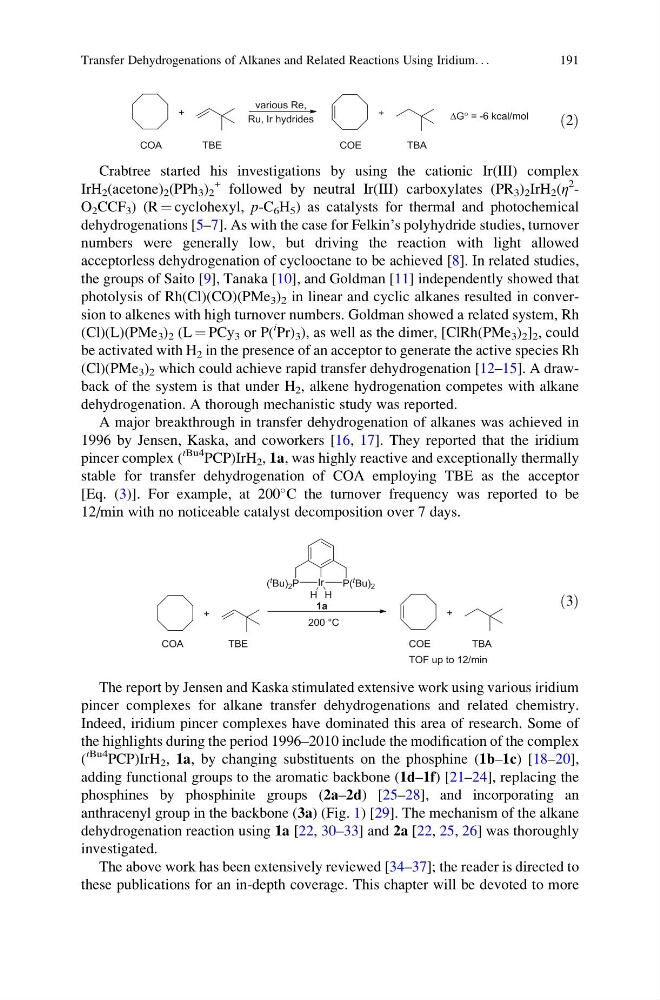
A major breakthrough in transfer dehydrogenation of alkanes was achieved in
1996 by Jensen, Kaska, and coworkers [16, 17]. They reported that the iridium
pincer complex (
tBu4 PCP)IrH 2 , 1a, was highly reactive and exceptionally thermally
stable for transfer dehydrogenation of COA employing TBE as the acceptor
[Eq. (3)]. For example, at 200
C the turnover frequency was reported to be
12/min with no noticeable catalyst decomposition over 7 days.
ð3Þ
The report by Jensen and Kaska stimulated extensive work using various iridium
pincer complexes for alkane transfer dehydrogenations and related chemistry.
Indeed, iridium pincer complexes have dominated this area of research. Some of
the highlights during the period 1996–2010 include the modification of the complex
(
tBu4 PCP)IrH 2 , 1a, by changing substituents on the phosphine (1b–1c) [18–20],
adding functional groups to the aromatic backbone (1d–1f) [21–24], replacing the
phosphines by phosphinite groups (2a–2d) [25–28], and incorporating an
anthracenyl group in the backbone (3a) (Fig. 1) [29]. The mechanism of the alkane
dehydrogenation reaction using 1a [22, 30–33] and 2a [22, 25, 26] was thoroughly
investigated.
The above work has been extensively reviewed [34–37]; the reader is directed to
these publications for an in-depth coverage. This chapter will be devoted to more
Transfer Dehydrogenations of Alkanes and Related Reactions Using Iridium. . .
191
Crabtree started his investigations by using the cationic Ir(III) complex
IrH 2 (acetone) 2 (PPh 3 ) 2
+ followed by neutral Ir(III) carboxylates (PR 3 ) 2 IrH 2 (η
2 -
O 2 CCF 3 ) (R ¼ cyclohexyl, p-C 6 H 5 ) as catalysts for thermal and photochemical
dehydrogenations [5–7]. As with the case for Felkin’s polyhydride studies, turnover
numbers were generally low, but driving the reaction with light allowed
acceptorless dehydrogenation of cyclooctane to be achieved [8]. In related studies,
the groups of Saito [9], Tanaka [10], and Goldman [11] independently showed that
photolysis of Rh(Cl)(CO)(PMe 3 ) 2 in linear and cyclic alkanes resulted in conversion to alkenes with high turnover numbers. Goldman showed a related system, Rh
(Cl)(L)(PMe 3 ) 2 (L ¼ PCy 3 or P(
i
Pr) 3 ), as well as the dimer, [ClRh(PMe 3 ) 2 ] 2 , could
be activated with H 2 in the presence of an acceptor to generate the active species Rh
(Cl)(PMe 3 ) 2 which could achieve rapid transfer dehydrogenation [12–15]. A drawback of the system is that under H 2 , alkene hydrogenation competes with alkane
dehydrogenation. A thorough mechanistic study was reported.
A major breakthrough in transfer dehydrogenation of alkanes was achieved in
1996 by Jensen, Kaska, and coworkers [16, 17]. They reported that the iridium
pincer complex (
tBu4 PCP)IrH 2 , 1a, was highly reactive and exceptionally thermally
stable for transfer dehydrogenation of COA employing TBE as the acceptor
[Eq. (3)]. For example, at 200
C the turnover frequency was reported to be
12/min with no noticeable catalyst decomposition over 7 days.
ð3Þ
The report by Jensen and Kaska stimulated extensive work using various iridium
pincer complexes for alkane transfer dehydrogenations and related chemistry.
Indeed, iridium pincer complexes have dominated this area of research. Some of
the highlights during the period 1996–2010 include the modification of the complex
(
tBu4 PCP)IrH 2 , 1a, by changing substituents on the phosphine (1b–1c) [18–20],
adding functional groups to the aromatic backbone (1d–1f) [21–24], replacing the
phosphines by phosphinite groups (2a–2d) [25–28], and incorporating an
anthracenyl group in the backbone (3a) (Fig. 1) [29]. The mechanism of the alkane
dehydrogenation reaction using 1a [22, 30–33] and 2a [22, 25, 26] was thoroughly
investigated.
The above work has been extensively reviewed [34–37]; the reader is directed to
these publications for an in-depth coverage. This chapter will be devoted to more
Transfer Dehydrogenations of Alkanes and Related Reactions Using Iridium. . .
191