

1 Introduction
Alkanes are the primary feedstock from which the majority of the world’s
chemicals are derived. They are the primary constituents of petroleum and natural
gas and the associated low boiling components of natural gas. Coal, natural gas, and
biomass are also sources of alkanes produced via gasification of these materials to
syngas (CO/H 2 ) followed by Fischer–Tropsch catalysis resulting in a stochastic
distribution of linear hydrocarbons.
Alkenes as well as aromatics are derived from alkanes through dehydrogenation.
Alkenes and aromatics are highly versatile intermediates which can be converted to
a wide array of value-added chemicals and materials including detergents, pharmaceutical intermediates, and polymers. Alkenes are primarily produced via
“cracking” alkanes over heterogeneous dehydrogenation catalysts at very high
temperatures (500–900
C) [1]. Such “acceptorless” dehydrogenations are endothermic (ca. 28–30 kcal/mol), but the large positive entropy gained from loss of H 2
renders these processes exergonic at such high temperatures. Additionally, aromatics are also made by heterogeneous dehydrogenations of various hydrocarbon
feedstocks. Such high-temperature processes often result in low selectivities and
generation of by-products.
There has been growing interest in homogeneous alkane dehydrogenations due
to the possibility of obtaining higher selectivities and the prospects for production
of functionalized alkenes via dehydrogenation of functionalized alkanes. Homogeneous dehydrogenations are normally carried out at much lower temperatures
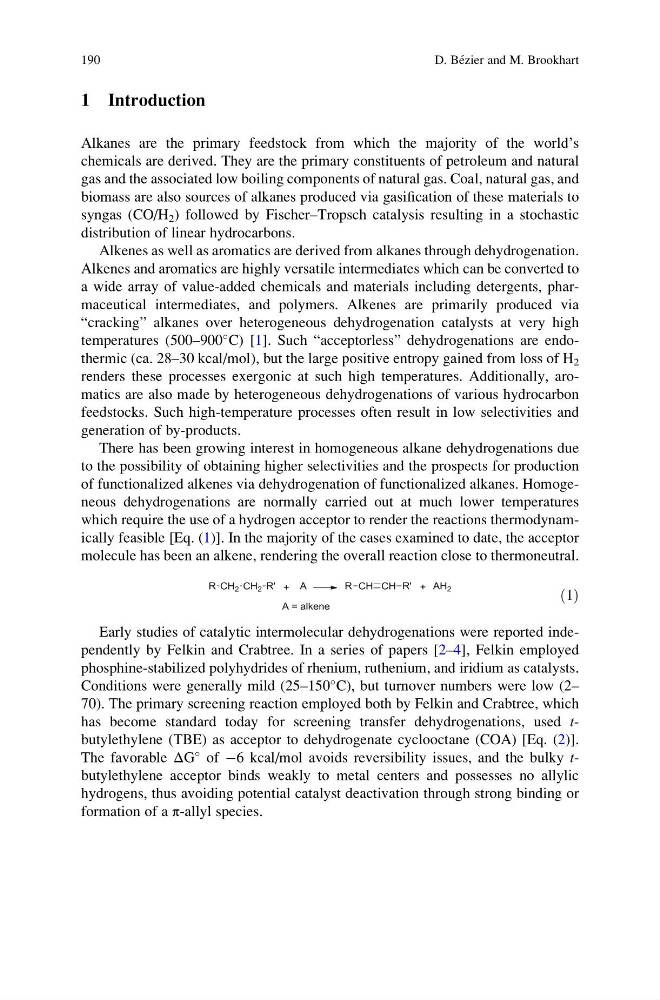
which require the use of a hydrogen acceptor to render the reactions thermodynamically feasible [Eq. (1)]. In the majority of the cases examined to date, the acceptor
molecule has been an alkene, rendering the overall reaction close to thermoneutral.
ð1Þ
Early studies of catalytic intermolecular dehydrogenations were reported independently by Felkin and Crabtree. In a series of papers [2–4], Felkin employed
phosphine-stabilized polyhydrides of rhenium, ruthenium, and iridium as catalysts.
Conditions were generally mild (25–150
C), but turnover numbers were low (2–
70). The primary screening reaction employed both by Felkin and Crabtree, which
has become standard today for screening transfer dehydrogenations, used tbutylethylene (TBE) as acceptor to dehydrogenate cyclooctane (COA) [Eq. (2)].
The favorable ΔG
of À6 kcal/mol avoids reversibility issues, and the bulky tbutylethylene acceptor binds weakly to metal centers and possesses no allylic
hydrogens, thus avoiding potential catalyst deactivation through strong binding or
formation of a π-allyl species.
190
D. Be ´zier and M. Brookhart
Alkanes are the primary feedstock from which the majority of the world’s
chemicals are derived. They are the primary constituents of petroleum and natural
gas and the associated low boiling components of natural gas. Coal, natural gas, and
biomass are also sources of alkanes produced via gasification of these materials to
syngas (CO/H 2 ) followed by Fischer–Tropsch catalysis resulting in a stochastic
distribution of linear hydrocarbons.
Alkenes as well as aromatics are derived from alkanes through dehydrogenation.
Alkenes and aromatics are highly versatile intermediates which can be converted to
a wide array of value-added chemicals and materials including detergents, pharmaceutical intermediates, and polymers. Alkenes are primarily produced via
“cracking” alkanes over heterogeneous dehydrogenation catalysts at very high
temperatures (500–900
C) [1]. Such “acceptorless” dehydrogenations are endothermic (ca. 28–30 kcal/mol), but the large positive entropy gained from loss of H 2
renders these processes exergonic at such high temperatures. Additionally, aromatics are also made by heterogeneous dehydrogenations of various hydrocarbon
feedstocks. Such high-temperature processes often result in low selectivities and
generation of by-products.
There has been growing interest in homogeneous alkane dehydrogenations due
to the possibility of obtaining higher selectivities and the prospects for production
of functionalized alkenes via dehydrogenation of functionalized alkanes. Homogeneous dehydrogenations are normally carried out at much lower temperatures
which require the use of a hydrogen acceptor to render the reactions thermodynamically feasible [Eq. (1)]. In the majority of the cases examined to date, the acceptor
molecule has been an alkene, rendering the overall reaction close to thermoneutral.
ð1Þ
Early studies of catalytic intermolecular dehydrogenations were reported independently by Felkin and Crabtree. In a series of papers [2–4], Felkin employed
phosphine-stabilized polyhydrides of rhenium, ruthenium, and iridium as catalysts.
Conditions were generally mild (25–150
C), but turnover numbers were low (2–
70). The primary screening reaction employed both by Felkin and Crabtree, which
has become standard today for screening transfer dehydrogenations, used tbutylethylene (TBE) as acceptor to dehydrogenate cyclooctane (COA) [Eq. (2)].
The favorable ΔG
of À6 kcal/mol avoids reversibility issues, and the bulky tbutylethylene acceptor binds weakly to metal centers and possesses no allylic
hydrogens, thus avoiding potential catalyst deactivation through strong binding or
formation of a π-allyl species.
190
D. Be ´zier and M. Brookhart