

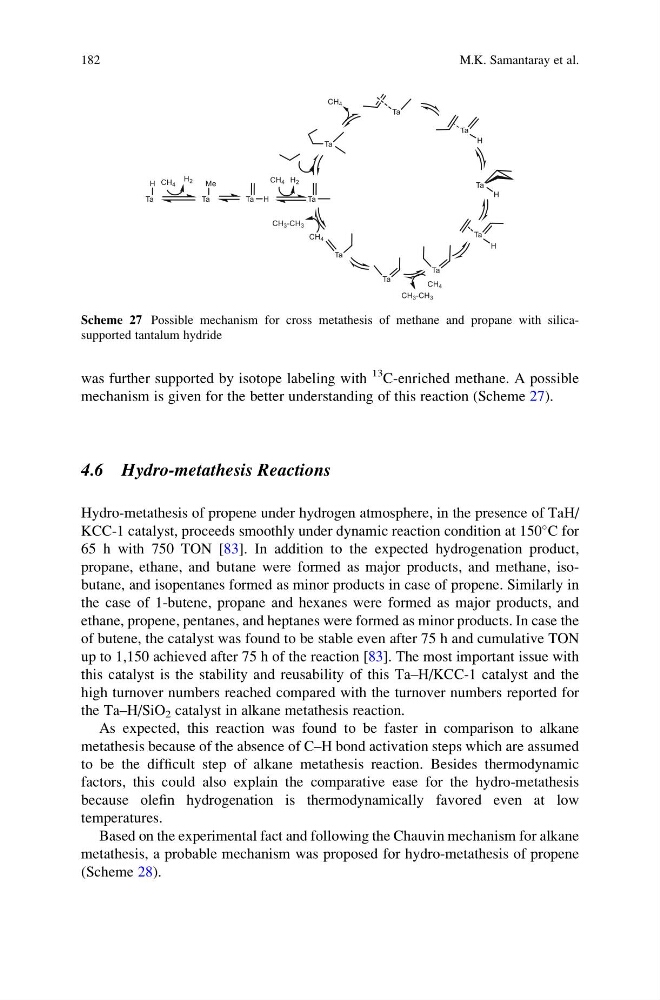
was further supported by isotope labeling with
13 C-enriched methane. A possible
mechanism is given for the better understanding of this reaction (Scheme 27).
4.6 Hydro-metathesis Reactions
Hydro-metathesis of propene under hydrogen atmosphere, in the presence of TaH/
KCC-1 catalyst, proceeds smoothly under dynamic reaction condition at 150
C for
65 h with 750 TON [83]. In addition to the expected hydrogenation product,
propane, ethane, and butane were formed as major products, and methane, isobutane, and isopentanes formed as minor products in case of propene. Similarly in
the case of 1-butene, propane and hexanes were formed as major products, and
ethane, propene, pentanes, and heptanes were formed as minor products. In case the
of butene, the catalyst was found to be stable even after 75 h and cumulative TON
up to 1,150 achieved after 75 h of the reaction [83]. The most important issue with
this catalyst is the stability and reusability of this Ta–H/KCC-1 catalyst and the
high turnover numbers reached compared with the turnover numbers reported for
the Ta–H/SiO 2 catalyst in alkane metathesis reaction.
As expected, this reaction was found to be faster in comparison to alkane
metathesis because of the absence of C–H bond activation steps which are assumed
to be the difficult step of alkane metathesis reaction. Besides thermodynamic
factors, this could also explain the comparative ease for the hydro-metathesis
because olefin hydrogenation is thermodynamically favored even at low
temperatures.
Based on the experimental fact and following the Chauvin mechanism for alkane
metathesis, a probable mechanism was proposed for hydro-metathesis of propene
(Scheme 28).
Scheme 27 Possible mechanism for cross metathesis of methane and propane with silicasupported tantalum hydride
182
M.K. Samantaray et al.
13 C-enriched methane. A possible
mechanism is given for the better understanding of this reaction (Scheme 27).
4.6 Hydro-metathesis Reactions
Hydro-metathesis of propene under hydrogen atmosphere, in the presence of TaH/
KCC-1 catalyst, proceeds smoothly under dynamic reaction condition at 150
C for
65 h with 750 TON [83]. In addition to the expected hydrogenation product,
propane, ethane, and butane were formed as major products, and methane, isobutane, and isopentanes formed as minor products in case of propene. Similarly in
the case of 1-butene, propane and hexanes were formed as major products, and
ethane, propene, pentanes, and heptanes were formed as minor products. In case the
of butene, the catalyst was found to be stable even after 75 h and cumulative TON
up to 1,150 achieved after 75 h of the reaction [83]. The most important issue with
this catalyst is the stability and reusability of this Ta–H/KCC-1 catalyst and the
high turnover numbers reached compared with the turnover numbers reported for
the Ta–H/SiO 2 catalyst in alkane metathesis reaction.
As expected, this reaction was found to be faster in comparison to alkane
metathesis because of the absence of C–H bond activation steps which are assumed
to be the difficult step of alkane metathesis reaction. Besides thermodynamic
factors, this could also explain the comparative ease for the hydro-metathesis
because olefin hydrogenation is thermodynamically favored even at low
temperatures.
Based on the experimental fact and following the Chauvin mechanism for alkane
metathesis, a probable mechanism was proposed for hydro-metathesis of propene
(Scheme 28).
Scheme 27 Possible mechanism for cross metathesis of methane and propane with silicasupported tantalum hydride
182
M.K. Samantaray et al.