

5 Conclusions
The rules of molecular organometallic chemistry apply when reacting organometallics with surfaces of oxides. A new field has emerged in catalysis
called SOMC.
The reasons why the surface organometallic compounds of group IV and V
exhibit a high reactivity toward C–H and C–C bonds of alkane are likely multiple:
1. They are highly electron deficient (between eight and 12 electrons in the
Green formalism).
2. It was already known in organometallic chemistry that the transition metals of
group IV and V can activate C–H bonds of alkanes by sigma bond metathesis,
but the number of catalytic examples (see, e.g., the early works of P. Watson
H/D exchange and CH 4 /CD 4 exchange) [84] was not so high because in solution,
the complexes may lose activity by dimerization or any other type of bimolecular interactions. In contrast, isolation on a support of a highly electrondeficient complex prevents any sort of bimolecular deactivation. This is a
well-known concept, but it deserves to be repeated.
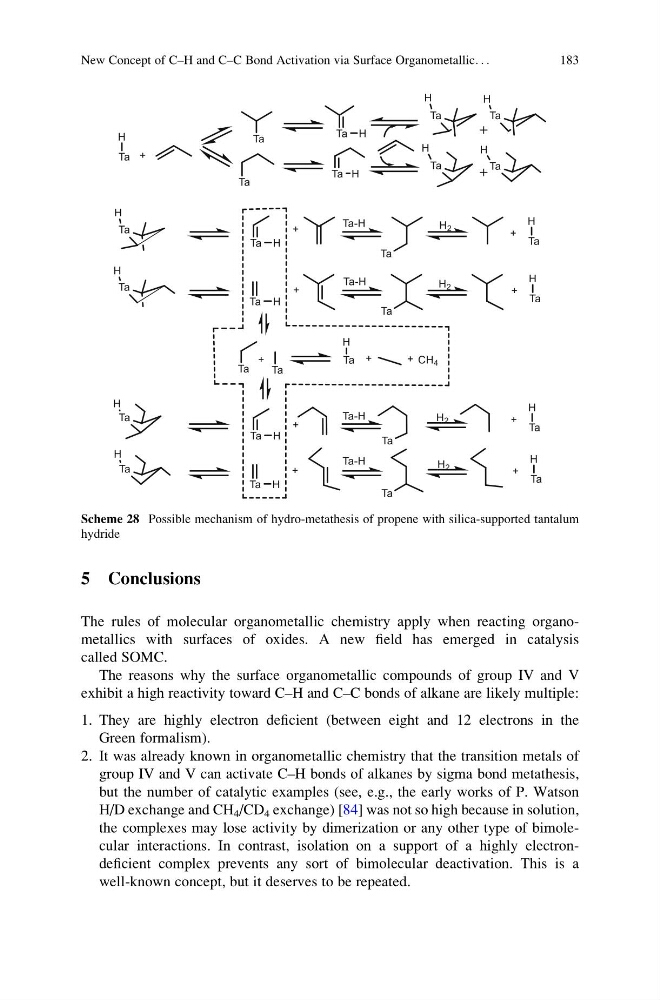
Scheme 28 Possible mechanism of hydro-metathesis of propene with silica-supported tantalum
hydride
New Concept of C–H and C–C Bond Activation via Surface Organometallic. . .
183
The rules of molecular organometallic chemistry apply when reacting organometallics with surfaces of oxides. A new field has emerged in catalysis
called SOMC.
The reasons why the surface organometallic compounds of group IV and V
exhibit a high reactivity toward C–H and C–C bonds of alkane are likely multiple:
1. They are highly electron deficient (between eight and 12 electrons in the
Green formalism).
2. It was already known in organometallic chemistry that the transition metals of
group IV and V can activate C–H bonds of alkanes by sigma bond metathesis,
but the number of catalytic examples (see, e.g., the early works of P. Watson
H/D exchange and CH 4 /CD 4 exchange) [84] was not so high because in solution,
the complexes may lose activity by dimerization or any other type of bimolecular interactions. In contrast, isolation on a support of a highly electrondeficient complex prevents any sort of bimolecular deactivation. This is a
well-known concept, but it deserves to be repeated.
Scheme 28 Possible mechanism of hydro-metathesis of propene with silica-supported tantalum
hydride
New Concept of C–H and C–C Bond Activation via Surface Organometallic. . .
183