

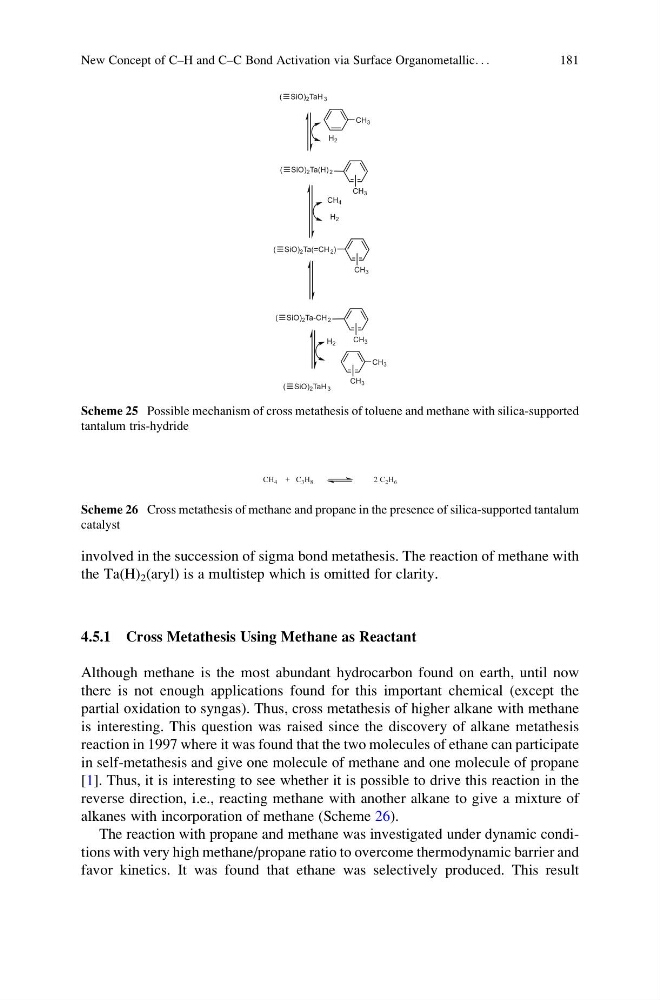
involved in the succession of sigma bond metathesis. The reaction of methane with
the Ta(H) 2 (aryl) is a multistep which is omitted for clarity.
4.5.1 Cross Metathesis Using Methane as Reactant
Although methane is the most abundant hydrocarbon found on earth, until now
there is not enough applications found for this important chemical (except the
partial oxidation to syngas). Thus, cross metathesis of higher alkane with methane
is interesting. This question was raised since the discovery of alkane metathesis
reaction in 1997 where it was found that the two molecules of ethane can participate
in self-metathesis and give one molecule of methane and one molecule of propane
[1]. Thus, it is interesting to see whether it is possible to drive this reaction in the
reverse direction, i.e., reacting methane with another alkane to give a mixture of
alkanes with incorporation of methane (Scheme 26).
The reaction with propane and methane was investigated under dynamic conditions with very high methane/propane ratio to overcome thermodynamic barrier and
favor kinetics. It was found that ethane was selectively produced. This result
Scheme 25 Possible mechanism of cross metathesis of toluene and methane with silica-supported
tantalum tris-hydride
Scheme 26 Cross metathesis of methane and propane in the presence of silica-supported tantalum
catalyst
New Concept of C–H and C–C Bond Activation via Surface Organometallic. . .
181
the Ta(H) 2 (aryl) is a multistep which is omitted for clarity.
4.5.1 Cross Metathesis Using Methane as Reactant
Although methane is the most abundant hydrocarbon found on earth, until now
there is not enough applications found for this important chemical (except the
partial oxidation to syngas). Thus, cross metathesis of higher alkane with methane
is interesting. This question was raised since the discovery of alkane metathesis
reaction in 1997 where it was found that the two molecules of ethane can participate
in self-metathesis and give one molecule of methane and one molecule of propane
[1]. Thus, it is interesting to see whether it is possible to drive this reaction in the
reverse direction, i.e., reacting methane with another alkane to give a mixture of
alkanes with incorporation of methane (Scheme 26).
The reaction with propane and methane was investigated under dynamic conditions with very high methane/propane ratio to overcome thermodynamic barrier and
favor kinetics. It was found that ethane was selectively produced. This result
Scheme 25 Possible mechanism of cross metathesis of toluene and methane with silica-supported
tantalum tris-hydride
Scheme 26 Cross metathesis of methane and propane in the presence of silica-supported tantalum
catalyst
New Concept of C–H and C–C Bond Activation via Surface Organometallic. . .
181