

Subsequently, the alkanes are liberated via a known process of hydrogenation and
hydrogenolysis [67] or possibly via σ-bond metathesis [68].
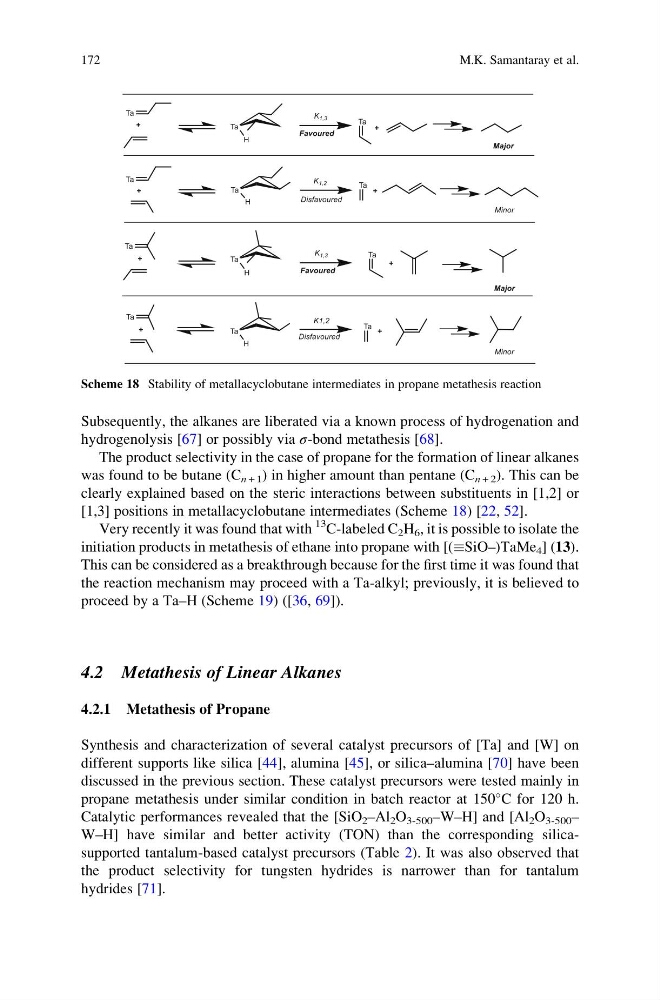
The product selectivity in the case of propane for the formation of linear alkanes
was found to be butane (C n + 1 ) in higher amount than pentane (C n + 2 ). This can be
clearly explained based on the steric interactions between substituents in [1,2] or
[1,3] positions in metallacyclobutane intermediates (Scheme 18) [22, 52].
Very recently it was found that with
13 C-labeled C 2 H 6 , it is possible to isolate the
initiation products in metathesis of ethane into propane with [(SiO–)TaMe 4 ] (13).
This can be considered as a breakthrough because for the first time it was found that
the reaction mechanism may proceed with a Ta-alkyl; previously, it is believed to
proceed by a Ta–H (Scheme 19) ([36, 69]).
4.2 Metathesis of Linear Alkanes
4.2.1 Metathesis of Propane
Synthesis and characterization of several catalyst precursors of [Ta] and [W] on
different supports like silica [44], alumina [45], or silica–alumina [70] have been
discussed in the previous section. These catalyst precursors were tested mainly in
propane metathesis under similar condition in batch reactor at 150
C for 120 h.
Catalytic performances revealed that the [SiO 2 –Al 2 O 3-500 –W–H] and [Al 2 O 3-500 –
W–H] have similar and better activity (TON) than the corresponding silicasupported tantalum-based catalyst precursors (Table 2). It was also observed that
the product selectivity for tungsten hydrides is narrower than for tantalum
hydrides [71].
Scheme 18 Stability of metallacyclobutane intermediates in propane metathesis reaction
172
M.K. Samantaray et al.
hydrogenolysis [67] or possibly via σ-bond metathesis [68].
The product selectivity in the case of propane for the formation of linear alkanes
was found to be butane (C n + 1 ) in higher amount than pentane (C n + 2 ). This can be
clearly explained based on the steric interactions between substituents in [1,2] or
[1,3] positions in metallacyclobutane intermediates (Scheme 18) [22, 52].
Very recently it was found that with
13 C-labeled C 2 H 6 , it is possible to isolate the
initiation products in metathesis of ethane into propane with [(SiO–)TaMe 4 ] (13).
This can be considered as a breakthrough because for the first time it was found that
the reaction mechanism may proceed with a Ta-alkyl; previously, it is believed to
proceed by a Ta–H (Scheme 19) ([36, 69]).
4.2 Metathesis of Linear Alkanes
4.2.1 Metathesis of Propane
Synthesis and characterization of several catalyst precursors of [Ta] and [W] on
different supports like silica [44], alumina [45], or silica–alumina [70] have been
discussed in the previous section. These catalyst precursors were tested mainly in
propane metathesis under similar condition in batch reactor at 150
C for 120 h.
Catalytic performances revealed that the [SiO 2 –Al 2 O 3-500 –W–H] and [Al 2 O 3-500 –
W–H] have similar and better activity (TON) than the corresponding silicasupported tantalum-based catalyst precursors (Table 2). It was also observed that
the product selectivity for tungsten hydrides is narrower than for tantalum
hydrides [71].
Scheme 18 Stability of metallacyclobutane intermediates in propane metathesis reaction
172
M.K. Samantaray et al.