

Presently, one can summarize as follows the various observations that we made
on the mechanism of alkane metathesis:
As already mentioned, it was observed that one mole of hydrogen is liberated
when methane is reacted with the tantalum hydride with the formation of tantalum
methyl. The reaction with methane above 150
C leads to the formation of the
Ta-methyl, Ta-methylene, and Ta-methylidyne species plus H 2 (M ¼ Ta) [40–42,
54]. These observations are a proof that the first step of alkane metathesis is the
formation of metal alkyl intermediate via cleavage of the C–H bond of the alkane
likely by sigma bond metathesis. Further, detailed mechanistic [22, 55] and experimental kinetic studies revealed that the alkenes and hydrogen are the primary
products [56]. Initially, it was believed that the active site was a bis-siloxy tantalum-monohydride, but progressively, evidence came in favor of an equilibrium
between bis-siloxy tantalum-monohydride d
2 and bis-siloxy-tantalum-tris-hydride
d
0 [57], and the mechanism would fit much better with a bis-siloxy-tantalum-trishydride [58].
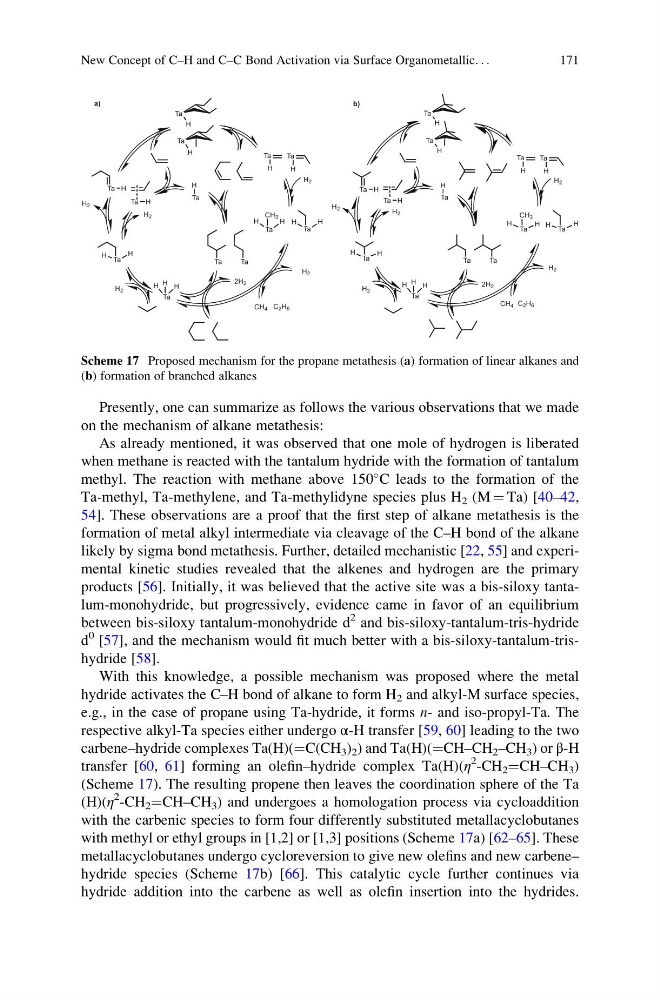
With this knowledge, a possible mechanism was proposed where the metal
hydride activates the C–H bond of alkane to form H 2 and alkyl-M surface species,
e.g., in the case of propane using Ta-hydride, it forms n- and iso-propyl-Ta. The
respective alkyl-Ta species either undergo α-H transfer [59, 60] leading to the two
carbene–hydride complexes Ta(H)(¼C(CH 3 ) 2 ) and Ta(H)(¼CH–CH 2 –CH 3 ) or β-H
transfer [60, 61] forming an olefin–hydride complex Ta(H)(η
2 -CH 2 ¼CH–CH 3 )
(Scheme 17). The resulting propene then leaves the coordination sphere of the Ta
(H)(η
2 -CH 2 ¼CH–CH 3 ) and undergoes a homologation process via cycloaddition
with the carbenic species to form four differently substituted metallacyclobutanes
with methyl or ethyl groups in [1,2] or [1,3] positions (Scheme 17a) [62–65]. These
metallacyclobutanes undergo cycloreversion to give new olefins and new carbene–
hydride species (Scheme 17b) [66]. This catalytic cycle further continues via
hydride addition into the carbene as well as olefin insertion into the hydrides.
Scheme 17 Proposed mechanism for the propane metathesis (a) formation of linear alkanes and
(b) formation of branched alkanes
New Concept of C–H and C–C Bond Activation via Surface Organometallic. . .
171
on the mechanism of alkane metathesis:
As already mentioned, it was observed that one mole of hydrogen is liberated
when methane is reacted with the tantalum hydride with the formation of tantalum
methyl. The reaction with methane above 150
C leads to the formation of the
Ta-methyl, Ta-methylene, and Ta-methylidyne species plus H 2 (M ¼ Ta) [40–42,
54]. These observations are a proof that the first step of alkane metathesis is the
formation of metal alkyl intermediate via cleavage of the C–H bond of the alkane
likely by sigma bond metathesis. Further, detailed mechanistic [22, 55] and experimental kinetic studies revealed that the alkenes and hydrogen are the primary
products [56]. Initially, it was believed that the active site was a bis-siloxy tantalum-monohydride, but progressively, evidence came in favor of an equilibrium
between bis-siloxy tantalum-monohydride d
2 and bis-siloxy-tantalum-tris-hydride
d
0 [57], and the mechanism would fit much better with a bis-siloxy-tantalum-trishydride [58].
With this knowledge, a possible mechanism was proposed where the metal
hydride activates the C–H bond of alkane to form H 2 and alkyl-M surface species,
e.g., in the case of propane using Ta-hydride, it forms n- and iso-propyl-Ta. The
respective alkyl-Ta species either undergo α-H transfer [59, 60] leading to the two
carbene–hydride complexes Ta(H)(¼C(CH 3 ) 2 ) and Ta(H)(¼CH–CH 2 –CH 3 ) or β-H
transfer [60, 61] forming an olefin–hydride complex Ta(H)(η
2 -CH 2 ¼CH–CH 3 )
(Scheme 17). The resulting propene then leaves the coordination sphere of the Ta
(H)(η
2 -CH 2 ¼CH–CH 3 ) and undergoes a homologation process via cycloaddition
with the carbenic species to form four differently substituted metallacyclobutanes
with methyl or ethyl groups in [1,2] or [1,3] positions (Scheme 17a) [62–65]. These
metallacyclobutanes undergo cycloreversion to give new olefins and new carbene–
hydride species (Scheme 17b) [66]. This catalytic cycle further continues via
hydride addition into the carbene as well as olefin insertion into the hydrides.
Scheme 17 Proposed mechanism for the propane metathesis (a) formation of linear alkanes and
(b) formation of branched alkanes
New Concept of C–H and C–C Bond Activation via Surface Organometallic. . .
171