

or hydrides have exhibited very specific properties in catalysis related to alkanes but
also olefins.
4 Metathesis of Alkane
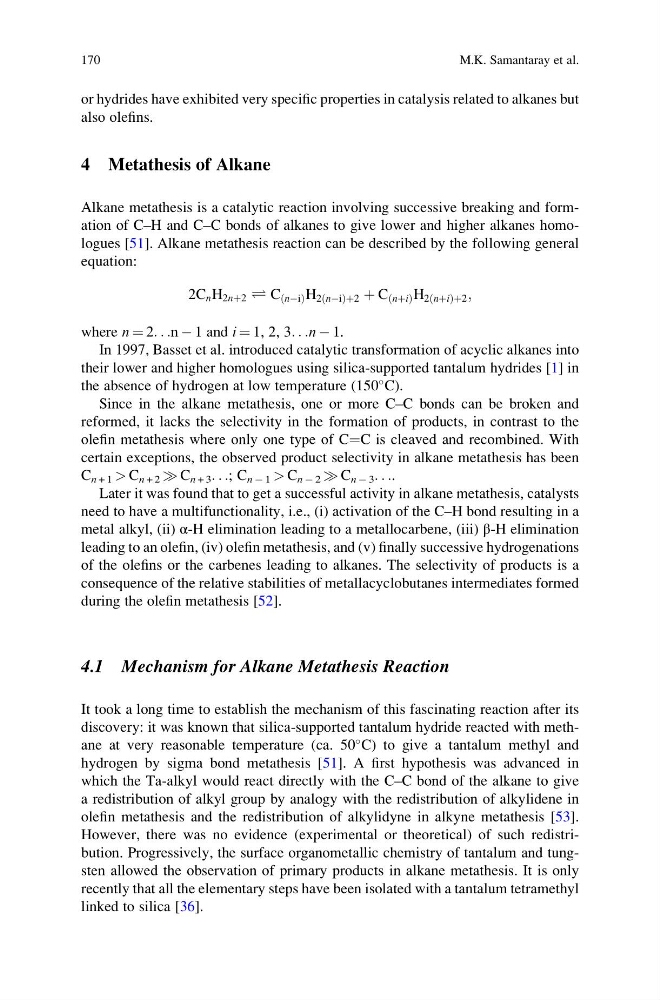
Alkane metathesis is a catalytic reaction involving successive breaking and formation of C–H and C–C bonds of alkanes to give lower and higher alkanes homologues [51]. Alkane metathesis reaction can be described by the following general
equation:
2C n H 2nþ2 Ð C nÀi
ð
Þ H 2 nÀi
ð
Þþ2 þ C nþi
ð
Þ H 2 nþi
ð
Þþ2 ;
where n ¼ 2. . .n À 1 and i ¼ 1, 2, 3. . .n À 1.
In 1997, Basset et al. introduced catalytic transformation of acyclic alkanes into
their lower and higher homologues using silica-supported tantalum hydrides [1] in
the absence of hydrogen at low temperature (150
C).
Since in the alkane metathesis, one or more C–C bonds can be broken and
reformed, it lacks the selectivity in the formation of products, in contrast to the
olefin metathesis where only one type of C¼C is cleaved and recombined. With
certain exceptions, the observed product selectivity in alkane metathesis has been
C n + 1 > C n + 2 ) C n + 3 . . .; C n À 1 > C n À 2 ) C n À 3 . . ..
Later it was found that to get a successful activity in alkane metathesis, catalysts
need to have a multifunctionality, i.e., (i) activation of the C–H bond resulting in a
metal alkyl, (ii) α-H elimination leading to a metallocarbene, (iii) β-H elimination
leading to an olefin, (iv) olefin metathesis, and (v) finally successive hydrogenations
of the olefins or the carbenes leading to alkanes. The selectivity of products is a
consequence of the relative stabilities of metallacyclobutanes intermediates formed
during the olefin metathesis [52].
4.1 Mechanism for Alkane Metathesis Reaction
It took a long time to establish the mechanism of this fascinating reaction after its
discovery: it was known that silica-supported tantalum hydride reacted with methane at very reasonable temperature (ca. 50
C) to give a tantalum methyl and
hydrogen by sigma bond metathesis [51]. A first hypothesis was advanced in
which the Ta-alkyl would react directly with the C–C bond of the alkane to give
a redistribution of alkyl group by analogy with the redistribution of alkylidene in
olefin metathesis and the redistribution of alkylidyne in alkyne metathesis [53].
However, there was no evidence (experimental or theoretical) of such redistribution. Progressively, the surface organometallic chemistry of tantalum and tungsten allowed the observation of primary products in alkane metathesis. It is only
recently that all the elementary steps have been isolated with a tantalum tetramethyl
linked to silica [36].
170
M.K. Samantaray et al.
also olefins.
4 Metathesis of Alkane
Alkane metathesis is a catalytic reaction involving successive breaking and formation of C–H and C–C bonds of alkanes to give lower and higher alkanes homologues [51]. Alkane metathesis reaction can be described by the following general
equation:
2C n H 2nþ2 Ð C nÀi
ð
Þ H 2 nÀi
ð
Þþ2 þ C nþi
ð
Þ H 2 nþi
ð
Þþ2 ;
where n ¼ 2. . .n À 1 and i ¼ 1, 2, 3. . .n À 1.
In 1997, Basset et al. introduced catalytic transformation of acyclic alkanes into
their lower and higher homologues using silica-supported tantalum hydrides [1] in
the absence of hydrogen at low temperature (150
C).
Since in the alkane metathesis, one or more C–C bonds can be broken and
reformed, it lacks the selectivity in the formation of products, in contrast to the
olefin metathesis where only one type of C¼C is cleaved and recombined. With
certain exceptions, the observed product selectivity in alkane metathesis has been
C n + 1 > C n + 2 ) C n + 3 . . .; C n À 1 > C n À 2 ) C n À 3 . . ..
Later it was found that to get a successful activity in alkane metathesis, catalysts
need to have a multifunctionality, i.e., (i) activation of the C–H bond resulting in a
metal alkyl, (ii) α-H elimination leading to a metallocarbene, (iii) β-H elimination
leading to an olefin, (iv) olefin metathesis, and (v) finally successive hydrogenations
of the olefins or the carbenes leading to alkanes. The selectivity of products is a
consequence of the relative stabilities of metallacyclobutanes intermediates formed
during the olefin metathesis [52].
4.1 Mechanism for Alkane Metathesis Reaction
It took a long time to establish the mechanism of this fascinating reaction after its
discovery: it was known that silica-supported tantalum hydride reacted with methane at very reasonable temperature (ca. 50
C) to give a tantalum methyl and
hydrogen by sigma bond metathesis [51]. A first hypothesis was advanced in
which the Ta-alkyl would react directly with the C–C bond of the alkane to give
a redistribution of alkyl group by analogy with the redistribution of alkylidene in
olefin metathesis and the redistribution of alkylidyne in alkyne metathesis [53].
However, there was no evidence (experimental or theoretical) of such redistribution. Progressively, the surface organometallic chemistry of tantalum and tungsten allowed the observation of primary products in alkane metathesis. It is only
recently that all the elementary steps have been isolated with a tantalum tetramethyl
linked to silica [36].
170
M.K. Samantaray et al.