

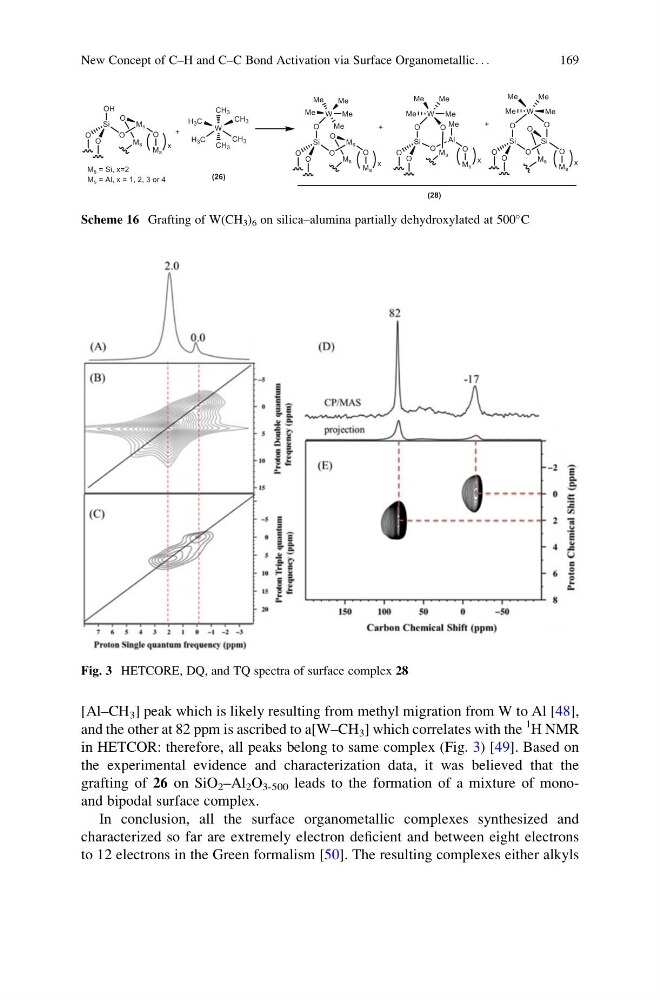
[Al–CH 3 ] peak which is likely resulting from methyl migration from W to Al [48],
and the other at 82 ppm is ascribed to a[W–CH 3 ] which correlates with the
1 H NMR
in HETCOR: therefore, all peaks belong to same complex (Fig. 3) [49]. Based on
the experimental evidence and characterization data, it was believed that the
grafting of 26 on SiO 2 –Al 2 O 3-500 leads to the formation of a mixture of monoand bipodal surface complex.
In conclusion, all the surface organometallic complexes synthesized and
characterized so far are extremely electron deficient and between eight electrons
to 12 electrons in the Green formalism [50]. The resulting complexes either alkyls
Scheme 16 Grafting of W(CH 3 ) 6 on silica–alumina partially dehydroxylated at 500
C
Fig. 3 HETCORE, DQ, and TQ spectra of surface complex 28
New Concept of C–H and C–C Bond Activation via Surface Organometallic. . .
169
and the other at 82 ppm is ascribed to a[W–CH 3 ] which correlates with the
1 H NMR
in HETCOR: therefore, all peaks belong to same complex (Fig. 3) [49]. Based on
the experimental evidence and characterization data, it was believed that the
grafting of 26 on SiO 2 –Al 2 O 3-500 leads to the formation of a mixture of monoand bipodal surface complex.
In conclusion, all the surface organometallic complexes synthesized and
characterized so far are extremely electron deficient and between eight electrons
to 12 electrons in the Green formalism [50]. The resulting complexes either alkyls
Scheme 16 Grafting of W(CH 3 ) 6 on silica–alumina partially dehydroxylated at 500
C
Fig. 3 HETCORE, DQ, and TQ spectra of surface complex 28
New Concept of C–H and C–C Bond Activation via Surface Organometallic. . .
169