

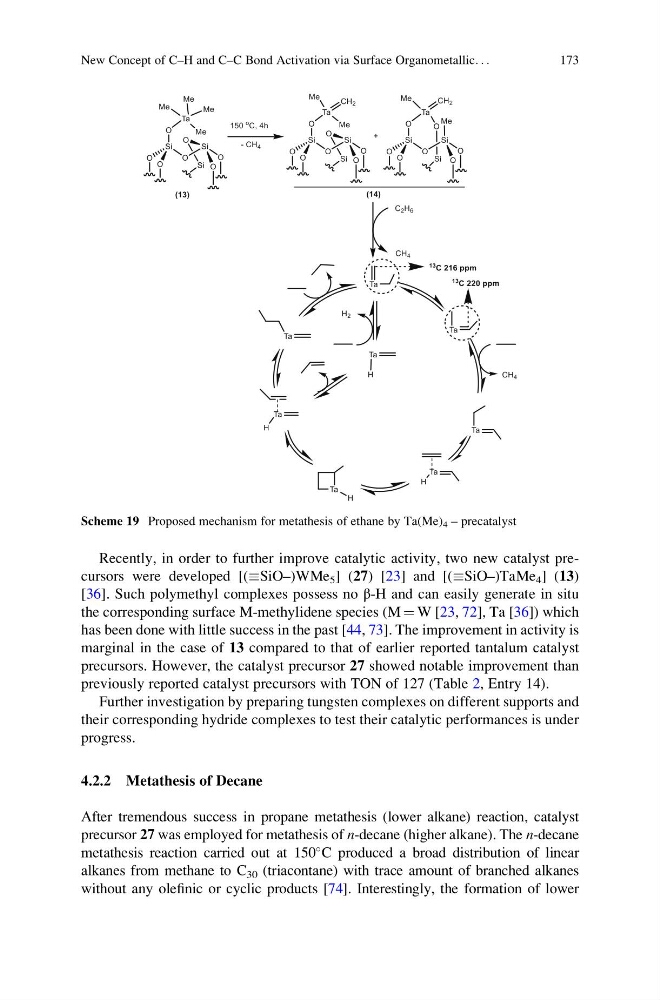
Recently, in order to further improve catalytic activity, two new catalyst precursors were developed [(SiO–)WMe 5 ] (27) [23] and [(SiO–)TaMe 4 ] (13)
[36]. Such polymethyl complexes possess no β-H and can easily generate in situ
the corresponding surface M-methylidene species (M ¼ W [23, 72], Ta [36]) which
has been done with little success in the past [44, 73]. The improvement in activity is
marginal in the case of 13 compared to that of earlier reported tantalum catalyst
precursors. However, the catalyst precursor 27 showed notable improvement than
previously reported catalyst precursors with TON of 127 (Table 2, Entry 14).
Further investigation by preparing tungsten complexes on different supports and
their corresponding hydride complexes to test their catalytic performances is under
progress.
4.2.2 Metathesis of Decane
After tremendous success in propane metathesis (lower alkane) reaction, catalyst
precursor 27 was employed for metathesis of n-decane (higher alkane). The n-decane
metathesis reaction carried out at 150
C produced a broad distribution of linear
alkanes from methane to C 30 (triacontane) with trace amount of branched alkanes
without any olefinic or cyclic products [74]. Interestingly, the formation of lower
Scheme 19 Proposed mechanism for metathesis of ethane by Ta(Me) 4 – precatalyst
New Concept of C–H and C–C Bond Activation via Surface Organometallic. . .
173
[36]. Such polymethyl complexes possess no β-H and can easily generate in situ
the corresponding surface M-methylidene species (M ¼ W [23, 72], Ta [36]) which
has been done with little success in the past [44, 73]. The improvement in activity is
marginal in the case of 13 compared to that of earlier reported tantalum catalyst
precursors. However, the catalyst precursor 27 showed notable improvement than
previously reported catalyst precursors with TON of 127 (Table 2, Entry 14).
Further investigation by preparing tungsten complexes on different supports and
their corresponding hydride complexes to test their catalytic performances is under
progress.
4.2.2 Metathesis of Decane
After tremendous success in propane metathesis (lower alkane) reaction, catalyst
precursor 27 was employed for metathesis of n-decane (higher alkane). The n-decane
metathesis reaction carried out at 150
C produced a broad distribution of linear
alkanes from methane to C 30 (triacontane) with trace amount of branched alkanes
without any olefinic or cyclic products [74]. Interestingly, the formation of lower
Scheme 19 Proposed mechanism for metathesis of ethane by Ta(Me) 4 – precatalyst
New Concept of C–H and C–C Bond Activation via Surface Organometallic. . .
173