

corresponding stable grafted surface organometallic complex (Scheme 14). When a
pentane solution of 26 was allowed to react with SiO 2-700 at À50 to À30
C for a
required time period, golden yellow solid power was formed [23].
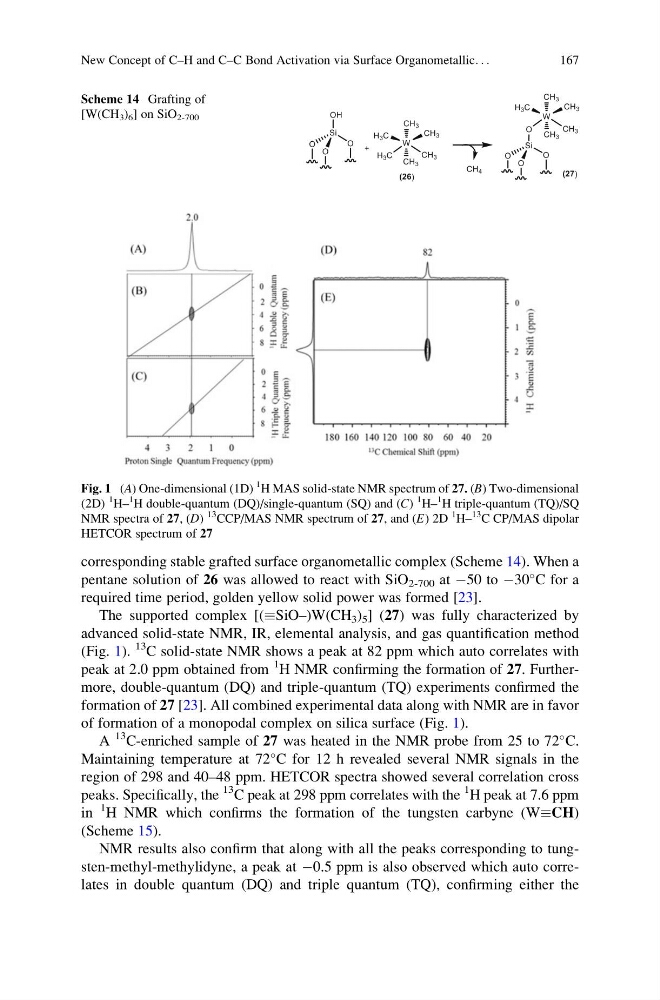
The supported complex [(SiO–)W(CH 3 ) 5 ] (27) was fully characterized by
advanced solid-state NMR, IR, elemental analysis, and gas quantification method
(Fig. 1).
13 C solid-state NMR shows a peak at 82 ppm which auto correlates with
peak at 2.0 ppm obtained from
1 H NMR confirming the formation of 27. Furthermore, double-quantum (DQ) and triple-quantum (TQ) experiments confirmed the
formation of 27 [23]. All combined experimental data along with NMR are in favor
of formation of a monopodal complex on silica surface (Fig. 1).
A
13 C-enriched sample of 27 was heated in the NMR probe from 25 to 72
C.
Maintaining temperature at 72
C for 12 h revealed several NMR signals in the
region of 298 and 40–48 ppm. HETCOR spectra showed several correlation cross
peaks. Specifically, the
13 C peak at 298 ppm correlates with the
1 H peak at 7.6 ppm
in
1 H NMR which confirms the formation of the tungsten carbyne (WCH)
(Scheme 15).
NMR results also confirm that along with all the peaks corresponding to tungsten-methyl-methylidyne, a peak at À0.5 ppm is also observed which auto correlates in double quantum (DQ) and triple quantum (TQ), confirming either the
Fig. 1 (A) One-dimensional (1D)
1
H MAS solid-state NMR spectrum of 27. (B) Two-dimensional
(2D)
1
H–
1
H double-quantum (DQ)/single-quantum (SQ) and (C)
1 H–
1
H triple-quantum (TQ)/SQ
NMR spectra of 27, (D)
13
CCP/MAS NMR spectrum of 27, and (E) 2D
1
H–
13
C CP/MAS dipolar
HETCOR spectrum of 27
Scheme 14 Grafting of
[W(CH 3 ) 6 ] on SiO 2-700
New Concept of C–H and C–C Bond Activation via Surface Organometallic. . .
167
pentane solution of 26 was allowed to react with SiO 2-700 at À50 to À30
C for a
required time period, golden yellow solid power was formed [23].
The supported complex [(SiO–)W(CH 3 ) 5 ] (27) was fully characterized by
advanced solid-state NMR, IR, elemental analysis, and gas quantification method
(Fig. 1).
13 C solid-state NMR shows a peak at 82 ppm which auto correlates with
peak at 2.0 ppm obtained from
1 H NMR confirming the formation of 27. Furthermore, double-quantum (DQ) and triple-quantum (TQ) experiments confirmed the
formation of 27 [23]. All combined experimental data along with NMR are in favor
of formation of a monopodal complex on silica surface (Fig. 1).
A
13 C-enriched sample of 27 was heated in the NMR probe from 25 to 72
C.
Maintaining temperature at 72
C for 12 h revealed several NMR signals in the
region of 298 and 40–48 ppm. HETCOR spectra showed several correlation cross
peaks. Specifically, the
13 C peak at 298 ppm correlates with the
1 H peak at 7.6 ppm
in
1 H NMR which confirms the formation of the tungsten carbyne (WCH)
(Scheme 15).
NMR results also confirm that along with all the peaks corresponding to tungsten-methyl-methylidyne, a peak at À0.5 ppm is also observed which auto correlates in double quantum (DQ) and triple quantum (TQ), confirming either the
Fig. 1 (A) One-dimensional (1D)
1
H MAS solid-state NMR spectrum of 27. (B) Two-dimensional
(2D)
1
H–
1
H double-quantum (DQ)/single-quantum (SQ) and (C)
1 H–
1
H triple-quantum (TQ)/SQ
NMR spectra of 27, (D)
13
CCP/MAS NMR spectrum of 27, and (E) 2D
1
H–
13
C CP/MAS dipolar
HETCOR spectrum of 27
Scheme 14 Grafting of
[W(CH 3 ) 6 ] on SiO 2-700
New Concept of C–H and C–C Bond Activation via Surface Organometallic. . .
167