

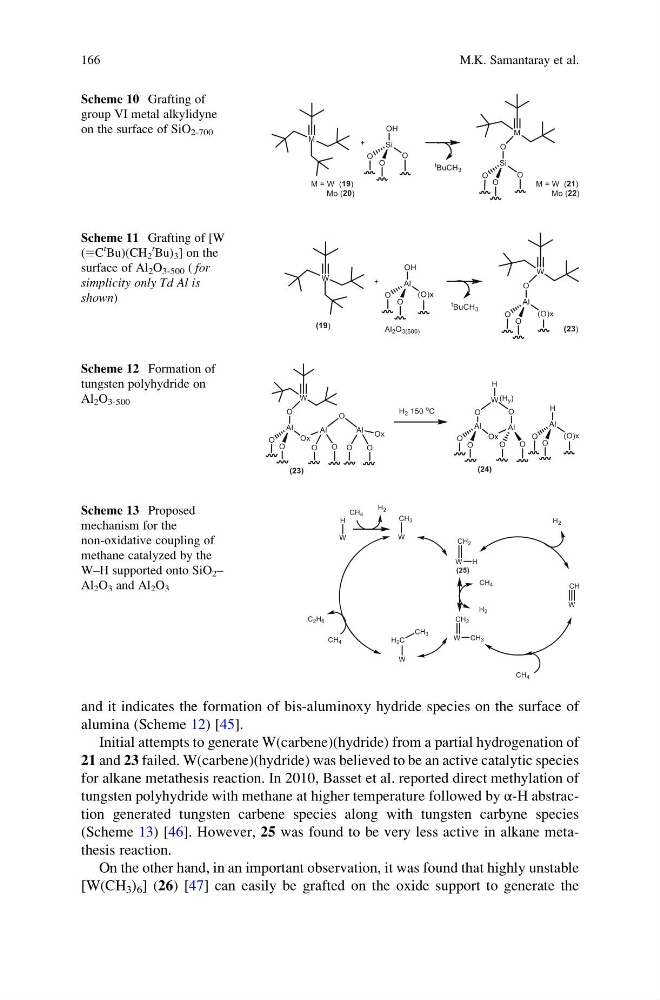
and it indicates the formation of bis-aluminoxy hydride species on the surface of
alumina (Scheme 12) [45].
Initial attempts to generate W(carbene)(hydride) from a partial hydrogenation of
21 and 23 failed. W(carbene)(hydride) was believed to be an active catalytic species
for alkane metathesis reaction. In 2010, Basset et al. reported direct methylation of
tungsten polyhydride with methane at higher temperature followed by α-H abstraction generated tungsten carbene species along with tungsten carbyne species
(Scheme 13) [46]. However, 25 was found to be very less active in alkane metathesis reaction.
On the other hand, in an important observation, it was found that highly unstable
[W(CH 3 ) 6 ] (26) [47] can easily be grafted on the oxide support to generate the
Scheme 11 Grafting of [W
(C
t
Bu)(CH 2
t
Bu) 3 ] on the
surface of Al 2 O 3-500 ( for
simplicity only Td Al is
shown)
Scheme 10 Grafting of
group VI metal alkylidyne
on the surface of SiO 2-700
Scheme 12 Formation of
tungsten polyhydride on
Al 2 O 3-500
Scheme 13 Proposed
mechanism for the
non-oxidative coupling of
methane catalyzed by the
W–H supported onto SiO 2 –
Al 2 O 3 and Al 2 O 3
166
M.K. Samantaray et al.
alumina (Scheme 12) [45].
Initial attempts to generate W(carbene)(hydride) from a partial hydrogenation of
21 and 23 failed. W(carbene)(hydride) was believed to be an active catalytic species
for alkane metathesis reaction. In 2010, Basset et al. reported direct methylation of
tungsten polyhydride with methane at higher temperature followed by α-H abstraction generated tungsten carbene species along with tungsten carbyne species
(Scheme 13) [46]. However, 25 was found to be very less active in alkane metathesis reaction.
On the other hand, in an important observation, it was found that highly unstable
[W(CH 3 ) 6 ] (26) [47] can easily be grafted on the oxide support to generate the
Scheme 11 Grafting of [W
(C
t
Bu)(CH 2
t
Bu) 3 ] on the
surface of Al 2 O 3-500 ( for
simplicity only Td Al is
shown)
Scheme 10 Grafting of
group VI metal alkylidyne
on the surface of SiO 2-700
Scheme 12 Formation of
tungsten polyhydride on
Al 2 O 3-500
Scheme 13 Proposed
mechanism for the
non-oxidative coupling of
methane catalyzed by the
W–H supported onto SiO 2 –
Al 2 O 3 and Al 2 O 3
166
M.K. Samantaray et al.