

Similarly in previous literature reports, [Ta(¼C
t
Bu)(CH 2
t
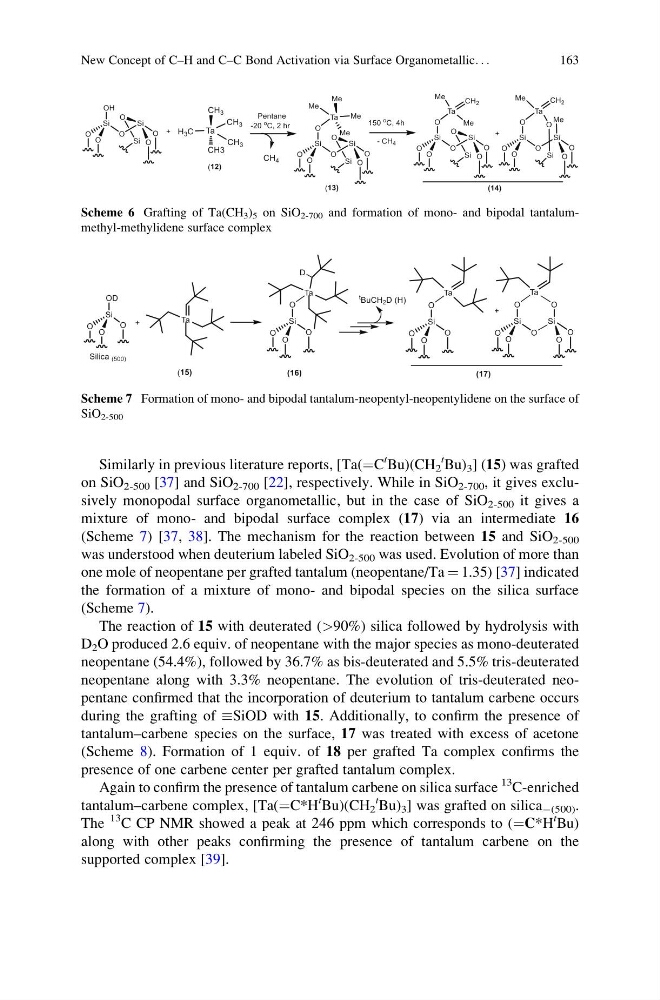
Bu) 3 ] (15) was grafted
on SiO 2-500 [37] and SiO 2-700 [22], respectively. While in SiO 2-700 , it gives exclusively monopodal surface organometallic, but in the case of SiO 2-500 it gives a
mixture of mono- and bipodal surface complex (17) via an intermediate 16
(Scheme 7) [37, 38]. The mechanism for the reaction between 15 and SiO 2-500
was understood when deuterium labeled SiO 2-500 was used. Evolution of more than
one mole of neopentane per grafted tantalum (neopentane/Ta ¼ 1.35) [37] indicated
the formation of a mixture of mono- and bipodal species on the silica surface
(Scheme 7).
The reaction of 15 with deuterated (>90%) silica followed by hydrolysis with
D 2 O produced 2.6 equiv. of neopentane with the major species as mono-deuterated
neopentane (54.4%), followed by 36.7% as bis-deuterated and 5.5% tris-deuterated
neopentane along with 3.3% neopentane. The evolution of tris-deuterated neopentane confirmed that the incorporation of deuterium to tantalum carbene occurs
during the grafting of SiOD with 15. Additionally, to confirm the presence of
tantalum–carbene species on the surface, 17 was treated with excess of acetone
(Scheme 8). Formation of 1 equiv. of 18 per grafted Ta complex confirms the
presence of one carbene center per grafted tantalum complex.
Again to confirm the presence of tantalum carbene on silica surface
13 C-enriched
tantalum–carbene complex, [Ta(¼C*H
t
Bu)(CH 2
t
Bu) 3 ] was grafted on silica À(500) .
The
13
C CP NMR showed a peak at 246 ppm which corresponds to (¼C*H
t
Bu)
along with other peaks confirming the presence of tantalum carbene on the
supported complex [39].
Scheme 7 Formation of mono- and bipodal tantalum-neopentyl-neopentylidene on the surface of
SiO 2-500
Scheme 6 Grafting of Ta(CH 3 ) 5 on SiO 2-700 and formation of mono- and bipodal tantalummethyl-methylidene surface complex
New Concept of C–H and C–C Bond Activation via Surface Organometallic. . .
163
t
Bu)(CH 2
t
Bu) 3 ] (15) was grafted
on SiO 2-500 [37] and SiO 2-700 [22], respectively. While in SiO 2-700 , it gives exclusively monopodal surface organometallic, but in the case of SiO 2-500 it gives a
mixture of mono- and bipodal surface complex (17) via an intermediate 16
(Scheme 7) [37, 38]. The mechanism for the reaction between 15 and SiO 2-500
was understood when deuterium labeled SiO 2-500 was used. Evolution of more than
one mole of neopentane per grafted tantalum (neopentane/Ta ¼ 1.35) [37] indicated
the formation of a mixture of mono- and bipodal species on the silica surface
(Scheme 7).
The reaction of 15 with deuterated (>90%) silica followed by hydrolysis with
D 2 O produced 2.6 equiv. of neopentane with the major species as mono-deuterated
neopentane (54.4%), followed by 36.7% as bis-deuterated and 5.5% tris-deuterated
neopentane along with 3.3% neopentane. The evolution of tris-deuterated neopentane confirmed that the incorporation of deuterium to tantalum carbene occurs
during the grafting of SiOD with 15. Additionally, to confirm the presence of
tantalum–carbene species on the surface, 17 was treated with excess of acetone
(Scheme 8). Formation of 1 equiv. of 18 per grafted Ta complex confirms the
presence of one carbene center per grafted tantalum complex.
Again to confirm the presence of tantalum carbene on silica surface
13 C-enriched
tantalum–carbene complex, [Ta(¼C*H
t
Bu)(CH 2
t
Bu) 3 ] was grafted on silica À(500) .
The
13
C CP NMR showed a peak at 246 ppm which corresponds to (¼C*H
t
Bu)
along with other peaks confirming the presence of tantalum carbene on the
supported complex [39].
Scheme 7 Formation of mono- and bipodal tantalum-neopentyl-neopentylidene on the surface of
SiO 2-500
Scheme 6 Grafting of Ta(CH 3 ) 5 on SiO 2-700 and formation of mono- and bipodal tantalummethyl-methylidene surface complex
New Concept of C–H and C–C Bond Activation via Surface Organometallic. . .
163