

MCM-41 partially dehydroxylated at 500
C was also used to understand the
behavior of the [Ta(¼C
t
Bu)(CH 2
t
Bu) 3 ] complex on oxide support. Interestingly,
NMR, EXAFS, elemental analysis, and gas quantification results support the formation of monopodal species, whereas in the case of SiO 2-500 , it produces a mixture
of mono and bipodal species [40, 41].
3.1.3 Reactivity of Group V (Ta) Hydride on Oxide Surfaces
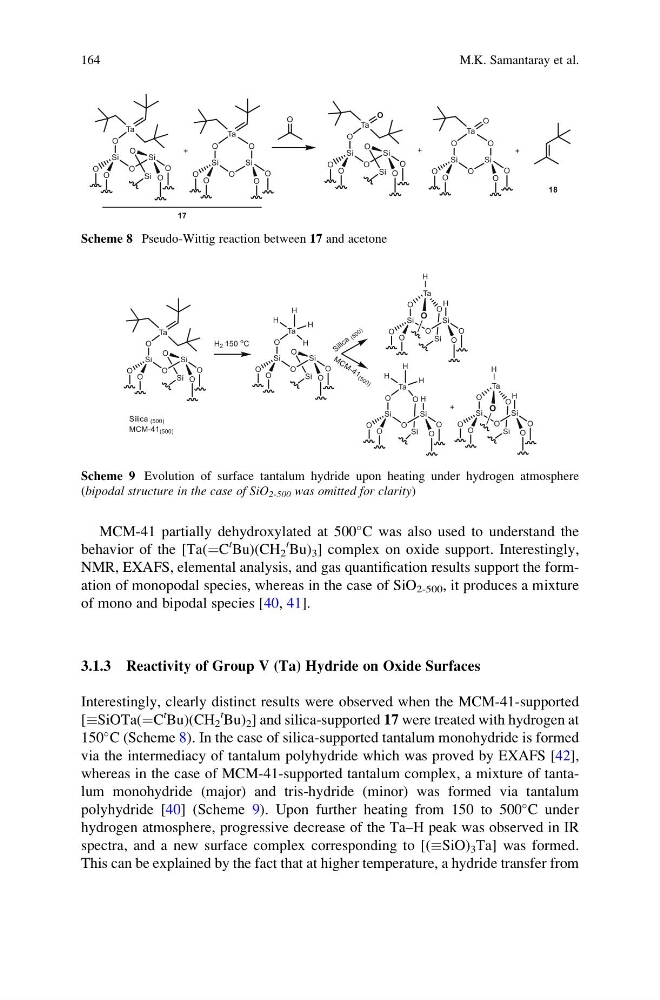
Interestingly, clearly distinct results were observed when the MCM-41-supported
[SiOTa(¼C
t
Bu)(CH 2
t
Bu) 2 ] and silica-supported 17 were treated with hydrogen at
150
C (Scheme 8). In the case of silica-supported tantalum monohydride is formed
via the intermediacy of tantalum polyhydride which was proved by EXAFS [42],
whereas in the case of MCM-41-supported tantalum complex, a mixture of tantalum monohydride (major) and tris-hydride (minor) was formed via tantalum
polyhydride [40] (Scheme 9). Upon further heating from 150 to 500
C under
hydrogen atmosphere, progressive decrease of the Ta–H peak was observed in IR
spectra, and a new surface complex corresponding to [(SiO) 3 Ta] was formed.
This can be explained by the fact that at higher temperature, a hydride transfer from
Scheme 9 Evolution of surface tantalum hydride upon heating under hydrogen atmosphere
(bipodal structure in the case of SiO 2-500 was omitted for clarity)
Scheme 8 Pseudo-Wittig reaction between 17 and acetone
164
M.K. Samantaray et al.
C was also used to understand the
behavior of the [Ta(¼C
t
Bu)(CH 2
t
Bu) 3 ] complex on oxide support. Interestingly,
NMR, EXAFS, elemental analysis, and gas quantification results support the formation of monopodal species, whereas in the case of SiO 2-500 , it produces a mixture
of mono and bipodal species [40, 41].
3.1.3 Reactivity of Group V (Ta) Hydride on Oxide Surfaces
Interestingly, clearly distinct results were observed when the MCM-41-supported
[SiOTa(¼C
t
Bu)(CH 2
t
Bu) 2 ] and silica-supported 17 were treated with hydrogen at
150
C (Scheme 8). In the case of silica-supported tantalum monohydride is formed
via the intermediacy of tantalum polyhydride which was proved by EXAFS [42],
whereas in the case of MCM-41-supported tantalum complex, a mixture of tantalum monohydride (major) and tris-hydride (minor) was formed via tantalum
polyhydride [40] (Scheme 9). Upon further heating from 150 to 500
C under
hydrogen atmosphere, progressive decrease of the Ta–H peak was observed in IR
spectra, and a new surface complex corresponding to [(SiO) 3 Ta] was formed.
This can be explained by the fact that at higher temperature, a hydride transfer from
Scheme 9 Evolution of surface tantalum hydride upon heating under hydrogen atmosphere
(bipodal structure in the case of SiO 2-500 was omitted for clarity)
Scheme 8 Pseudo-Wittig reaction between 17 and acetone
164
M.K. Samantaray et al.