

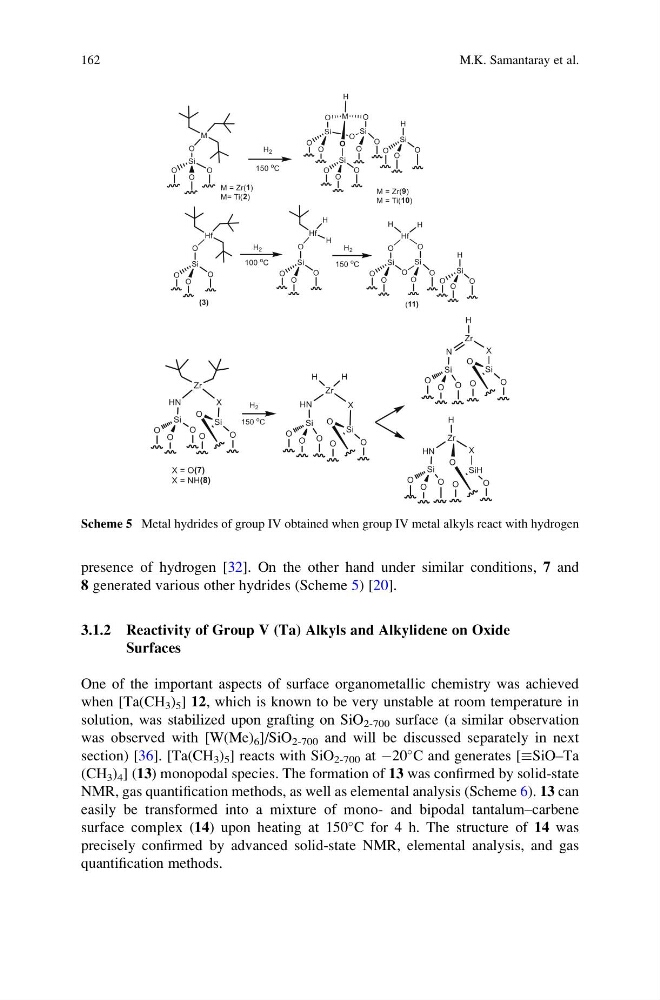
presence of hydrogen [32]. On the other hand under similar conditions, 7 and
8 generated various other hydrides (Scheme 5) [20].
3.1.2 Reactivity of Group V (Ta) Alkyls and Alkylidene on Oxide
Surfaces
One of the important aspects of surface organometallic chemistry was achieved
when [Ta(CH 3 ) 5 ] 12, which is known to be very unstable at room temperature in
solution, was stabilized upon grafting on SiO 2-700 surface (a similar observation
was observed with [W(Me) 6 ]/SiO 2-700 and will be discussed separately in next
section) [36]. [Ta(CH 3 ) 5 ] reacts with SiO 2-700 at À20
C and generates [SiO–Ta
(CH 3 ) 4 ] (13) monopodal species. The formation of 13 was confirmed by solid-state
NMR, gas quantification methods, as well as elemental analysis (Scheme 6). 13 can
easily be transformed into a mixture of mono- and bipodal tantalum–carbene
surface complex (14) upon heating at 150
C for 4 h. The structure of 14 was
precisely confirmed by advanced solid-state NMR, elemental analysis, and gas
quantification methods.
Scheme 5 Metal hydrides of group IV obtained when group IV metal alkyls react with hydrogen
162
M.K. Samantaray et al.
8 generated various other hydrides (Scheme 5) [20].
3.1.2 Reactivity of Group V (Ta) Alkyls and Alkylidene on Oxide
Surfaces
One of the important aspects of surface organometallic chemistry was achieved
when [Ta(CH 3 ) 5 ] 12, which is known to be very unstable at room temperature in
solution, was stabilized upon grafting on SiO 2-700 surface (a similar observation
was observed with [W(Me) 6 ]/SiO 2-700 and will be discussed separately in next
section) [36]. [Ta(CH 3 ) 5 ] reacts with SiO 2-700 at À20
C and generates [SiO–Ta
(CH 3 ) 4 ] (13) monopodal species. The formation of 13 was confirmed by solid-state
NMR, gas quantification methods, as well as elemental analysis (Scheme 6). 13 can
easily be transformed into a mixture of mono- and bipodal tantalum–carbene
surface complex (14) upon heating at 150
C for 4 h. The structure of 14 was
precisely confirmed by advanced solid-state NMR, elemental analysis, and gas
quantification methods.
Scheme 5 Metal hydrides of group IV obtained when group IV metal alkyls react with hydrogen
162
M.K. Samantaray et al.