

(NP) 4 gives only monopodal species which was proved by elemental analysis, gas
quantification, and NMR.
The grafting of Zr(Np) 4 was not only restricted to silica surface but also to other
well-defined oxide surfaces. Recently, amino-modified SBA-15 surfaces were
prepared by the reaction of partially dehydroxylated SBA-15 at 1100
C with
ammonia at 200 and 500
C to generate [(Si–NH 2 )(Si–OH)] (5) and [(Si–
NH 2 ) 2 ] (6). The advantage of this method is the preparation of adjacent groups in
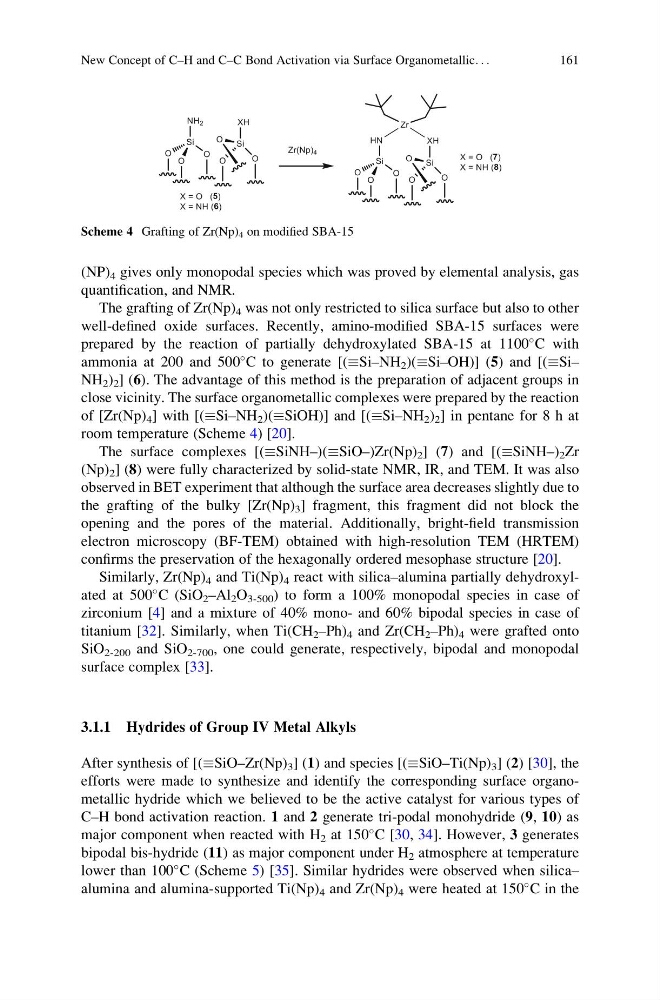
close vicinity. The surface organometallic complexes were prepared by the reaction
of [Zr(Np) 4 ] with [(Si–NH 2 )(SiOH)] and [(Si–NH 2 ) 2 ] in pentane for 8 h at
room temperature (Scheme 4) [20].
The surface complexes [(SiNH–)(SiO–)Zr(Np) 2 ] (7) and [(SiNH–) 2 Zr
(Np) 2 ] (8) were fully characterized by solid-state NMR, IR, and TEM. It was also
observed in BET experiment that although the surface area decreases slightly due to
the grafting of the bulky [Zr(Np) 3 ] fragment, this fragment did not block the
opening and the pores of the material. Additionally, bright-field transmission
electron microscopy (BF-TEM) obtained with high-resolution TEM (HRTEM)
confirms the preservation of the hexagonally ordered mesophase structure [20].
Similarly, Zr(Np) 4 and Ti(Np) 4 react with silica–alumina partially dehydroxylated at 500
C (SiO 2 –Al 2 O 3-500 ) to form a 100% monopodal species in case of
zirconium [4] and a mixture of 40% mono- and 60% bipodal species in case of
titanium [32]. Similarly, when Ti(CH 2 –Ph) 4 and Zr(CH 2 –Ph) 4 were grafted onto
SiO 2-200 and SiO 2-700 , one could generate, respectively, bipodal and monopodal
surface complex [33].
3.1.1 Hydrides of Group IV Metal Alkyls
After synthesis of [(SiO–Zr(Np) 3 ] (1) and species [(SiO–Ti(Np) 3 ] (2) [30], the
efforts were made to synthesize and identify the corresponding surface organometallic hydride which we believed to be the active catalyst for various types of
C–H bond activation reaction. 1 and 2 generate tri-podal monohydride (9, 10) as
major component when reacted with H 2 at 150
C [30, 34]. However, 3 generates
bipodal bis-hydride (11) as major component under H 2 atmosphere at temperature
lower than 100
C (Scheme 5) [35]. Similar hydrides were observed when silica–
alumina and alumina-supported Ti(Np) 4 and Zr(Np) 4 were heated at 150
C in the
Scheme 4 Grafting of Zr(Np) 4 on modified SBA-15
New Concept of C–H and C–C Bond Activation via Surface Organometallic. . .
161
quantification, and NMR.
The grafting of Zr(Np) 4 was not only restricted to silica surface but also to other
well-defined oxide surfaces. Recently, amino-modified SBA-15 surfaces were
prepared by the reaction of partially dehydroxylated SBA-15 at 1100
C with
ammonia at 200 and 500
C to generate [(Si–NH 2 )(Si–OH)] (5) and [(Si–
NH 2 ) 2 ] (6). The advantage of this method is the preparation of adjacent groups in
close vicinity. The surface organometallic complexes were prepared by the reaction
of [Zr(Np) 4 ] with [(Si–NH 2 )(SiOH)] and [(Si–NH 2 ) 2 ] in pentane for 8 h at
room temperature (Scheme 4) [20].
The surface complexes [(SiNH–)(SiO–)Zr(Np) 2 ] (7) and [(SiNH–) 2 Zr
(Np) 2 ] (8) were fully characterized by solid-state NMR, IR, and TEM. It was also
observed in BET experiment that although the surface area decreases slightly due to
the grafting of the bulky [Zr(Np) 3 ] fragment, this fragment did not block the
opening and the pores of the material. Additionally, bright-field transmission
electron microscopy (BF-TEM) obtained with high-resolution TEM (HRTEM)
confirms the preservation of the hexagonally ordered mesophase structure [20].
Similarly, Zr(Np) 4 and Ti(Np) 4 react with silica–alumina partially dehydroxylated at 500
C (SiO 2 –Al 2 O 3-500 ) to form a 100% monopodal species in case of
zirconium [4] and a mixture of 40% mono- and 60% bipodal species in case of
titanium [32]. Similarly, when Ti(CH 2 –Ph) 4 and Zr(CH 2 –Ph) 4 were grafted onto
SiO 2-200 and SiO 2-700 , one could generate, respectively, bipodal and monopodal
surface complex [33].
3.1.1 Hydrides of Group IV Metal Alkyls
After synthesis of [(SiO–Zr(Np) 3 ] (1) and species [(SiO–Ti(Np) 3 ] (2) [30], the
efforts were made to synthesize and identify the corresponding surface organometallic hydride which we believed to be the active catalyst for various types of
C–H bond activation reaction. 1 and 2 generate tri-podal monohydride (9, 10) as
major component when reacted with H 2 at 150
C [30, 34]. However, 3 generates
bipodal bis-hydride (11) as major component under H 2 atmosphere at temperature
lower than 100
C (Scheme 5) [35]. Similar hydrides were observed when silica–
alumina and alumina-supported Ti(Np) 4 and Zr(Np) 4 were heated at 150
C in the
Scheme 4 Grafting of Zr(Np) 4 on modified SBA-15
New Concept of C–H and C–C Bond Activation via Surface Organometallic. . .
161