

3 Surface Organometallic Chemistry of Metal Alkyls/
Alkylidene and Alkylidyne
3.1 Reactivity of Group IV (Zr, Hf, and Ti) Metal Alkyls
on Oxide Surfaces
This area was really at the origin of alkane activation with surface metal hydrides.
Those surface metal hydrides were obtained by treatment under hydrogen of silicasupported metal alkyls. The first one in this series was tris-neopentylzirconium
surface complex [SiO–Zr(Np) 3 ] 1.
Zirconium tris-neopentyl surface complex 1 was synthesized by the sublimation
of tetra-neopentylzirconium complex onto the surface of partially dehydroxylated
silica at 500
C [26, 27] and fully characterized by IR, NMR, EXAFS, elemental
analysis, and gas quantification methods as well as chemical methods [3, 28, 29].
Furthermore, in order to confirm its surface structure, the grafting experiment was
carried out with deuterated silica and tetra-neopentylzirconium. Evolution of 1 mol
of deuterated neopentane per mole of grafted zirconium proved that there is a
single bond between zirconium and oxygen. This monopodal surface structure
was further confirmed by EXAFS experiment with 1.
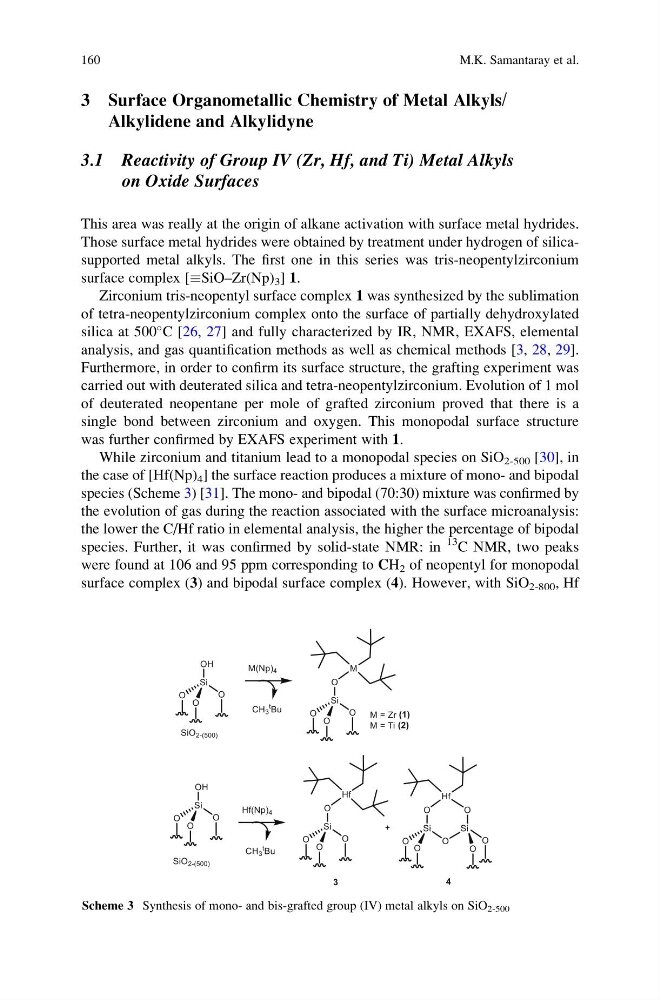
While zirconium and titanium lead to a monopodal species on SiO 2-500 [30], in
the case of [Hf(Np) 4 ] the surface reaction produces a mixture of mono- and bipodal
species (Scheme 3) [31]. The mono- and bipodal (70:30) mixture was confirmed by
the evolution of gas during the reaction associated with the surface microanalysis:
the lower the C/Hf ratio in elemental analysis, the higher the percentage of bipodal
species. Further, it was confirmed by solid-state NMR: in
13 C NMR, two peaks
were found at 106 and 95 ppm corresponding to CH 2 of neopentyl for monopodal
surface complex (3) and bipodal surface complex (4). However, with SiO 2-800 , Hf
Scheme 3 Synthesis of mono- and bis-grafted group (IV) metal alkyls on SiO 2-500
160
M.K. Samantaray et al.
Alkylidene and Alkylidyne
3.1 Reactivity of Group IV (Zr, Hf, and Ti) Metal Alkyls
on Oxide Surfaces
This area was really at the origin of alkane activation with surface metal hydrides.
Those surface metal hydrides were obtained by treatment under hydrogen of silicasupported metal alkyls. The first one in this series was tris-neopentylzirconium
surface complex [SiO–Zr(Np) 3 ] 1.
Zirconium tris-neopentyl surface complex 1 was synthesized by the sublimation
of tetra-neopentylzirconium complex onto the surface of partially dehydroxylated
silica at 500
C [26, 27] and fully characterized by IR, NMR, EXAFS, elemental
analysis, and gas quantification methods as well as chemical methods [3, 28, 29].
Furthermore, in order to confirm its surface structure, the grafting experiment was
carried out with deuterated silica and tetra-neopentylzirconium. Evolution of 1 mol
of deuterated neopentane per mole of grafted zirconium proved that there is a
single bond between zirconium and oxygen. This monopodal surface structure
was further confirmed by EXAFS experiment with 1.
While zirconium and titanium lead to a monopodal species on SiO 2-500 [30], in
the case of [Hf(Np) 4 ] the surface reaction produces a mixture of mono- and bipodal
species (Scheme 3) [31]. The mono- and bipodal (70:30) mixture was confirmed by
the evolution of gas during the reaction associated with the surface microanalysis:
the lower the C/Hf ratio in elemental analysis, the higher the percentage of bipodal
species. Further, it was confirmed by solid-state NMR: in
13 C NMR, two peaks
were found at 106 and 95 ppm corresponding to CH 2 of neopentyl for monopodal
surface complex (3) and bipodal surface complex (4). However, with SiO 2-800 , Hf
Scheme 3 Synthesis of mono- and bis-grafted group (IV) metal alkyls on SiO 2-500
160
M.K. Samantaray et al.