

good yield with a high degree of regioselectivity. More recently, the same authors
reported its application to the synthesis of the bicyclic (Choi) core of aeruginosin
marine natural products [93–95]. Cyclohexenyl bromide 61 which was obtained
through a six-step synthesis from readily available precursors underwent C(sp
3 )–H
alkenylation on multigram scale under re-optimized conditions, to provide
hexahydroindole 62 in good yield. In parallel, a rapid and divergent access to the
hydroxyphenyllactic (Hpla) subunits of the natural products, including those
containing chlorine or bromine atoms on the benzene ring, was developed, by
using a palladium-catalyzed directed β-C–H arylation of a D-lactic acid derivative
(63). After screening various directing groups and reaction conditions, the
2-pyridinylisopropyl (PIP) group introduced by Shi and co-workers [41] was
found to be the best option to furnish the various required Hpla subunits 64a–c in
good yield and without erosion of optical purity. A multistep sequence involving
peptide coupling and deprotections allowed to complete the total synthesis of
aeruginosins 98B and 298A, with an unprecedented overall yield and scale for
the latter (0.7 g, 8.2% overall yield), and started from simple chiral pool precursors
[93]. This strategy also allows to synthesize aeruginosin congeners bearing halogen
atoms on the Hpla subunit [94]. This final application highlights the synthetic
power of C(sp
3 )–H activation, when employed in a strategic manner to streamline
complex molecule synthesis.
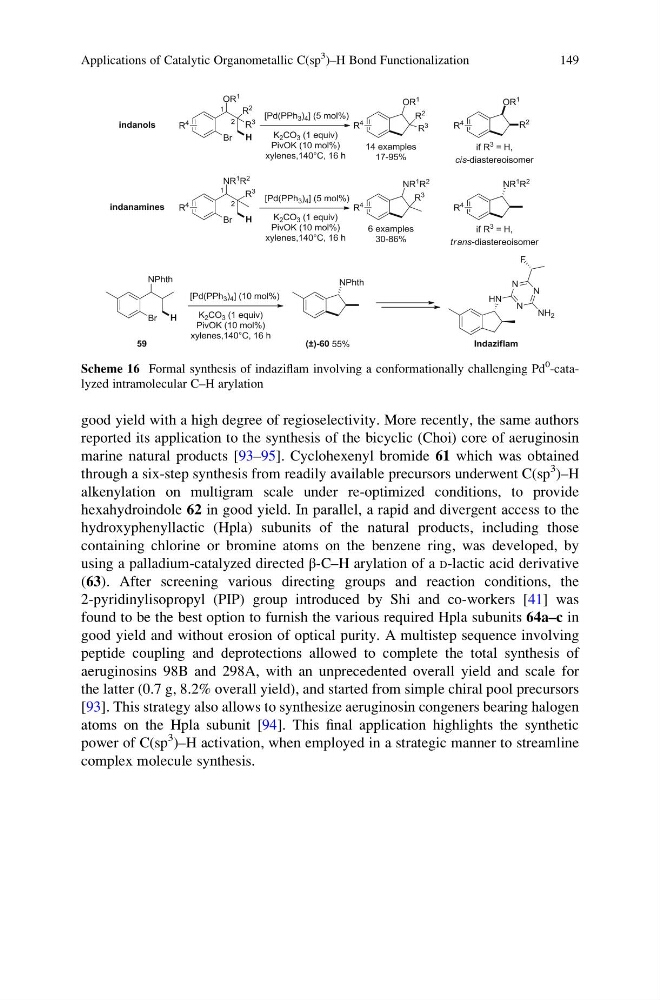
Scheme 16 Formal synthesis of indaziflam involving a conformationally challenging Pd
0
-catalyzed intramolecular C–H arylation
Applications of Catalytic Organometallic C(sp
3
)–H Bond Functionalization
149
reported its application to the synthesis of the bicyclic (Choi) core of aeruginosin
marine natural products [93–95]. Cyclohexenyl bromide 61 which was obtained
through a six-step synthesis from readily available precursors underwent C(sp
3 )–H
alkenylation on multigram scale under re-optimized conditions, to provide
hexahydroindole 62 in good yield. In parallel, a rapid and divergent access to the
hydroxyphenyllactic (Hpla) subunits of the natural products, including those
containing chlorine or bromine atoms on the benzene ring, was developed, by
using a palladium-catalyzed directed β-C–H arylation of a D-lactic acid derivative
(63). After screening various directing groups and reaction conditions, the
2-pyridinylisopropyl (PIP) group introduced by Shi and co-workers [41] was
found to be the best option to furnish the various required Hpla subunits 64a–c in
good yield and without erosion of optical purity. A multistep sequence involving
peptide coupling and deprotections allowed to complete the total synthesis of
aeruginosins 98B and 298A, with an unprecedented overall yield and scale for
the latter (0.7 g, 8.2% overall yield), and started from simple chiral pool precursors
[93]. This strategy also allows to synthesize aeruginosin congeners bearing halogen
atoms on the Hpla subunit [94]. This final application highlights the synthetic
power of C(sp
3 )–H activation, when employed in a strategic manner to streamline
complex molecule synthesis.
Scheme 16 Formal synthesis of indaziflam involving a conformationally challenging Pd
0
-catalyzed intramolecular C–H arylation
Applications of Catalytic Organometallic C(sp
3
)–H Bond Functionalization
149