

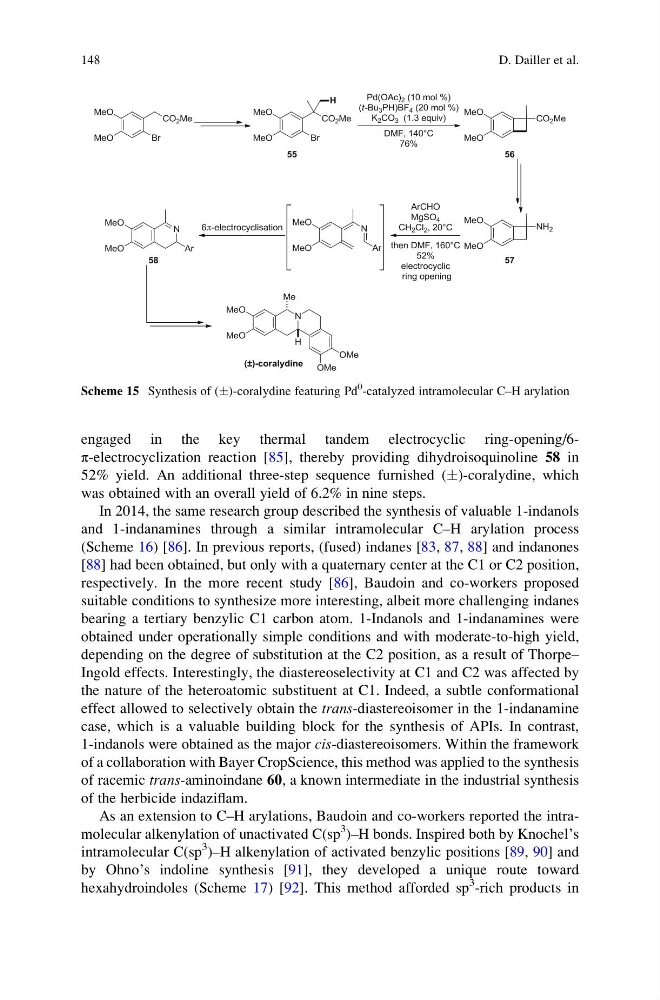
engaged in the key thermal tandem electrocyclic ring-opening/6π-electrocyclization reaction [85], thereby providing dihydroisoquinoline 58 in
52% yield. An additional three-step sequence furnished (Æ)-coralydine, which
was obtained with an overall yield of 6.2% in nine steps.
In 2014, the same research group described the synthesis of valuable 1-indanols
and 1-indanamines through a similar intramolecular C–H arylation process
(Scheme 16) [86]. In previous reports, (fused) indanes [83, 87, 88] and indanones
[88] had been obtained, but only with a quaternary center at the C1 or C2 position,
respectively. In the more recent study [86], Baudoin and co-workers proposed
suitable conditions to synthesize more interesting, albeit more challenging indanes
bearing a tertiary benzylic C1 carbon atom. 1-Indanols and 1-indanamines were
obtained under operationally simple conditions and with moderate-to-high yield,
depending on the degree of substitution at the C2 position, as a result of Thorpe–
Ingold effects. Interestingly, the diastereoselectivity at C1 and C2 was affected by
the nature of the heteroatomic substituent at C1. Indeed, a subtle conformational
effect allowed to selectively obtain the trans-diastereoisomer in the 1-indanamine
case, which is a valuable building block for the synthesis of APIs. In contrast,
1-indanols were obtained as the major cis-diastereoisomers. Within the framework
of a collaboration with Bayer CropScience, this method was applied to the synthesis
of racemic trans-aminoindane 60, a known intermediate in the industrial synthesis
of the herbicide indaziflam.
As an extension to C–H arylations, Baudoin and co-workers reported the intramolecular alkenylation of unactivated C(sp
3 )–H bonds. Inspired both by Knochel’s
intramolecular C(sp
3 )–H alkenylation of activated benzylic positions [89, 90] and
by Ohno’s indoline synthesis [91], they developed a unique route toward
hexahydroindoles (Scheme 17) [92]. This method afforded sp
3 -rich products in
Scheme 15 Synthesis of (Æ)-coralydine featuring Pd
0
-catalyzed intramolecular C–H arylation
148
D. Dailler et al.
52% yield. An additional three-step sequence furnished (Æ)-coralydine, which
was obtained with an overall yield of 6.2% in nine steps.
In 2014, the same research group described the synthesis of valuable 1-indanols
and 1-indanamines through a similar intramolecular C–H arylation process
(Scheme 16) [86]. In previous reports, (fused) indanes [83, 87, 88] and indanones
[88] had been obtained, but only with a quaternary center at the C1 or C2 position,
respectively. In the more recent study [86], Baudoin and co-workers proposed
suitable conditions to synthesize more interesting, albeit more challenging indanes
bearing a tertiary benzylic C1 carbon atom. 1-Indanols and 1-indanamines were
obtained under operationally simple conditions and with moderate-to-high yield,
depending on the degree of substitution at the C2 position, as a result of Thorpe–
Ingold effects. Interestingly, the diastereoselectivity at C1 and C2 was affected by
the nature of the heteroatomic substituent at C1. Indeed, a subtle conformational
effect allowed to selectively obtain the trans-diastereoisomer in the 1-indanamine
case, which is a valuable building block for the synthesis of APIs. In contrast,
1-indanols were obtained as the major cis-diastereoisomers. Within the framework
of a collaboration with Bayer CropScience, this method was applied to the synthesis
of racemic trans-aminoindane 60, a known intermediate in the industrial synthesis
of the herbicide indaziflam.
As an extension to C–H arylations, Baudoin and co-workers reported the intramolecular alkenylation of unactivated C(sp
3 )–H bonds. Inspired both by Knochel’s
intramolecular C(sp
3 )–H alkenylation of activated benzylic positions [89, 90] and
by Ohno’s indoline synthesis [91], they developed a unique route toward
hexahydroindoles (Scheme 17) [92]. This method afforded sp
3 -rich products in
Scheme 15 Synthesis of (Æ)-coralydine featuring Pd
0
-catalyzed intramolecular C–H arylation
148
D. Dailler et al.