

C(sp
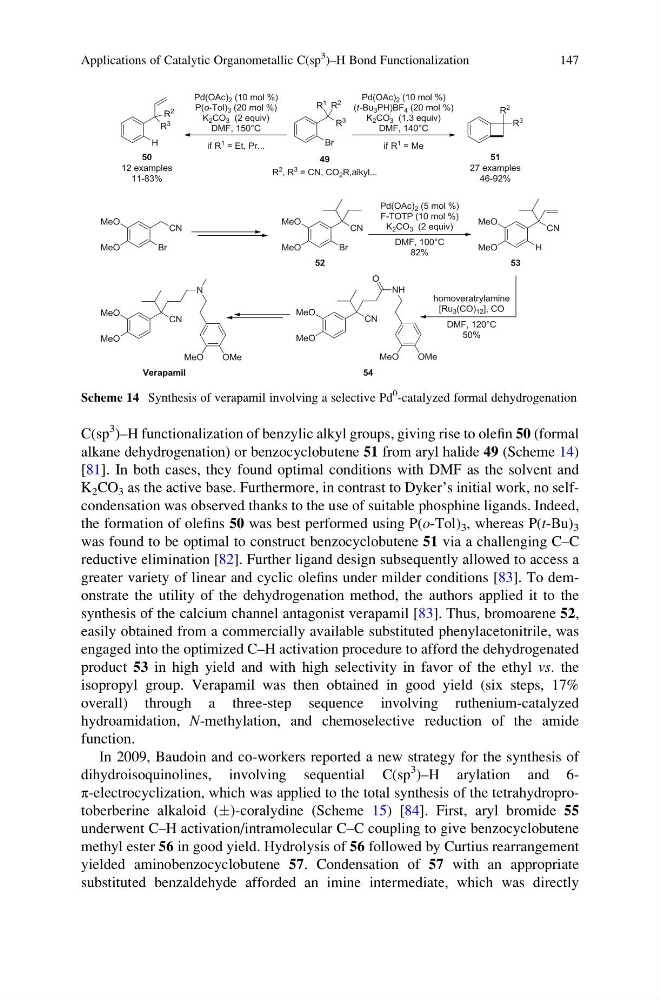
3 )–H functionalization of benzylic alkyl groups, giving rise to olefin 50 (formal
alkane dehydrogenation) or benzocyclobutene 51 from aryl halide 49 (Scheme 14)
[81]. In both cases, they found optimal conditions with DMF as the solvent and
K 2 CO 3 as the active base. Furthermore, in contrast to Dyker’s initial work, no selfcondensation was observed thanks to the use of suitable phosphine ligands. Indeed,
the formation of olefins 50 was best performed using P(o-Tol) 3 , whereas P(t-Bu) 3
was found to be optimal to construct benzocyclobutene 51 via a challenging C–C
reductive elimination [82]. Further ligand design subsequently allowed to access a
greater variety of linear and cyclic olefins under milder conditions [83]. To demonstrate the utility of the dehydrogenation method, the authors applied it to the
synthesis of the calcium channel antagonist verapamil [83]. Thus, bromoarene 52,
easily obtained from a commercially available substituted phenylacetonitrile, was
engaged into the optimized C–H activation procedure to afford the dehydrogenated
product 53 in high yield and with high selectivity in favor of the ethyl vs. the
isopropyl group. Verapamil was then obtained in good yield (six steps, 17%
overall) through a three-step sequence involving ruthenium-catalyzed
hydroamidation, N-methylation, and chemoselective reduction of the amide
function.
In 2009, Baudoin and co-workers reported a new strategy for the synthesis of
dihydroisoquinolines, involving sequential C(sp
3
)–H arylation and 6π-electrocyclization, which was applied to the total synthesis of the tetrahydroprotoberberine alkaloid (Æ)-coralydine (Scheme 15) [84]. First, aryl bromide 55
underwent C–H activation/intramolecular C–C coupling to give benzocyclobutene
methyl ester 56 in good yield. Hydrolysis of 56 followed by Curtius rearrangement
yielded aminobenzocyclobutene 57. Condensation of 57 with an appropriate
substituted benzaldehyde afforded an imine intermediate, which was directly
Scheme 14 Synthesis of verapamil involving a selective Pd
0
-catalyzed formal dehydrogenation
Applications of Catalytic Organometallic C(sp
3
)–H Bond Functionalization
147
3 )–H functionalization of benzylic alkyl groups, giving rise to olefin 50 (formal
alkane dehydrogenation) or benzocyclobutene 51 from aryl halide 49 (Scheme 14)
[81]. In both cases, they found optimal conditions with DMF as the solvent and
K 2 CO 3 as the active base. Furthermore, in contrast to Dyker’s initial work, no selfcondensation was observed thanks to the use of suitable phosphine ligands. Indeed,
the formation of olefins 50 was best performed using P(o-Tol) 3 , whereas P(t-Bu) 3
was found to be optimal to construct benzocyclobutene 51 via a challenging C–C
reductive elimination [82]. Further ligand design subsequently allowed to access a
greater variety of linear and cyclic olefins under milder conditions [83]. To demonstrate the utility of the dehydrogenation method, the authors applied it to the
synthesis of the calcium channel antagonist verapamil [83]. Thus, bromoarene 52,
easily obtained from a commercially available substituted phenylacetonitrile, was
engaged into the optimized C–H activation procedure to afford the dehydrogenated
product 53 in high yield and with high selectivity in favor of the ethyl vs. the
isopropyl group. Verapamil was then obtained in good yield (six steps, 17%
overall) through a three-step sequence involving ruthenium-catalyzed
hydroamidation, N-methylation, and chemoselective reduction of the amide
function.
In 2009, Baudoin and co-workers reported a new strategy for the synthesis of
dihydroisoquinolines, involving sequential C(sp
3
)–H arylation and 6π-electrocyclization, which was applied to the total synthesis of the tetrahydroprotoberberine alkaloid (Æ)-coralydine (Scheme 15) [84]. First, aryl bromide 55
underwent C–H activation/intramolecular C–C coupling to give benzocyclobutene
methyl ester 56 in good yield. Hydrolysis of 56 followed by Curtius rearrangement
yielded aminobenzocyclobutene 57. Condensation of 57 with an appropriate
substituted benzaldehyde afforded an imine intermediate, which was directly
Scheme 14 Synthesis of verapamil involving a selective Pd
0
-catalyzed formal dehydrogenation
Applications of Catalytic Organometallic C(sp
3
)–H Bond Functionalization
147