

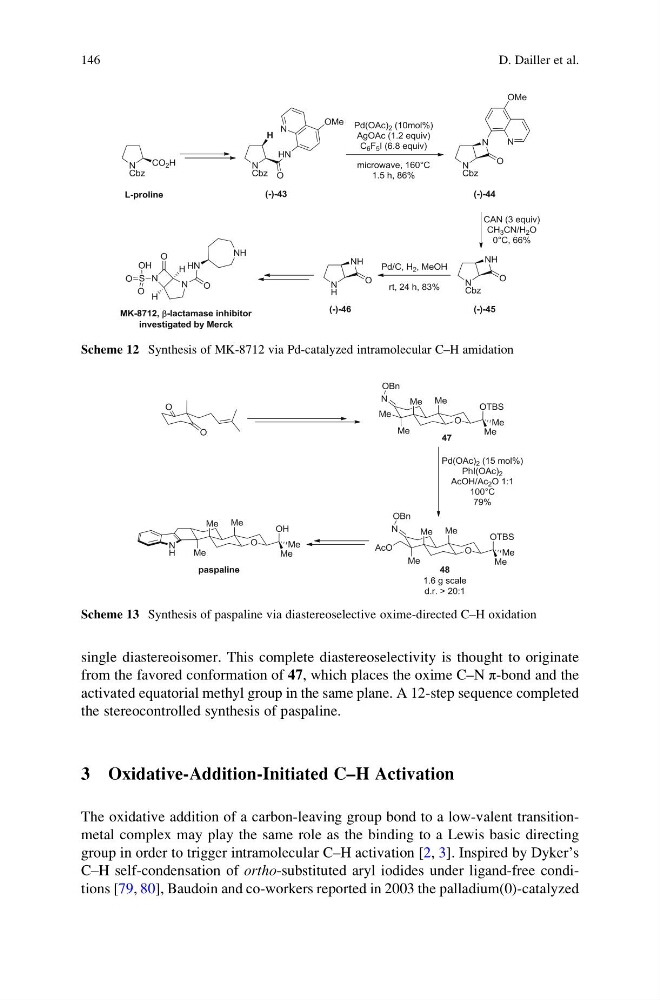
single diastereoisomer. This complete diastereoselectivity is thought to originate
from the favored conformation of 47, which places the oxime C–N π-bond and the
activated equatorial methyl group in the same plane. A 12-step sequence completed
the stereocontrolled synthesis of paspaline.
3 Oxidative-Addition-Initiated C–H Activation
The oxidative addition of a carbon-leaving group bond to a low-valent transitionmetal complex may play the same role as the binding to a Lewis basic directing
group in order to trigger intramolecular C–H activation [2, 3]. Inspired by Dyker’s
C–H self-condensation of ortho-substituted aryl iodides under ligand-free conditions [79, 80], Baudoin and co-workers reported in 2003 the palladium(0)-catalyzed
Scheme 12 Synthesis of MK-8712 via Pd-catalyzed intramolecular C–H amidation
Scheme 13 Synthesis of paspaline via diastereoselective oxime-directed C–H oxidation
146
D. Dailler et al.
from the favored conformation of 47, which places the oxime C–N π-bond and the
activated equatorial methyl group in the same plane. A 12-step sequence completed
the stereocontrolled synthesis of paspaline.
3 Oxidative-Addition-Initiated C–H Activation
The oxidative addition of a carbon-leaving group bond to a low-valent transitionmetal complex may play the same role as the binding to a Lewis basic directing
group in order to trigger intramolecular C–H activation [2, 3]. Inspired by Dyker’s
C–H self-condensation of ortho-substituted aryl iodides under ligand-free conditions [79, 80], Baudoin and co-workers reported in 2003 the palladium(0)-catalyzed
Scheme 12 Synthesis of MK-8712 via Pd-catalyzed intramolecular C–H amidation
Scheme 13 Synthesis of paspaline via diastereoselective oxime-directed C–H oxidation
146
D. Dailler et al.