

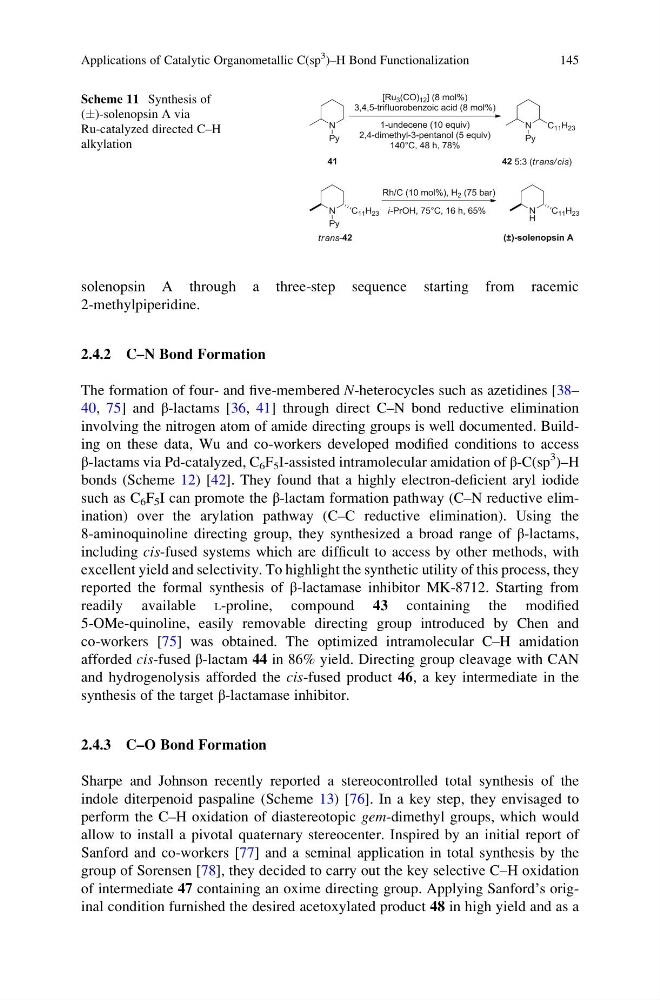
solenopsin A through a three-step sequence starting from racemic
2-methylpiperidine.
2.4.2 C–N Bond Formation
The formation of four- and five-membered N-heterocycles such as azetidines [38–
40, 75] and β-lactams [36, 41] through direct C–N bond reductive elimination
involving the nitrogen atom of amide directing groups is well documented. Building on these data, Wu and co-workers developed modified conditions to access
β-lactams via Pd-catalyzed, C 6 F 5 I-assisted intramolecular amidation of β-C(sp
3 )–H
bonds (Scheme 12) [42]. They found that a highly electron-deficient aryl iodide
such as C 6 F 5 I can promote the β-lactam formation pathway (C–N reductive elimination) over the arylation pathway (C–C reductive elimination). Using the
8-aminoquinoline directing group, they synthesized a broad range of β-lactams,
including cis-fused systems which are difficult to access by other methods, with
excellent yield and selectivity. To highlight the synthetic utility of this process, they
reported the formal synthesis of β-lactamase inhibitor MK-8712. Starting from
readily available L-proline, compound 43 containing the modified
5-OMe-quinoline, easily removable directing group introduced by Chen and
co-workers [75] was obtained. The optimized intramolecular C–H amidation
afforded cis-fused β-lactam 44 in 86% yield. Directing group cleavage with CAN
and hydrogenolysis afforded the cis-fused product 46, a key intermediate in the
synthesis of the target β-lactamase inhibitor.
2.4.3 C–O Bond Formation
Sharpe and Johnson recently reported a stereocontrolled total synthesis of the
indole diterpenoid paspaline (Scheme 13) [76]. In a key step, they envisaged to
perform the C–H oxidation of diastereotopic gem-dimethyl groups, which would
allow to install a pivotal quaternary stereocenter. Inspired by an initial report of
Sanford and co-workers [77] and a seminal application in total synthesis by the
group of Sorensen [78], they decided to carry out the key selective C–H oxidation
of intermediate 47 containing an oxime directing group. Applying Sanford’s original condition furnished the desired acetoxylated product 48 in high yield and as a
Scheme 11 Synthesis of
(Æ)-solenopsin A via
Ru-catalyzed directed C–H
alkylation
Applications of Catalytic Organometallic C(sp
3
)–H Bond Functionalization
145
2-methylpiperidine.
2.4.2 C–N Bond Formation
The formation of four- and five-membered N-heterocycles such as azetidines [38–
40, 75] and β-lactams [36, 41] through direct C–N bond reductive elimination
involving the nitrogen atom of amide directing groups is well documented. Building on these data, Wu and co-workers developed modified conditions to access
β-lactams via Pd-catalyzed, C 6 F 5 I-assisted intramolecular amidation of β-C(sp
3 )–H
bonds (Scheme 12) [42]. They found that a highly electron-deficient aryl iodide
such as C 6 F 5 I can promote the β-lactam formation pathway (C–N reductive elimination) over the arylation pathway (C–C reductive elimination). Using the
8-aminoquinoline directing group, they synthesized a broad range of β-lactams,
including cis-fused systems which are difficult to access by other methods, with
excellent yield and selectivity. To highlight the synthetic utility of this process, they
reported the formal synthesis of β-lactamase inhibitor MK-8712. Starting from
readily available L-proline, compound 43 containing the modified
5-OMe-quinoline, easily removable directing group introduced by Chen and
co-workers [75] was obtained. The optimized intramolecular C–H amidation
afforded cis-fused β-lactam 44 in 86% yield. Directing group cleavage with CAN
and hydrogenolysis afforded the cis-fused product 46, a key intermediate in the
synthesis of the target β-lactamase inhibitor.
2.4.3 C–O Bond Formation
Sharpe and Johnson recently reported a stereocontrolled total synthesis of the
indole diterpenoid paspaline (Scheme 13) [76]. In a key step, they envisaged to
perform the C–H oxidation of diastereotopic gem-dimethyl groups, which would
allow to install a pivotal quaternary stereocenter. Inspired by an initial report of
Sanford and co-workers [77] and a seminal application in total synthesis by the
group of Sorensen [78], they decided to carry out the key selective C–H oxidation
of intermediate 47 containing an oxime directing group. Applying Sanford’s original condition furnished the desired acetoxylated product 48 in high yield and as a
Scheme 11 Synthesis of
(Æ)-solenopsin A via
Ru-catalyzed directed C–H
alkylation
Applications of Catalytic Organometallic C(sp
3
)–H Bond Functionalization
145