

2.4 Other Directed C–H Functionalizations
2.4.1 C–C Bond Formation
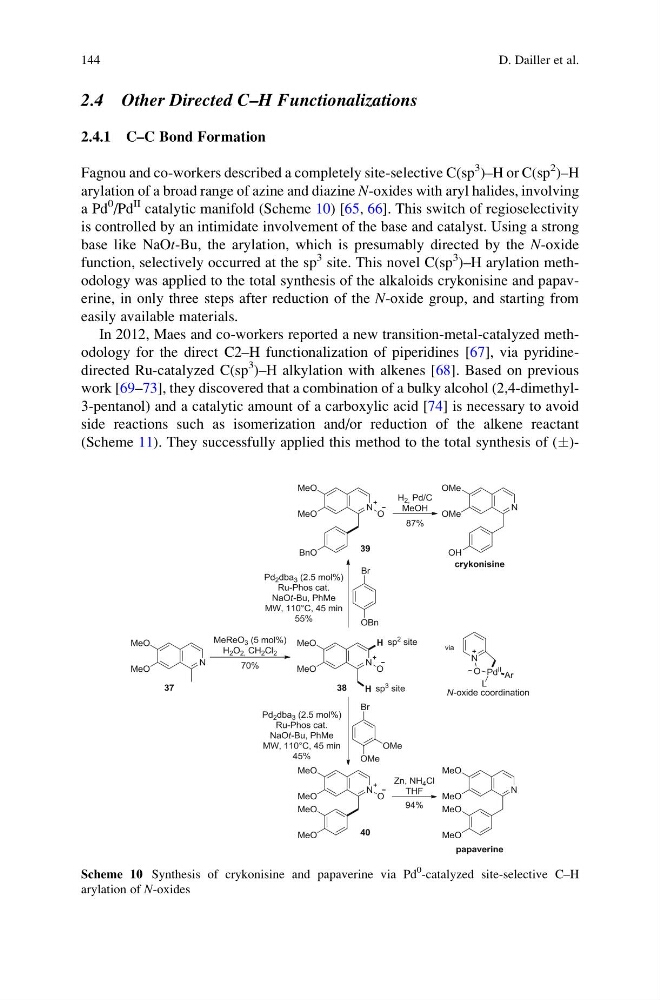
Fagnou and co-workers described a completely site-selective C(sp
3 )–H or C(sp
2 )–H
arylation of a broad range of azine and diazine N-oxides with aryl halides, involving
a Pd
0 /Pd
II catalytic manifold (Scheme 10) [65, 66]. This switch of regioselectivity
is controlled by an intimidate involvement of the base and catalyst. Using a strong
base like NaOt-Bu, the arylation, which is presumably directed by the N-oxide
function, selectively occurred at the sp
3 site. This novel C(sp
3 )–H arylation methodology was applied to the total synthesis of the alkaloids crykonisine and papaverine, in only three steps after reduction of the N-oxide group, and starting from
easily available materials.
In 2012, Maes and co-workers reported a new transition-metal-catalyzed methodology for the direct C2–H functionalization of piperidines [67], via pyridinedirected Ru-catalyzed C(sp
3 )–H alkylation with alkenes [68]. Based on previous
work [69–73], they discovered that a combination of a bulky alcohol (2,4-dimethyl3-pentanol) and a catalytic amount of a carboxylic acid [74] is necessary to avoid
side reactions such as isomerization and/or reduction of the alkene reactant
(Scheme 11). They successfully applied this method to the total synthesis of (Æ)Scheme 10 Synthesis of crykonisine and papaverine via Pd
0 -catalyzed site-selective C–H
arylation of N-oxides
144
D. Dailler et al.
2.4.1 C–C Bond Formation
Fagnou and co-workers described a completely site-selective C(sp
3 )–H or C(sp
2 )–H
arylation of a broad range of azine and diazine N-oxides with aryl halides, involving
a Pd
0 /Pd
II catalytic manifold (Scheme 10) [65, 66]. This switch of regioselectivity
is controlled by an intimidate involvement of the base and catalyst. Using a strong
base like NaOt-Bu, the arylation, which is presumably directed by the N-oxide
function, selectively occurred at the sp
3 site. This novel C(sp
3 )–H arylation methodology was applied to the total synthesis of the alkaloids crykonisine and papaverine, in only three steps after reduction of the N-oxide group, and starting from
easily available materials.
In 2012, Maes and co-workers reported a new transition-metal-catalyzed methodology for the direct C2–H functionalization of piperidines [67], via pyridinedirected Ru-catalyzed C(sp
3 )–H alkylation with alkenes [68]. Based on previous
work [69–73], they discovered that a combination of a bulky alcohol (2,4-dimethyl3-pentanol) and a catalytic amount of a carboxylic acid [74] is necessary to avoid
side reactions such as isomerization and/or reduction of the alkene reactant
(Scheme 11). They successfully applied this method to the total synthesis of (Æ)Scheme 10 Synthesis of crykonisine and papaverine via Pd
0 -catalyzed site-selective C–H
arylation of N-oxides
144
D. Dailler et al.