

easily removed. The latter was employed to perform the γ-Me arylation of Ile
derivative 31 with ortho-substituted aryl iodide 32, which provided the key Ile-Hpa
residue 33 in moderate yield. A three-step cleavage sequence then furnished
carboxylic acid 34, a key intermediate of the synthesis of hibispeptin A.
Only a few amine-derived directing groups have been reported, and all of them
display drawbacks such as high reaction temperatures (typically 150
C) [59],
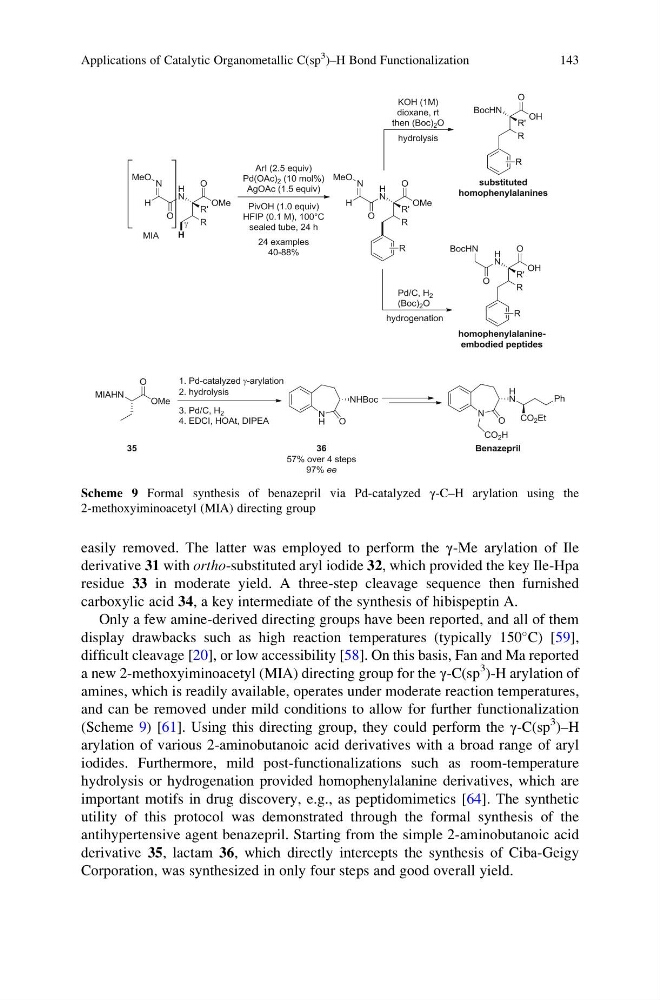
difficult cleavage [20], or low accessibility [58]. On this basis, Fan and Ma reported
a new 2-methoxyiminoacetyl (MIA) directing group for the γ-C(sp
3 )-H arylation of
amines, which is readily available, operates under moderate reaction temperatures,
and can be removed under mild conditions to allow for further functionalization
(Scheme 9) [61]. Using this directing group, they could perform the γ-C(sp
3 )–H
arylation of various 2-aminobutanoic acid derivatives with a broad range of aryl
iodides. Furthermore, mild post-functionalizations such as room-temperature
hydrolysis or hydrogenation provided homophenylalanine derivatives, which are
important motifs in drug discovery, e.g., as peptidomimetics [64]. The synthetic
utility of this protocol was demonstrated through the formal synthesis of the
antihypertensive agent benazepril. Starting from the simple 2-aminobutanoic acid
derivative 35, lactam 36, which directly intercepts the synthesis of Ciba-Geigy
Corporation, was synthesized in only four steps and good overall yield.
Scheme 9 Formal synthesis of benazepril via Pd-catalyzed γ-C–H arylation using the
2-methoxyiminoacetyl (MIA) directing group
Applications of Catalytic Organometallic C(sp
3
)–H Bond Functionalization
143
derivative 31 with ortho-substituted aryl iodide 32, which provided the key Ile-Hpa
residue 33 in moderate yield. A three-step cleavage sequence then furnished
carboxylic acid 34, a key intermediate of the synthesis of hibispeptin A.
Only a few amine-derived directing groups have been reported, and all of them
display drawbacks such as high reaction temperatures (typically 150
C) [59],
difficult cleavage [20], or low accessibility [58]. On this basis, Fan and Ma reported
a new 2-methoxyiminoacetyl (MIA) directing group for the γ-C(sp
3 )-H arylation of
amines, which is readily available, operates under moderate reaction temperatures,
and can be removed under mild conditions to allow for further functionalization
(Scheme 9) [61]. Using this directing group, they could perform the γ-C(sp
3 )–H
arylation of various 2-aminobutanoic acid derivatives with a broad range of aryl
iodides. Furthermore, mild post-functionalizations such as room-temperature
hydrolysis or hydrogenation provided homophenylalanine derivatives, which are
important motifs in drug discovery, e.g., as peptidomimetics [64]. The synthetic
utility of this protocol was demonstrated through the formal synthesis of the
antihypertensive agent benazepril. Starting from the simple 2-aminobutanoic acid
derivative 35, lactam 36, which directly intercepts the synthesis of Ciba-Geigy
Corporation, was synthesized in only four steps and good overall yield.
Scheme 9 Formal synthesis of benazepril via Pd-catalyzed γ-C–H arylation using the
2-methoxyiminoacetyl (MIA) directing group
Applications of Catalytic Organometallic C(sp
3
)–H Bond Functionalization
143